EricaChenoweth
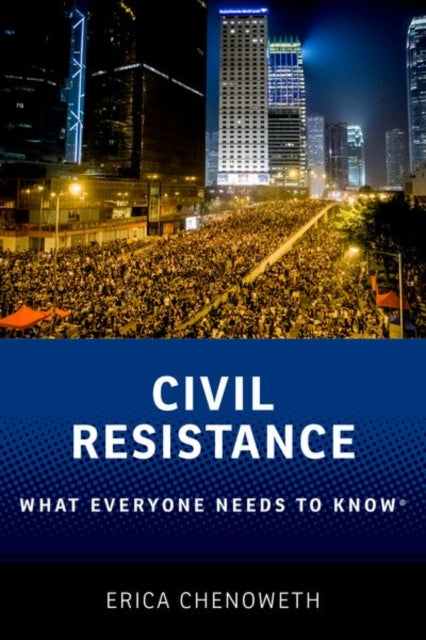
Civil Resistance: What Everyone Needs to Know (R)
Civil Resistance: What Everyone Needs to Know (R)
💎 Earn 45 Points (£0.45) on this item.
YOU SAVE £3.80
- Condition: Brand new
- UK Delivery times: Usually arrives within 2 - 3 working days
- UK Shipping: Fee starts at £2.39. Subject to product weight & dimension
Bulk ordering. Want 15 or more copies? Get a personalised quote and bigger discounts. Learn more about bulk orders.
Couldn't load pickup availability
- More about Civil Resistance: What Everyone Needs to Know (R)
Civil resistance is a form of conflict resolution in which unarmed civilians employ various coordinated strategies to challenge an adversary without inflicting physical harm or posing a threat of harm. It has been a prominent form of resistance in postwar anti-colonial movements, the 1989 revolutions, and the Arab Awakenings, and is currently being practiced at an increased rate worldwide. This book offers a comprehensive overview of civil resistance, including its definition, mechanisms, effectiveness, and potential challenges, drawing from historical and contemporary examples.
Format: Paperback / softback
Length: 256 pages
Publication date: 23 September 2021
Publisher: Oxford University Press Inc
Civil resistance is a powerful strategy employed by unarmed civilians to challenge and oppose oppressive regimes and systems of power. It encompasses a wide range of coordinated methods, including strikes, protests, demonstrations, boycotts, and many other tactics, aimed at achieving specific political goals without directly harming or threatening opponents. This form of political action, often referred to as nonviolent resistance, unarmed struggle, or nonviolent action, has gained widespread popularity across the globe in recent years.
Civil resistance played a crucial role in the postwar anti-colonial movements, the 1989 revolutions, and the Arab Awakenings. It has continued to be a prominent form of resistance in various regions, including the United States, where movements such as Black Lives Matter and the Women's March have drawn international attention.
Understanding civil resistance is essential for comprehending the diverse protest movements that are emerging around the world. In her book, Civil Resistance: What Everyone Needs to Know, Erica Chenoweth, a renowned scholar in the field, provides a comprehensive and insightful exploration of civil resistance.
Chenoweth defines civil resistance as a form of political action that involves the use of nonviolent means to challenge and overthrow oppressive regimes or systems of power. She explains that civil resistance operates on the principle of collective action, where individuals and groups come together to exert pressure on their adversaries and demand change.
One of the key strengths of civil resistance is its ability to mobilize large numbers of people and create a sense of urgency and momentum. By leveraging social media, grassroots organizing, and other forms of communication, civil resistance movements can quickly gather support and attract attention to their cause. This mobilization can be particularly effective in challenging authoritarian regimes or resisting oppressive policies.
However, civil resistance is not without its challenges. One of the primary obstacles is the response of repressive regimes, which often resort to violence and repression to suppress opposition. This can include the use of force, mass arrests, torture, and other forms of violence to intimidate and silence activists. Repressive regimes may also use legal and political measures to marginalize and suppress civil resistance movements, such as censorship, surveillance, and the criminalization of dissent.
Despite these challenges, civil resistance has had a significant impact on the course of history. It has helped topple oppressive regimes, promote democratic reforms, and advance social and human rights. For example, the civil resistance movements in South Africa, Eastern Europe, and Latin America played a crucial role in ending apartheid, communism, and authoritarian rule, respectively.
In conclusion, civil resistance is a powerful strategy that enables unarmed civilians to challenge and oppose oppressive regimes and systems of power. It operates on the principle of collective action, mobilizing large numbers of people and creating a sense of urgency and momentum. While civil resistance faces challenges from repressive regimes, it has had a significant impact on the course of history and continues to be a prominent form of resistance in various regions. By understanding the dynamics and manifestations of civil resistance, we can better appreciate the role that ordinary people play in shaping the world around us.
Weight: 418g
Dimension: 210 x 138 x 23 (mm)
ISBN-13: 9780190244408
This item can be found in:
UK and International shipping information
UK and International shipping information
UK Delivery and returns information:
- Delivery within 2 - 3 days when ordering in the UK.
- Shipping fee for UK customers from £2.39. Fully tracked shipping service available.
- Returns policy: Return within 30 days of receipt for full refund.
International deliveries:
Shulph Ink now ships to Australia, Belgium, Canada, France, Germany, Ireland, Italy, India, Luxembourg Saudi Arabia, Singapore, Spain, Netherlands, New Zealand, United Arab Emirates, United States of America.
- Delivery times: within 5 - 10 days for international orders.
- Shipping fee: charges vary for overseas orders. Only tracked services are available for most international orders. Some countries have untracked shipping options.
- Customs charges: If ordering to addresses outside the United Kingdom, you may or may not incur additional customs and duties fees during local delivery.