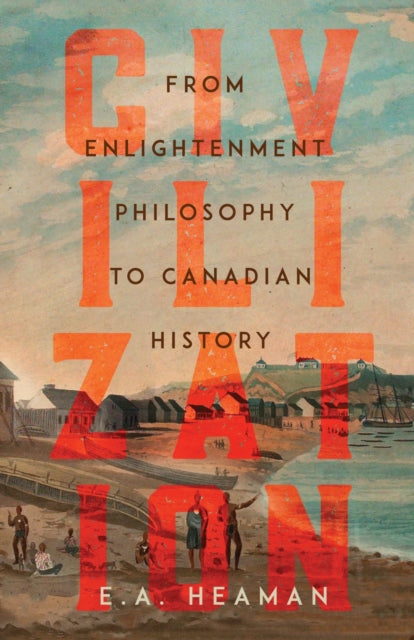
E.A. Heaman
Civilization: From Enlightenment Philosophy to Canadian History
Civilization: From Enlightenment Philosophy to Canadian History
We can order this item for you. Delivery usually takes about 4 to 6 weeks.
This item is not held in our immediate stock. We will order it for you after checkout.
Estimated delivery: About 4 to 6 weeks
YOU SAVE £18.56
- Condition: Brand new
- UK Delivery times: Usually arrives within 2 - 3 working days
- UK Shipping: Fee starts at £3.89. Subject to product weight & dimension
Bulk ordering. Want 15 or more copies? Get a personalised quote and bigger discounts. Learn more about bulk orders.
Couldn't load pickup availability
- More about Civilization: From Enlightenment Philosophy to Canadian History
The concept of civilization in colonial Canada evolved from a cosmopolitan and optimistic theory to a contradictory theory of unrestrained power and restraints. This book historicizes the concept of civilization, connecting Enlightenment ideals and anti-colonialism to colonialism in Canada before Confederation.
Format: Hardback
Publication date: 15 August 2022
Publisher: McGill-Queen's University Press
Between the 1760s and the 1860s, colonial Canada underwent significant transformations, marked by the Conquest and Confederation. However, the concept of civilization that guided these changes underwent even more profound shifts. The founding Canadian constitution embraced a cosmopolitan and optimistic theory of history as a means to curb state violence, only to witness a reversal and undoing over the ensuing century. Civilization became a contradictory concept, representing both unrestrained power and the constraints placed upon it. Occupying a middle ground between British and American hegemonies, the diverse populations residing in Canada keenly felt these contradictions. Britain and America, frustrated in their attempts to violently bend Canada to their will, resorted to new forms of hegemony, emphasizing the use of soft power to exert influence.
In his insightful work, E.A. Heaman emphasizes the significance of viewing colonial Canada from an intellectual and political perspective. Canada posed challenges to various prevailing ideologies, including the Scottish Enlightenment, the Pax Britannica, American manifest destiny, and the emerging model of the nation-state. David Humes's theory of history played a significant role in shaping the Canadian imaginary, manifesting in constitutional documents, historical narratives, and a certain liberal-conservative political and financial orientation. However, as settlers continued to flood across the continent, cosmopolitanism gave way to chauvinism, and the notion of civilization became associated with plunder and predation on a transcontinental scale.
Through detailed case studies, Heaman highlights crucial moments of conceptual reversal, some of which have broader implications and others that are uniquely Canadian. He examines the Seven Years War, domestic relations, the fiscal military state, liberal reform, social statistics, democracy, constitutionalism, and scholarly history. By dissecting these various aspects, Heaman demonstrates how key British and Canadian public figures grappled with the growing gap between the ideal of civilization and the realities of colonialism.
The shift from a cosmopolitan to a chauvinistic view of civilization in colonial Canada had far-reaching consequences. It led to the exploitation and subjugation of indigenous peoples, the expansion of colonial territories, and the perpetuation of unequal power relations. The contradictions inherent in the concept of civilization became more pronounced, as the pursuit of power and wealth often overshadowed the values of justice, equality, and human dignity.
The study of colonial Canada's history offers valuable insights into the complex interplay between civilization, power, and the pursuit of empire. It highlights the limitations of idealistic theories of history and the need to consider the lived experiences and perspectives of the people involved. By examining the complexities of colonialism, we can better understand the origins
The shift from a cosmopolitan to a chauvinistic view of civilization in colonial Canada had far-reaching consequences. It led to the exploitation and subjugation of indigenous peoples, the expansion of colonial territories, and the perpetuation of unequal power relations. The contradictions inherent in the concept of civilization became more pronounced, as the pursuit of power and wealth often overshadowed the values of justice, equality, and human dignity.
The study of colonial Canada's history offers valuable insights into the complex interplay between civilization, power, and the pursuit of empire. It highlights the limitations of idealistic theories of history and the need to consider the lived experiences and perspectives of the people involved. By examining the complexities of colonialism, we can better understand the origins of contemporary global power structures and the ongoing struggles for justice, equality, and human rights.
In conclusion, colonial Canada underwent significant transformations between the 1760s and the 1860s, marked by the Conquest and Confederation. The concept of civilization that guided these changes underwent a profound shift, from a cosmopolitan and optimistic theory to a contradictory one characterized by unrestrained power and constraints. The Canadian constitution initially embraced a cosmopolitan and optimistic view of history as a check on state violence, only to witness a reversal and undoing over the ensuing century. As settlers flooded across the continent, cosmopolitanism gave way to chauvinism, and the notion of civilization became associated with plunder and predation on a transcontinental scale. The study of colonial Canada's history offers valuable insights into the complex interplay between civilization, power, and the pursuit of empire. It highlights the limitations of idealistic theories of history and the need to consider the lived experiences and perspectives of the people involved. By examining the complexities of colonialism, we can better understand the origins of contemporary global power structures and the ongoing struggles for justice, equality, and human rights.
Weight: 1034g
Dimension: 164 x 234 x 45 (mm)
ISBN-13: 9780228011484
UK and International shipping information
UK and International shipping information
We deliver throughout the United Kingdom and to 128 countries and territories worldwide, including the United States, Australia, Canada, Germany, Spain and France.