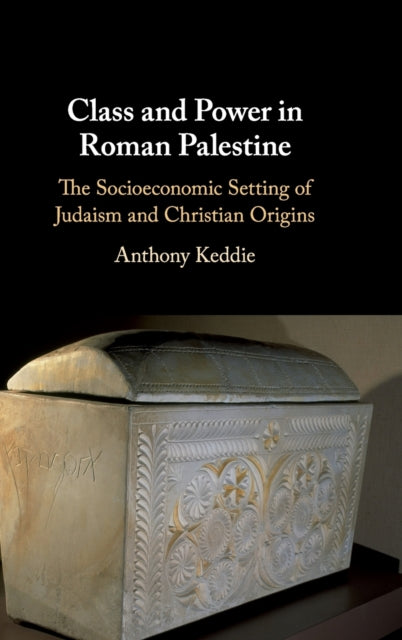
AnthonyKeddie
Class and Power in Roman Palestine: The Socioeconomic Setting of Judaism and Christian Origins
Class and Power in Roman Palestine: The Socioeconomic Setting of Judaism and Christian Origins
💎 Earn 547 Points (£5.47) on this item.
We can order this item for you. Delivery usually takes about 4 to 6 weeks.
This item is not held in our immediate stock. We will order it for you after checkout.
Estimated delivery: About 4 to 6 weeks
YOU SAVE £6.50
- Condition: Brand new
- UK Delivery times: Usually arrives within 2 - 3 working days
- UK Shipping: Fee starts at £2.39. Subject to product weight & dimension
Bulk ordering. Want 15 or more copies? Get a personalised quote and bigger discounts. Learn more about bulk orders.
Couldn't load pickup availability
- More about Class and Power in Roman Palestine: The Socioeconomic Setting of Judaism and Christian Origins
During its early stages of incorporation into the Roman Empire, Palestine experienced a significant shift in class and power dynamics. Anthony Keddie's research identifies institutions such as civic administration, taxation, agricultural tenancy, and the Jerusalem Temple as sources of unequal power distribution. He demonstrates how elites facilitated institutional changes that repositioned non-elites within new, sometimes more precarious, relations with privileged classes, but did not typically worsen their economic conditions. These shifts led to changing class dispositions, with Judaean elites and non-elites increasingly distinguishing themselves from each other through material culture.
\n Format: Hardback
\n Length: 374 pages
\n Publication date: 03 October 2019
\n Publisher: Cambridge University Press
\n
Anthony Keddie delves into the intricate dynamics of class and power during a pivotal period in the history of Judaism and Christianity – Palestine, as it embarked on its integration into the Roman Empire. By examining the institutions associated with civic administration, taxation, agricultural tenancy, and the Jerusalem Temple, Keddie uncovers the root causes of an uneven distribution of economic, political, and ideological power. Through a comprehensive analysis of a diverse array of literary, documentary, epigraphic, and archaeological evidence, including the most recent discoveries, Keddie challenges conventional notions of class relations, revealing how elites actively facilitated institutional transformations that repositioned non-elites within new and sometimes precarious relationships with privileged classes. However, it is important to note that these socioeconomic shifts did not invariably lead to a deterioration in the economic conditions of non-elites. Instead, they sparked a shift in class dispositions, as Judaean elites and non-elites began to differentiate themselves from one another through material culture, such as tableware, clothing, and tombs.
This period of transition witnessed the emergence of distinct social classes, with the elite enjoying privileges and benefits that were not accessible to the common people. The Roman occupation brought about significant changes in the political landscape, as the empire sought to exert control over its newly acquired territories. The Jewish population, which had been thriving for centuries, faced challenges and discrimination under Roman rule.
Keddie's study provides valuable insights into the complex interplay of class, power, and social change in ancient Palestine. His analysis challenges traditional narratives and sheds light on the nuanced dynamics that shaped the society of that time. By examining the institutions and practices that contributed to the unequal distribution of resources and power, Keddie offers a fresh perspective on the history of Judaism and Christianity in the Roman Empire.
In conclusion, Anthony Keddie's investigation into the changing dynamics of class and power in ancient Palestine during the Roman Empire is a groundbreaking work that contributes to our understanding of this complex period. Through meticulous research and analysis, Keddie challenges conventional notions of class relations and sheds light on the intricate web of social, economic, and political factors that shaped the society of that time. His study provides valuable insights into the complex interplay of class, power, and social change and offers a fresh perspective on the history of Judaism and Christianity in the Roman Empire.
\n Weight: 674g\n
Dimension: 161 x 234 x 28 (mm)\n
ISBN-13: 9781108493949\n \n
UK and International shipping information
UK and International shipping information
UK Delivery and returns information:
- Delivery within 2 - 3 days when ordering in the UK.
- Shipping fee for UK customers from £2.39. Fully tracked shipping service available.
- Returns policy: Return within 30 days of receipt for full refund.
International deliveries:
Shulph Ink now ships to Australia, Belgium, Canada, France, Germany, Ireland, Italy, India, Luxembourg Saudi Arabia, Singapore, Spain, Netherlands, New Zealand, United Arab Emirates, United States of America.
- Delivery times: within 5 - 10 days for international orders.
- Shipping fee: charges vary for overseas orders. Only tracked services are available for most international orders. Some countries have untracked shipping options.
- Customs charges: If ordering to addresses outside the United Kingdom, you may or may not incur additional customs and duties fees during local delivery.