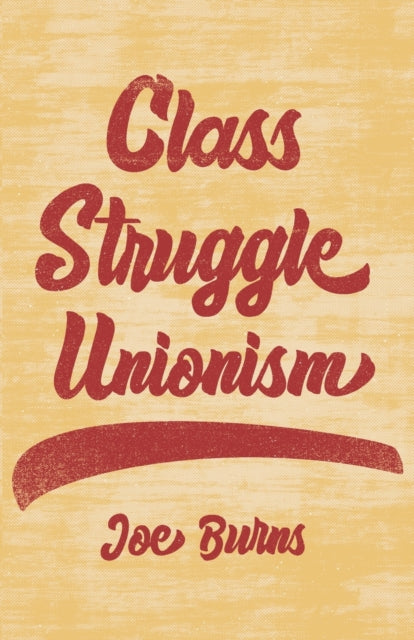
Joe Burns
Class Struggle Unionism
Class Struggle Unionism
💎 Earn 65 Points (£0.65) on this item.
YOU SAVE £3.96
- Condition: Brand new
- UK Delivery times: Usually arrives within 2 - 3 working days
- UK Shipping: Fee starts at £2.39. Subject to product weight & dimension
Bulk ordering. Want 15 or more copies? Get a personalised quote and bigger discounts. Learn more about bulk orders.
Couldn't load pickup availability
- More about Class Struggle Unionism
Class struggle unionism is a form of unionism that believes the union struggle exists within a larger struggle between the working class and the exploiting billionaire class. It prioritizes broader class demands and is rooted in workplace-based militancy. Joe Burns outlines the key set of ideas common to class struggle unionism and shows how these ideas can create a more militant, democratic, and fighting labor movement.
Format: Paperback / softback
Length: 180 pages
Publication date: 14 April 2022
Publisher: Haymarket Books
For those seeking to establish a fighting labor movement, a multitude of questions arise. How to engage with the union establishment, which may not prioritize fighting? Whether to work within the rank-and-file or staff positions? How to balance broader class demands with shop-floor struggles? How to relate to foundation-funded worker centers and alternative union efforts? And, most importantly, how can we revive militancy and union power in the face of corporate power and a legal system that works against us?
Class struggle unionism is a belief that our union struggle is part of a broader struggle between an exploitative billionaire class and the working class, which is responsible for producing the goods and services in society. Class struggle unionism views the employment transaction as inherently exploitative, as it separates workers from the wealth they create and establishes the billionaire class. From this fundamental proposition, a powerful and radical form of unionism emerges.
Historically, class struggle unionists placed their workplace fights squarely within this larger fight between workers and the owning class. This perspective leads to a particular type of unionism that not only advocates for broader class issues but is also rooted in workplace-based militancy.
In his comprehensive work, "Class Struggle Unionism: Ideas for a More Militant, Democratic, and Fighting Labor Movement," Joe Burns outlines the key ideas common to class struggle unionism and demonstrates how these ideas can shape a more militant, democratic, and effective labor movement. Burns draws on his extensive experience in labor activism and his deep understanding of labor tradition to provide a comprehensive guide for those seeking to build a stronger and more resilient labor movement.
One of the central tenants of class struggle unionism is the recognition that our union struggle is not separate from the broader struggle for social and economic justice. Class struggle unionists understand that the billionaire class is not just a group of individuals, but a powerful institution that controls the means of production, the distribution of wealth, and the political system. Therefore, our union fights must be part of a broader movement that challenges the power and influence of the billionaire class.
To achieve this, class struggle unionists prioritize the need to build a strong and united labor movement. They recognize that the union movement is not just a collection of individual unions, but a network of workers and organizations that share common goals and values. By working together, we can strengthen our collective power and influence and create a more effective force for change.
One of the key strategies of class struggle unionism is to engage in workplace-based militancy. This means building strong union organizations that are capable of organizing and mobilizing workers to fight for their rights and interests. It also involves engaging in direct action, such as strikes, picketing, and other forms of protest, to pressure employers to meet our demands.
Class struggle unionism also emphasizes the importance of building broader alliances with other social and political movements. By working together with other groups, such as community organizations, environmentalists, and social justice activists, we can create a more powerful force for change that can challenge the power of the billionaire class and promote a more just and equitable society.
In addition to these strategies, class struggle unionism also emphasizes the need to prioritize broader class demands. Class struggle unionists understand that our union struggle is not just about improving our working conditions or increasing our wages, but about challenging the power and influence of the billionaire class. By advocating for policies that promote social and economic justice, such as universal healthcare, education, and housing, we can create a more just and equitable society that benefits all workers.
However, building a fighting labor movement is not an easy task. Class struggle unionism faces many challenges, including resistance from the union establishment, corporate power, and a legal system that works against us. To overcome these challenges, we need to be bold and innovative in our approach.
One of the key strategies is to build a strong and diverse labor movement that includes workers from all industries and sectors. By working together, we can create a more powerful force for change that can challenge the power of the billionaire class and promote a more just and equitable society.
Another strategy is to engage in grassroots organizing and mobilizing. By building strong relationships with workers and communities, we can create a base of support for our union movement and build momentum for change. This involves reaching out to workers through community organizations, social media, and other means to build a sense of urgency and urgency for our union movement.
Finally, we need to be willing to take risks and be bold in our actions. Class struggle unionism is not about compromising our values or compromising our principles, but about fighting for the rights and interests of all workers. By taking bold and innovative actions, we can create a more powerful force for change that can challenge the power of the billionaire class and promote a more just and equitable society.
In conclusion, class struggle unionism is a powerful and radical form of unionism that recognizes the inherent exploitative nature of the employment transaction and the broader struggle between workers and the billionaire class. By prioritizing workplace-based militancy, building broader alliances, and advocating for broader class demands, we can create a more militant, democratic, and fighting labor movement that can challenge the power of the billionaire class and promote a more just and equitable society. However, building a fighting labor movement is not an easy task, and we need to be bold and innovative in our approach to overcome the many challenges we face. By working together, we can create a more powerful force for change that can transform our society for the better.
Dimension: 133 x 190 (mm)
ISBN-13: 9781642595840
This item can be found in:
UK and International shipping information
UK and International shipping information
UK Delivery and returns information:
- Delivery within 2 - 3 days when ordering in the UK.
- Shipping fee for UK customers from £2.39. Fully tracked shipping service available.
- Returns policy: Return within 30 days of receipt for full refund.
International deliveries:
Shulph Ink now ships to Australia, Belgium, Canada, France, Germany, Ireland, Italy, India, Luxembourg Saudi Arabia, Singapore, Spain, Netherlands, New Zealand, United Arab Emirates, United States of America.
- Delivery times: within 5 - 10 days for international orders.
- Shipping fee: charges vary for overseas orders. Only tracked services are available for most international orders. Some countries have untracked shipping options.
- Customs charges: If ordering to addresses outside the United Kingdom, you may or may not incur additional customs and duties fees during local delivery.