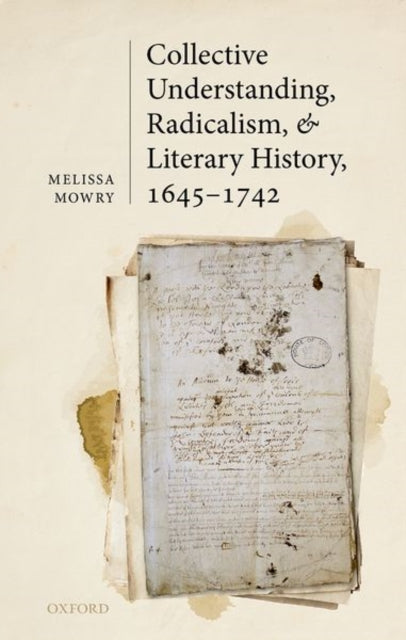
MelissaMowry
Collective Understanding, Radicalism, and Literary History, 1645-1742
Collective Understanding, Radicalism, and Literary History, 1645-1742
We can order this item for you. Delivery usually takes about 4 to 6 weeks.
This item is not held in our immediate stock. We will order it for you after checkout.
Estimated delivery: About 4 to 6 weeks
- Condition: Brand new
- UK Delivery times: Usually arrives within 2 - 3 working days
- UK Shipping: Fee starts at £3.89. Subject to product weight & dimension
Bulk ordering. Want 15 or more copies? Get a personalised quote and bigger discounts. Learn more about bulk orders.
Couldn't load pickup availability
- More about Collective Understanding, Radicalism, and Literary History, 1645-1742
The seventeenth century saw a conflict between sovereignty and collectivity, with individualism being a footnote. Collective Understanding argues that late Stuart and eighteenth-century literature played a central role in marginalizing the non-elite methods of interpretation and knowledge production that had emerged in the 1640s, highlighting the collaborative methods of civil war dissidents and the Levellers.
Format: Hardback
Length: 272 pages
Publication date: 21 October 2021
Publisher: Oxford University Press
The early modern Anglophone world witnessed a significant shift in the dominant theories of sovereignty during the crucial century between 1642 and 1742. This period marked a transition from absolutist models of governance to shared models of authority and a burgeoning doctrine of unalienable individual rights. However, a closer examination of the cultural record reveals that individualism was largely a footnote to the more profound conflict that erupted around the middle of the seventeenth century between sovereignty and collectivity.
Collective Understanding, Radicalism, and Literary History delve into this transformative era, tracing the emergence of a distinctive and anti-authoritarian hermeneutic from the dissident community known as the Levellers. Active between 1645 and 1653, the Levellers argued that a more just political order required a reorganization of knowledge around the principles and practices of affiliation and collectivity. They believed that the epistemology of singularity, upon which sovereignty had rested its authority, needed to be replaced with a collective understanding that prioritized collaboration and collective action.
Collective Understanding argues that late Stuart and eighteenth-century literature played a central role in marginalizing the non-elite methods of interpretation and knowledge production that had emerged in the 1640s. While pamphlets and other readily available texts ridiculed members of the commonalty, it was the longer narrative arcs of drama and fiction that were uniquely able to foreground the collaborative methods civil war dissidents, and the Levellers in particular, had used to advance their opposition to sovereignty's epistemological paradigm. Writers such as William Davenant, Aphra Behn, Edward Sexby, Algernon Sidney, and Daniel Defoe repeatedly exposed the limitations and flaws of the dominant sovereign epistemology through their works.
The Levellers' vision of a more just and equitable society resonated with many individuals who were dissatisfied with the existing political and social order. Their ideas influenced the broader intellectual and political landscape, leading to the emergence of radicalism and the eventual establishment of democratic principles in many parts of the world. The legacy of the Levellers continues to be felt today, as their ideas about collective understanding, social justice, and individual rights continue to inspire activists and scholars around the globe.
In conclusion, the period between 1642 and 1742 was a time of profound transformation in the theories of sovereignty and the cultural landscape of the early modern Anglophone world. While individualism played a role in this shift, it was largely a footnote to the more significant conflict between sovereignty and collectivity. The Levellers' vision of a more just and equitable society, and their contributions to literature and radicalism, have left a lasting impact on the world, shaping our understanding of political authority and social justice to this day.
Weight: 446g
Dimension: 146 x 225 x 22 (mm)
ISBN-13: 9780192844385
UK and International shipping information
UK and International shipping information
We deliver throughout the United Kingdom and to 128 countries and territories worldwide, including the United States, Australia, Canada, Germany, Spain and France.