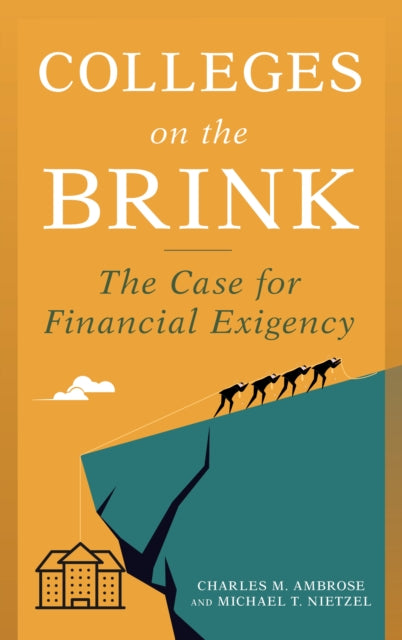
Charles M. Ambrose,Michael T. Nietzel
Colleges on the Brink: The Case for Financial Exigency
Colleges on the Brink: The Case for Financial Exigency
💎 Earn 331 Points (£3.31) on this item.
We can order this item for you. Delivery usually takes about 4 to 6 weeks.
This item is not held in our immediate stock. We will order it for you after checkout.
Estimated delivery: About 4 to 6 weeks
YOU SAVE £8.62
- Condition: Brand new
- UK Delivery times: Usually arrives within 2 - 3 working days
- UK Shipping: Fee starts at £3.89. Subject to product weight & dimension
Bulk ordering. Want 15 or more copies? Get a personalised quote and bigger discounts. Learn more about bulk orders.
Couldn't load pickup availability
- More about Colleges on the Brink: The Case for Financial Exigency
Colleges on the Brink explores financial crises and offers solutions to regain financial health, requiring changes in spending while maintaining academic values. Ambrose and Nietzel discuss financial exigency and budget overhauls, aiming to help institutions become leaner and financially stable.
Format: Hardback
Length: 238 pages
Publication date: 15 December 2023
Publisher: Rowman & Littlefield
Colleges on the Brink: Navigating Financial Crises in the Post-Pandemic Era
The post-pandemic era has brought about significant financial challenges for colleges worldwide. With the pandemic causing a decline in enrollment and revenue, many institutions are struggling to maintain their financial stability. This has led to a need for innovative solutions to address these financial crises.
One of the tools described in the book "Colleges on the Brink" is the use of financial exigency. Financial exigency is a situation where a college is facing a financial crisis that requires immediate action to ensure its survival. Ambrose and Nietzel discuss the conditions involving financial exigency and other major budget overhauls and outline how to maximize the likelihood institutions can regain financial health.
The challenge these colleges face is to come back from the brink and become leaner, financially stable institutions, ready to provide the education students need. This requires a comprehensive approach that involves changing how colleges spend money while still maintaining core academic values.
One of the key strategies outlined in the book is to focus on revenue generation. Colleges can increase their revenue by expanding their enrollment, increasing tuition rates, and attracting more donors. However, it is important to ensure that these revenue-generating strategies are sustainable and do not compromise the quality of education.
Another strategy is to reduce expenses. Colleges can reduce their expenses by reducing administrative costs, reducing the number of faculty and staff, and reducing the cost of facilities and equipment. However, it is important to ensure that these expense-reduction strategies do not negatively impact the quality of education.
In addition to these strategies, colleges can also seek out external funding. External funding can come from government grants, private donations, and corporate sponsorships. However, it is important to ensure that external funding is used responsibly and in a way that aligns with the college's mission and values.
One of the challenges facing colleges in the post-pandemic era is the impact of the pandemic on student enrollment. Many students have been unable to attend college due to the pandemic, which has led to a decline in revenue. Colleges can address this challenge by offering online courses and programs, which can allow students to continue their education from home.
However, offering online courses and programs can also be challenging. Colleges need to invest in technology and infrastructure to ensure that these courses and programs are high-quality and accessible to students. They also need to ensure that these courses and programs are aligned with the college's mission and values.
Another challenge facing colleges in the post-pandemic era is the impact of the pandemic on faculty and staff. Many faculty and staff have been furloughed or laid off due to the pandemic, which has led to a shortage of qualified teachers and staff. Colleges can address this challenge by offering training and development programs to help faculty and staff develop new skills and stay up-to-date with the latest trends in education.
In addition to these challenges, colleges also face a number of other financial challenges. These challenges include the cost of healthcare, the cost of student debt, and the cost of maintaining and upgrading facilities and equipment. Colleges can address these challenges by working with government agencies, private organizations, and other stakeholders to develop solutions.
One of the solutions that has been proposed to address the cost of healthcare is the implementation of a universal healthcare system. A universal healthcare system would provide healthcare coverage to all individuals, regardless of their income or employment status. This would reduce the cost of healthcare for colleges and students and would also improve the quality of healthcare.
Another solution that has been proposed to address the cost of student debt is the implementation of student loan forgiveness programs. Student loan forgiveness programs would provide students with the opportunity to have their student loan debt forgiven after a certain number of years of employment. This would reduce the burden of student debt on students and would also help to stimulate the economy.
In addition to these solutions, colleges can also work to improve their financial management practices. Colleges can implement financial management systems that are designed to track and manage their financial resources. They can also work to reduce their debt and improve their credit rating.
However, implementing these solutions can be challenging. Colleges need to have the resources and the support to implement these solutions. They also need to be willing to make changes to their financial management practices.
In conclusion, Colleges on the Brink is a book that provides innovative solutions to address the financial crises many colleges are facing in the post-pandemic era. The tools described in the book include the use of financial exigency, revenue generation, expense reduction, and external funding. Colleges need to focus on revenue generation, reduce expenses, seek out external funding, and address the impact of the pandemic on student enrollment, faculty and staff, and other financial challenges. By implementing these solutions, colleges can become leaner, financially stable institutions, ready to provide the education students need.
Weight: 508g
Dimension: 237 x 158 x 20 (mm)
ISBN-13: 9781475873252
UK and International shipping information
UK and International shipping information
We deliver throughout the United Kingdom and to 128 countries and territories worldwide, including the United States, Australia, Canada, Germany, Spain and France.