Marten Snickare
Colonial Objects in Early Modern Sweden and Beyond: From the Kunstkammer to the Current Museum Crisis
Colonial Objects in Early Modern Sweden and Beyond: From the Kunstkammer to the Current Museum Crisis
💎 Earn 689 Points (£6.89) on this item.
We can order this item for you. Delivery usually takes about 4 to 6 weeks.
This item is not held in our immediate stock. We will order it for you after checkout.
Estimated delivery: About 4 to 6 weeks
YOU SAVE £8.18
- Condition: Brand new
- UK Delivery times: Usually arrives within 2 - 3 working days
- UK Shipping: Fee starts at £2.39. Subject to product weight & dimension
Bulk ordering. Want 15 or more copies? Get a personalised quote and bigger discounts. Learn more about bulk orders.
Couldn't load pickup availability
- More about Colonial Objects in Early Modern Sweden and Beyond: From the Kunstkammer to the Current Museum Crisis
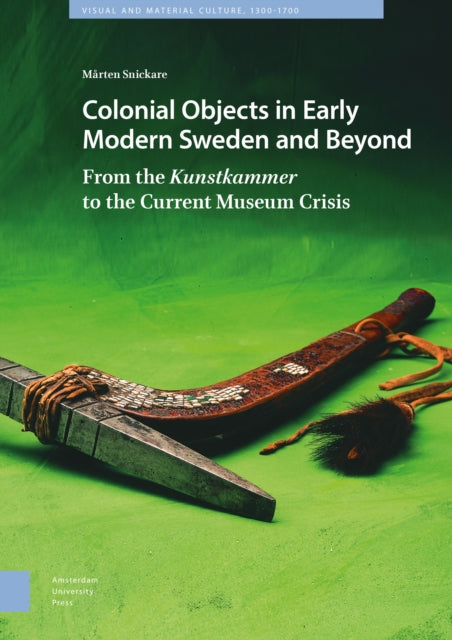
Colonial Objects in Early Modern Sweden and Beyond explores the tomahawk and other objects acquired in colonial contact zones and displayed by Swedish elites in the seventeenth century, situating them in two distinct spaces and tracing their physical and epistemological transfer to the modern museum system. It raises questions about the present state of museums and their possible futures.
Format: Hardback
Length: 216 pages
Publication date: 24 May 2022
Publisher: Amsterdam University Press
An elaborately crafted and decorated tomahawk from somewhere along the North American east coast has been a subject of fascination and debate for many years. Its presence in the royal collections in Stockholm in the late seventeenth century raises several questions about the Swedish kingdom's colonial ambitions and desires. This article explores the tomahawk and other objects like it, acquired in colonial contact zones and displayed by Swedish elites in the seventeenth century. It situates the objects in two distinct but related spaces: the expanding space of the colonial world and the exclusive space of the Kunstkammer. The second part traces the objects' physical and epistemological transfer from the Kunstkammer to the modern museum system. In the final part, colonial objects are considered at the centre of a heated debate over the present state of museums and their possible futures.
The tomahawk in question is a remarkable artifact that has been preserved and displayed in the Museum of Ethnography in Stockholm since the late seventeenth century. It is a testament to the cultural exchange and interaction that took place between the indigenous peoples of North America and the European colonizers during the colonial period. The tomahawk is a symbol of power, prestige, and cultural identity for the Native American tribes that created it. It was used in various ceremonies and rituals, including warfare, hunting, and peace negotiations.
The tomahawk's journey to Stockholm began in the late seventeenth century when it was acquired by a Swedish merchant named Johan Gustafsson. Gustafsson was a prominent figure in the Swedish colonial trade and had established trade routes with the Native American tribes in the region. He acquired the tomahawk from a Native American tribe in the area of present-day New York and brought it back to Sweden.
The tomahawk was immediately put on display in the Kunstkammer, a collection of art and artifacts that was owned by the Swedish king. The Kunstkammer was a prestigious and exclusive space that was only accessible to the royal family and the upper echelons of Swedish society. The tomahawk was displayed alongside other exotic objects, such as African masks, Chinese porcelain, and European paintings.
The tomahawk's presence in the Kunstkammer was a significant event in the history of Swedish colonialism. It represented the Swedish king's desire to showcase the wealth and power of the Swedish kingdom to the rest of the world. It also served as a symbol of the Swedish king's commitment to the colonial trade and the acquisition of new territories.
However, the tomahawk's presence in the Kunstkammer also raised several questions about the Swedish kingdom's colonial ambitions and desires. Some scholars argue that the tomahawk was acquired as a trophy of war, a symbol of the Swedish king's military might. Others argue that the tomahawk was acquired as a cultural artifact, a way to learn about the Native American culture and traditions.
Regardless of its origins, the tomahawk's presence in the Kunstkammer had a significant impact on the Swedish people. It helped to shape the Swedish people's perception of the Native American tribes and their culture. It also helped to promote the Swedish colonial trade and the acquisition of new territories.
In the late seventeenth century, the Kunstkammer was closed to the public, and the tomahawk was moved to the Museum of Ethnography in Stockholm. The museum was established in 1866 and is dedicated to the study of the cultures of the world. The tomahawk was displayed in the museum's permanent collection and has been a popular attraction for visitors from all over the world.
The tomahawk's presence in the museum has continued to raise questions about the Swedish kingdom's colonial ambitions and desires. Some scholars argue that the museum's display of the tomahawk is a form of cultural appropriation, a way to exploit the Native American culture for the benefit of the Swedish people. Others argue that the museum's display of the tomahawk is a way to educate the public about the Native American culture and its history.
Regardless of these debates, the tomahawk remains a significant artifact in the history of Swedish colonialism. It is a symbol of the Swedish king's commitment to the colonial trade and the acquisition of new territories. It is also a symbol of the Native American culture and its history.
In conclusion, the tomahawk from the North American east coast has been a subject of fascination and debate for many years. Its presence in the royal collections in Stockholm in the late seventeenth century raises several questions about the Swedish kingdom's colonial ambitions and desires. This article explores the tomahawk and other objects like it, acquired in colonial contact zones and displayed by Swedish elites in the seventeenth century. It situates the objects in two distinct but related spaces: the expanding space of the colonial world and the exclusive space of the Kunstkammer. The second part traces the objects' physical and epistemological transfer from the Kunstkammer to the modern museum system. In the final part, colonial objects are considered at the centre of a heated debate over the present state of museums and their possible futures.
Weight: 668g
Dimension: 177 x 246 x 19 (mm)
ISBN-13: 9789463728065
UK and International shipping information
UK and International shipping information
UK Delivery and returns information:
- Delivery within 2 - 3 days when ordering in the UK.
- Shipping fee for UK customers from £2.39. Fully tracked shipping service available.
- Returns policy: Return within 30 days of receipt for full refund.
International deliveries:
Shulph Ink now ships to Australia, Belgium, Canada, France, Germany, Ireland, Italy, India, Luxembourg Saudi Arabia, Singapore, Spain, Netherlands, New Zealand, United Arab Emirates, United States of America.
- Delivery times: within 5 - 10 days for international orders.
- Shipping fee: charges vary for overseas orders. Only tracked services are available for most international orders. Some countries have untracked shipping options.
- Customs charges: If ordering to addresses outside the United Kingdom, you may or may not incur additional customs and duties fees during local delivery.