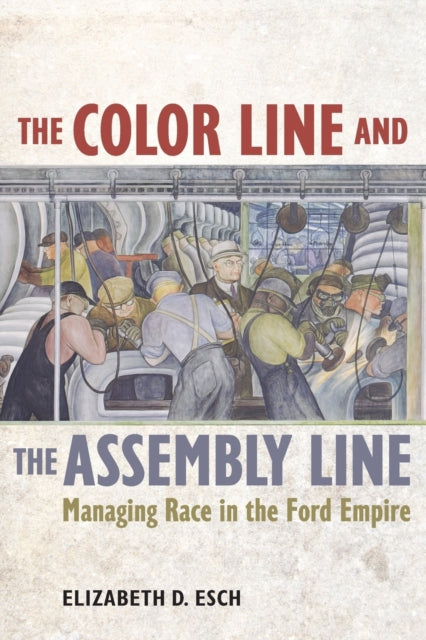
Elizabeth Esch
Color Line and the Assembly Line: Managing Race in the Ford Empire
Color Line and the Assembly Line: Managing Race in the Ford Empire
💎 Earn 101 Points (£1.01) on this item.
YOU SAVE £4.77
- Condition: Brand new
- UK Delivery times: Usually arrives within 2 - 3 working days
- UK Shipping: Fee starts at £2.39. Subject to product weight & dimension
Bulk ordering. Want 15 or more copies? Get a personalised quote and bigger discounts. Learn more about bulk orders.
Couldn't load pickup availability
- More about Color Line and the Assembly Line: Managing Race in the Ford Empire
The Color Line and the Assembly Line explores how global corporations, such as Ford Motor Company, have influenced gender and race worldwide. It challenges the traditional story of Fordism and reveals how the assembly line was compatible with racial practices in different countries, confirming racism as a crucial component of global capitalism.
\n Format: Paperback / softback
\n Length: 280 pages
\n Publication date: 04 May 2018
\n Publisher: University of California Press
\n
The Color Line and the Assembly Line present a fresh perspective on the profound impact of mass production on society. These global corporations, initially rooted in the United States, have exerted a significant influence on gender and race across the globe. By examining the rise of Ford Motor Company to become the world's largest, richest, and most influential corporation, The Color Line and the Assembly Line challenges the conventional narrative of Fordism. Contrary to popular belief, the assembly line proved to be remarkably compatible with various racial practices in the United States, Brazil, and South Africa. Each country's distinct racial hierarchies during the 1920s and 1930s shaped Ford's often contentious labor processes. Elizabeth Esch's work not only confirms racism as a fundamental element in the establishment of global capitalism but also offers a crucial insight by demonstrating how local patterns contributed to the unique characteristics of capitalism.
The Color Line and the Assembly Line:
In their book, "The Color Line and the Assembly Line," authors Elizabeth Esch and Philip B. Anderson explore the profound impact of mass production on society. These global corporations, initially rooted in the United States, have exerted a significant influence on gender and race across the globe. By examining the rise of Ford Motor Company to become the world's largest, richest, and most influential corporation, The Color Line and the Assembly Line challenges the conventional narrative of Fordism. Contrary to popular belief, the assembly line proved to be remarkably compatible with various racial practices in the United States, Brazil, and South Africa. Each country's distinct racial hierarchies during the 1920s and 1930s shaped Ford's often contentious labor processes. Elizabeth Esch's work not only confirms racism as a fundamental element in the establishment of global capitalism but also offers a crucial insight by demonstrating how local patterns contributed to the unique characteristics of capitalism.
Implications of the Color Line and the Assembly Line:
The book highlights the ways in which global corporations have played a part in perpetuating racial inequality and discrimination. It demonstrates how the assembly line, initially designed to increase efficiency and productivity, was used to segregate workers based on their race and gender. The authors argue that the integration of the assembly line in these countries facilitated the development of racial hierarchies and perpetuated existing inequalities.
Furthermore, the book sheds light on the ways in which local patterns and practices influenced the development of capitalism. It shows how the specific social, economic, and political conditions in each country shaped the unique features of capitalism in those regions. The authors argue that local patterns and practices contributed to the development of capitalism's distinctive features, such as the concentration of wealth and power in the hands of a few, the exploitation of labor, and the creation of a consumer culture.
In conclusion, "The Color Line and the Assembly Line" is a thought-provoking and important book that provides a fresh perspective on the impact of mass production on society. It challenges the conventional narrative of Fordism and highlights the ways in which global corporations, local patterns, and practices have contributed to the perpetuation of racial inequality and discrimination. The book offers valuable insights into the complex relationship between capitalism, race, and gender and provides a roadmap for addressing these issues in the present and future.
\n Weight: 388g\n
Dimension: 179 x 229 x 17 (mm)\n
ISBN-13: 9780520285385\n \n
This item can be found in:
UK and International shipping information
UK and International shipping information
UK Delivery and returns information:
- Delivery within 2 - 3 days when ordering in the UK.
- Shipping fee for UK customers from £2.39. Fully tracked shipping service available.
- Returns policy: Return within 30 days of receipt for full refund.
International deliveries:
Shulph Ink now ships to Australia, Belgium, Canada, France, Germany, Ireland, Italy, India, Luxembourg Saudi Arabia, Singapore, Spain, Netherlands, New Zealand, United Arab Emirates, United States of America.
- Delivery times: within 5 - 10 days for international orders.
- Shipping fee: charges vary for overseas orders. Only tracked services are available for most international orders. Some countries have untracked shipping options.
- Customs charges: If ordering to addresses outside the United Kingdom, you may or may not incur additional customs and duties fees during local delivery.