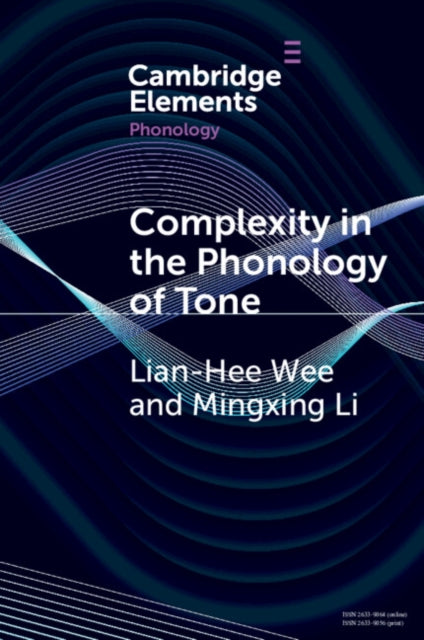
Lian-HeeWee,MingxingLi
Complexity in the Phonology of Tone
Complexity in the Phonology of Tone
💎 Earn 84 Points (£0.84) on this item.
We can order this item for you. Delivery usually takes about 4 to 6 weeks.
This item is not held in our immediate stock. We will order it for you after checkout.
Estimated delivery: About 4 to 6 weeks
YOU SAVE £1.01
- Condition: Brand new
- UK Delivery times: Usually arrives within 2 - 3 working days
- UK Shipping: Fee starts at £2.39. Subject to product weight & dimension
Bulk ordering. Want 15 or more copies? Get a personalised quote and bigger discounts. Learn more about bulk orders.
Couldn't load pickup availability
- More about Complexity in the Phonology of Tone
The complexity of tone is best appreciated through phonological patterning, which reveals structures beyond differences in pitch heights and contour profiles. Phonetically, fundamental frequency profiles are the best descriptors, and a language's tone inventory can be symmetrical. Sections 5, 6, and 7 discuss complexities where tones interact with one another and with other phonological entities, and Section 8 peeks into tone's phonological properties through music and poetry.
Format: Paperback / softback
Length: 75 pages
Publication date: 16 November 2023
Publisher: Cambridge University Press
The intricacy of tone is a profound linguistic phenomenon that cannot be fully understood without delving into the realm of phonological patterning. This intricate tapestry reveals structures that go beyond mere variations in pitch heights and contour profiles, unveiling a rich tapestry of meaning and expression.
In the first section, we explore the remarkable ability of tone to convey lexical and grammatical contrasts. Tone plays a crucial role in shaping the nuances of language, allowing speakers to convey subtle shades of meaning that go beyond mere words. By manipulating pitch, contour, and duration, speakers can create a wide range of emotions, attitudes, and moods, adding depth and complexity to their communication.
Phonetically, fundamental frequency profiles emerge as the most effective descriptors of tone. These profiles represent the relative intensity and frequency of sound waves, providing a concrete framework for analyzing and describing tone. By studying the patterns of fundamental frequency variation, linguists can identify the specific tonal characteristics of different languages and dialects.
Section 3 delves into the theoretical foundations of tone. It explains that the symmetry of a language's tone inventory can be attributed to the postulation of subatomic entities that comprise tones. These entities, such as phonemes or morphemes, are the building blocks of language and play a crucial role in shaping tone. Through the analysis of these entities, linguists can gain insights into the underlying mechanisms that govern tone production and perception.
In the fourth section, we examine the independence of tone from the syllable and segments. Tone is often considered an autosegment, meaning that it is produced and perceived as a distinct unit within a word or phrase. This independence allows tone to play a role in shaping the phonological structure of a language, influencing the placement of stress, intonation, and other phonological features.
Sections 5, 6, and 7 explore the complex interplay between tones and other phonological entities. The authors delve into the ways in which tones interact with each other, creating complex patterns of tone variation and blending. They also discuss the ways in which tones interact with other phonological features, such as vowels, consonants, and syllables, shaping the overall phonetic and phonological landscape of a language.
To capture the full range of complexities that arise when tones interact with one another and with other phonological entities, the authors offer a suggestion on how some of these interactions can be captured within the same analytical umbrella. They propose a framework that incorporates both phonetic and phonological perspectives, allowing for a comprehensive analysis of tone in language.
Section 8 takes a delightful detour into the realm of tone's phonological properties through music and poetry. The authors explore how music and poetry utilize tone to convey emotions, create mood, and convey meaning. They showcase examples of musical compositions and poetic verses that demonstrate the expressive power of tone, highlighting its ability to transcend linguistic boundaries and resonate with audiences on a profound level.
In conclusion, the complexity of tone is a testament to the rich and nuanced nature of language. Through phonological patterning, we gain a deeper understanding of the structures that underpin tone production and perception. By studying fundamental frequency profiles, the postulation of subatomic entities, and the interactions between tones and other phonological entities, we can unlock the full potential of this linguistic phenomenon and enhance our ability to communicate and comprehend the world around us.
ISBN-13: 9781009078061
This item can be found in:
UK and International shipping information
UK and International shipping information
UK Delivery and returns information:
- Delivery within 2 - 3 days when ordering in the UK.
- Shipping fee for UK customers from £2.39. Fully tracked shipping service available.
- Returns policy: Return within 30 days of receipt for full refund.
International deliveries:
Shulph Ink now ships to Australia, Belgium, Canada, France, Germany, Ireland, Italy, India, Luxembourg Saudi Arabia, Singapore, Spain, Netherlands, New Zealand, United Arab Emirates, United States of America.
- Delivery times: within 5 - 10 days for international orders.
- Shipping fee: charges vary for overseas orders. Only tracked services are available for most international orders. Some countries have untracked shipping options.
- Customs charges: If ordering to addresses outside the United Kingdom, you may or may not incur additional customs and duties fees during local delivery.