SamuelHelfont
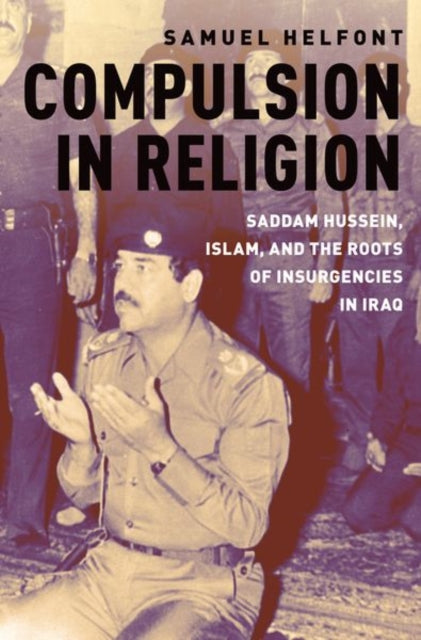
Compulsion in Religion: Saddam Hussein, Islam, and the Roots of Insurgencies in Iraq
Compulsion in Religion: Saddam Hussein, Islam, and the Roots of Insurgencies in Iraq
💎 Earn 131 Points (£1.31) on this item.
YOU SAVE £0.65
- Condition: Brand new
- UK Delivery times: Usually arrives within 2 - 3 working days
- UK Shipping: Fee starts at £2.39. Subject to product weight & dimension
Bulk ordering. Want 15 or more copies? Get a personalised quote and bigger discounts. Learn more about bulk orders.
Couldn't load pickup availability
- More about Compulsion in Religion: Saddam Hussein, Islam, and the Roots of Insurgencies in Iraq
Samuel Helfont's research in Ba thist archives reveals that Saddam Hussein's support for state-sponsored religion in the 1990s was part of a plan to use religion for political ends, not a shift away from Arab nationalism. The Faith Campaign was the culmination of this plan, but the US-Iraq war dismantled these structures, unleashing extremists that have plagued post-2003 Iraq.
\n Format: Paperback / softback
\n Length: 304 pages
\n Publication date: 12 October 2021
\n Publisher: Oxford University Press Inc
\n
Samuel Helfont delves into extensive research with Ba thist archives to explore the origins of the religious insurgencies that erupted in Iraq following the American-led invasion in 2003. Examining Saddam Hussein's policies in the 1990s, many have interpreted his support for state-sponsored religion as evidence of a significant shift away from Arab nationalism towards political Islam. While Islam did play a more prominent role in the regime's symbols and statements during this period, the regime's internal documents challenge this theory.
The Faith Campaign, launched by Saddam in 1979 upon assuming the Iraqi presidency, marked the culmination of a plan to utilize religion for political ends. During this period, Saddam began constructing the institutional capacity to control and monitor Iraqi religious institutions. The resulting authoritarian structures enabled him to employ Islamic symbols and rhetoric in public policy, albeit in a controlled manner. Saddam ultimately promoted a Ba thist interpretation of religion that subordinated it to Arab nationalism, rather than portraying it as an independent or primary political identity.
The purpose of this examination of Iraqi history, beyond correcting the current understanding of Saddam Hussein's political use of religion throughout his presidency, is to explore how Saddam's controlled use of religion was dismantled during the US-Iraq war, inadvertently unleashing extremists that had been suppressed under his regime. When the American-led invasion destroyed the regime's authoritarian structures, it inadvertently unhinged the forces that these structures were designed to contain, creating an atmosphere infused with religion but lacking the checks provided by the former regime. Groups such as al-Qaeda and the Islamic State of Iraq and al-Sham (ISIS) capitalized on this power vacuum, exploiting the religious sentiments of Iraqis to gain support and recruit members.
The US-led invasion of Iraq also had significant cultural and social consequences. The destruction of the Ba thist regime and the emergence of a more secular and democratic Iraq led to a surge in religious expression and diversity. However, this newfound freedom also brought challenges, including sectarian violence and the rise of extremist groups. The conflict between Sunnis and Shias, which had been suppressed under Saddam's regime, resurfaced, leading to a devastating civil war that lasted for years and claimed the lives of countless innocent civilians.
In conclusion, the religious insurgencies that erupted in Iraq following the American-led invasion in 2003 were a complex and multifaceted phenomenon. While Saddam Hussein's support for state-sponsored religion in the 1990s has been interpreted as a shift towards political Islam, the regime's internal documents challenge this theory. The Faith Campaign, launched in 1979, marked the culmination of a plan to utilize religion for political ends, and the authoritarian structures that resulted allowed Saddam to employ Islamic symbols and rhetoric in public policy, albeit in a controlled manner. The US-led invasion of Iraq dismantled these structures, inadvertently unleashing extremists that had been suppressed under Saddam's regime. The conflict between Sunnis and Shias, which had been suppressed under Saddam's regime, resurfaced, leading to a devastating civil war that lasted for years and claimed the lives of countless innocent civilians.
\n Weight: 444g\n
Dimension: 155 x 236 x 19 (mm)\n
ISBN-13: 9780197601266\n \n
This item can be found in:
UK and International shipping information
UK and International shipping information
UK Delivery and returns information:
- Delivery within 2 - 3 days when ordering in the UK.
- Shipping fee for UK customers from £2.39. Fully tracked shipping service available.
- Returns policy: Return within 30 days of receipt for full refund.
International deliveries:
Shulph Ink now ships to Australia, Belgium, Canada, France, Germany, Ireland, Italy, India, Luxembourg Saudi Arabia, Singapore, Spain, Netherlands, New Zealand, United Arab Emirates, United States of America.
- Delivery times: within 5 - 10 days for international orders.
- Shipping fee: charges vary for overseas orders. Only tracked services are available for most international orders. Some countries have untracked shipping options.
- Customs charges: If ordering to addresses outside the United Kingdom, you may or may not incur additional customs and duties fees during local delivery.