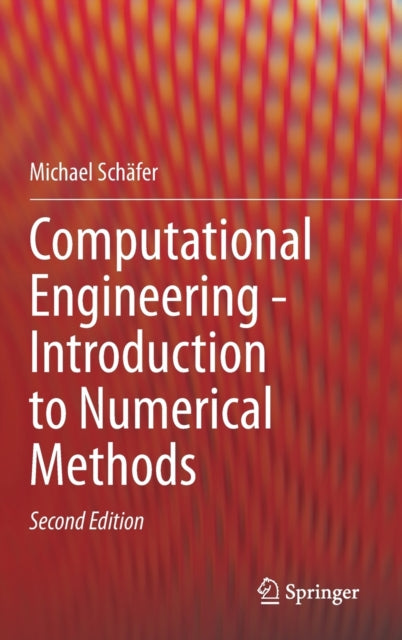
Michael Schafer
Computational Engineering - Introduction to Numerical Methods
Computational Engineering - Introduction to Numerical Methods
We can order this item for you. Delivery usually takes about 4 to 6 weeks.
This item is not held in our immediate stock. We will order it for you after checkout.
Estimated delivery: About 4 to 6 weeks
YOU SAVE £36.36
- Condition: Brand new
- UK Delivery times: Usually arrives within 2 - 3 working days
- UK Shipping: Fee starts at £3.89. Subject to product weight & dimension
Bulk ordering. Want 15 or more copies? Get a personalised quote and bigger discounts. Learn more about bulk orders.
Couldn't load pickup availability
- More about Computational Engineering - Introduction to Numerical Methods
Numerical simulation methods are essential in all engineering disciplines, and this text provides a practice-oriented introduction to modern numerical methods as they are applied in mechanical, chemical, or civil engineering. It discusses aspects of numerical mathematics, natural sciences, computer science, and the corresponding engineering area in a comprehensive multidisciplinary way, and is suitable for self-study or as an accompanying textbook for lectures. It can be useful for students of engineering disciplines and computational engineers in industrial practice.
Format: Hardback
Length: 373 pages
Publication date: 20 July 2021
Publisher: Springer Nature Switzerland AG
Numerical simulation methods hold increasing significance across all engineering disciplines, necessitating a solid foundation in underlying numerical techniques for their successful and efficient utilization. This text provides a practical introduction to modern numerical methods as they are commonly applied in mechanical, chemical, or civil engineering. It focuses on addressing problems related to heat transfer, structural mechanics, and fluid mechanics, providing a comprehensive multidisciplinary perspective. While the necessary information is typically dispersed across various textbooks within individual disciplines, this text aims to present the subject matter in a holistic and comprehensive manner. It discusses overarching aspects and critical questions related to accuracy, efficiency, and cost effectiveness, ensuring a foundational understanding for both self-study and accompanying lectures. The book is suitable for students of engineering disciplines as well as computational engineers in industrial practice, offering valuable insights and practical applications.
Numerical Simulation Methods in Engineering:
Numerical simulation methods have gained immense importance in various engineering disciplines, enabling the accurate modeling and analysis of complex systems. These methods utilize mathematical algorithms to solve differential equations and other mathematical problems, allowing engineers to predict the behavior and performance of structures, fluids, and systems.
The successful application of numerical simulation methods requires a fundamental understanding of the underlying numerical techniques. This includes knowledge of numerical methods, such as finite difference, finite element, and Monte Carlo methods, as well as computational techniques, such as parallel computing and optimization. Additionally, engineers must have a solid grasp of the physical principles and equations governing the systems they are simulating.
In mechanical engineering, numerical simulation methods are used to design and optimize mechanical components, systems, and machines. They can simulate the behavior of materials, structures, and fluids under various loading conditions, allowing engineers to identify potential weaknesses and improve the design efficiency. For example, finite element analysis (FEA) is a widely used method in mechanical engineering to simulate the stress and strain distribution in structures, enabling engineers to optimize their design and reduce the risk of failure.
In chemical engineering, numerical simulation methods are employed to model and optimize chemical reactions, processes, and systems. They can simulate the behavior of molecules, atoms, and ions in complex chemical environments, allowing engineers to predict the product yield, reaction kinetics, and energy consumption. For instance, molecular dynamics simulations are used to study the behavior of proteins and other biomolecules, which is crucial in drug discovery and development.
In civil engineering, numerical simulation methods are utilized to simulate the behavior of structures, bridges, and other infrastructure systems. They can simulate the effects of environmental factors, such as wind, earthquake, and traffic, on structures, enabling engineers to design resilient and sustainable infrastructure. For example, finite difference modeling is used to simulate the flow of water and other fluids in rivers and canals, which is essential in hydroelectric power generation and water resource management.
In addition to their practical applications, numerical simulation methods have significant implications for research and development in engineering. They can be used to explore new phenomena, validate theoretical models, and optimize existing designs. For example, computational fluid dynamics (CFD) is used to study the flow of fluids in complex geometries, such as aircraft engines and wind turbines, enabling engineers to improve their performance and efficiency.
However, the successful implementation of numerical simulation methods requires careful consideration of several factors. Accuracy, efficiency, and cost effectiveness are critical considerations, as numerical simulations can be computationally intensive and time-consuming. Engineers must also ensure that the models used in simulations are representative of the real-world systems they are simulating, and that the results obtained are reliable and valid.
To address these challenges, researchers and engineers are continuously developing and improving numerical simulation methods. This includes the use of advanced computational techniques, such as high-performance computing (HPC) and cloud computing, to accelerate the simulation process and reduce the computational costs. Additionally, researchers are exploring new numerical models and algorithms that can improve the accuracy and reliability of simulations.
In conclusion, numerical simulation methods have become an essential tool in engineering, enabling the accurate modeling and analysis of complex systems. Their successful application requires a solid foundation in numerical techniques, as well as a deep understanding of the physical principles and equations governing the systems being simulated. With ongoing research and development, numerical simulation methods will continue to play a pivotal role in advancing engineering technologies and solving real-world problems.
Weight: 746g
Dimension: 235 x 155 (mm)
ISBN-13: 9783030760267
Edition number: 2nd ed. 2022
UK and International shipping information
UK and International shipping information
We deliver throughout the United Kingdom and to 128 countries and territories worldwide, including the United States, Australia, Canada, Germany, Spain and France.