JosephCanning
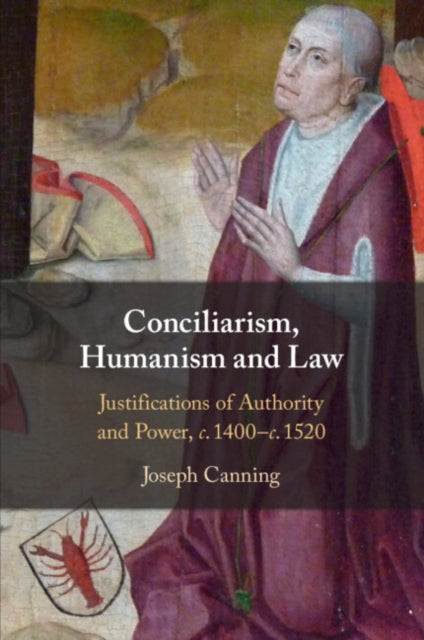
Conciliarism, Humanism and Law: Justifications of Authority and Power, c. 1400-c. 1520
Conciliarism, Humanism and Law: Justifications of Authority and Power, c. 1400-c. 1520
💎 Earn 113 Points (£1.13) on this item.
We can order this item for you. Delivery usually takes about 4 to 6 weeks.
This item is not held in our immediate stock. We will order it for you after checkout.
Estimated delivery: About 4 to 6 weeks
YOU SAVE £1.34
- Condition: Brand new
- UK Delivery times: Usually arrives within 2 - 3 working days
- UK Shipping: Fee starts at £2.39. Subject to product weight & dimension
Bulk ordering. Want 15 or more copies? Get a personalised quote and bigger discounts. Learn more about bulk orders.
Couldn't load pickup availability
- More about Conciliarism, Humanism and Law: Justifications of Authority and Power, c. 1400-c. 1520
This study explores the justifications for the distribution of power and authority in fifteenth- and early sixteenth-century Europe, based on the two key intellectual movements of conciliarism and humanism. It demonstrates that power had to be justified, but there were different kinds of justification employed. Joseph Canning's new interpretative approach offers a fresh perspective on conciliarist ideas and the contribution of Italian Renaissance humanists.
Format: Paperback / softback
Length: 215 pages
Publication date: 02 November 2023
Publisher: Cambridge University Press
In late medieval Europe, power was a complex and multifaceted concept that was justified in various ways by different individuals and groups. The justifications for power varied widely depending on the context and the intellectual movements of the time, including conciliarism in the church and humanism. This study explores the justifications for the distribution of power and authority in fifteenth- and early sixteenth-century Europe, focusing on the two key intellectual movements of the fifteenth century: conciliarism in the church and humanism.
Conciliarism was a movement within the Catholic Church that sought to reform the church and restore its authority after the Great Schism of 1054. Conciliarists believed that the church should be governed by a council of bishops and priests, rather than by a single pope. They argued that the council should be able to make decisions on important matters of faith and morals, and that the pope should be limited in his authority.
Humanism was a movement that emphasized the value of human reason, education, and culture. Humanists believed that individuals should be free to pursue their own interests and that the state should be limited in its power. They argued that the state should serve the interests of the people, rather than the interests of the rulers.
Joseph Canning's study explores the justifications for the distribution of power and authority in fifteenth- and early sixteenth-century Europe through the lenses of conciliarism, humanism, and law. He argues that it was almost universally assumed that power had to be justified, but that there were fundamentally different kinds of justification employed. Canning presents a new interpretative approach to the justifications of power, drawing on the ideas of conciliarists and Italian Renaissance humanists.
One of the key justifications for power in late medieval Europe was the idea of divine right. Conciliarists and humanists both believed that God had given certain individuals or groups the right to rule. They argued that this right was based on the Bible and the teachings of the church. For example, conciliarists argued that the pope had the right to rule because he was the successor of St. Peter, who was the first pope. Humanists, on the other hand, argued that kings had the right to rule because they were chosen by God to protect and serve the people.
Another justification for power was the idea of natural law. Conciliarists and humanists both believed that there was a natural law that governed the universe and that human beings were bound by this law. They argued that the state had the responsibility to enforce this law and to protect the rights of individuals. For example, conciliarists argued that the church had the right to punish heretics and sinners because they were violating the natural law. Humanists, on the other hand, argued that the state had the right to punish criminals because they were harming others.
A third justification for power was the idea of social contract. Conciliarists and humanists both believed that individuals had a social contract with the state. They argued that the state had the responsibility to protect and serve the people, and that the people had the responsibility to obey the laws of the state. For example, conciliarists argued that the church had the right to tax the people because they were providing services to the community. Humanists, on the other hand, argued that the state had the right to tax the people because it was necessary to fund public services.
In addition to these justifications, there were other factors that influenced the distribution of power and authority in late medieval Europe. These included the political and economic interests of individuals and groups, as well as the power of the church and the state. For example, the Holy Roman Empire was a political entity that was composed of several kingdoms and territories. The emperor was the head of the empire, but he had limited power over the individual kingdoms. The church, on the other hand, had significant power over the individual kingdoms, particularly in terms of religious affairs.
Overall, the justifications for power in late medieval Europe were complex and multifaceted. Conciliarism, humanism, and law were all important intellectual movements that influenced the distribution of power and authority in the region. Joseph Canning's study provides a new interpretative approach to the justifications of power, drawing on the ideas of conciliarists and Italian Renaissance humanists. By examining the arguments that convinced people in this period, Canning demonstrates that it was almost universally assumed that power had to be justified, but that there were fundamentally different kinds of justification employed.
ISBN-13: 9781108927192
UK and International shipping information
UK and International shipping information
UK Delivery and returns information:
- Delivery within 2 - 3 days when ordering in the UK.
- Shipping fee for UK customers from £2.39. Fully tracked shipping service available.
- Returns policy: Return within 30 days of receipt for full refund.
International deliveries:
Shulph Ink now ships to Australia, Belgium, Canada, France, Germany, Ireland, Italy, India, Luxembourg Saudi Arabia, Singapore, Spain, Netherlands, New Zealand, United Arab Emirates, United States of America.
- Delivery times: within 5 - 10 days for international orders.
- Shipping fee: charges vary for overseas orders. Only tracked services are available for most international orders. Some countries have untracked shipping options.
- Customs charges: If ordering to addresses outside the United Kingdom, you may or may not incur additional customs and duties fees during local delivery.