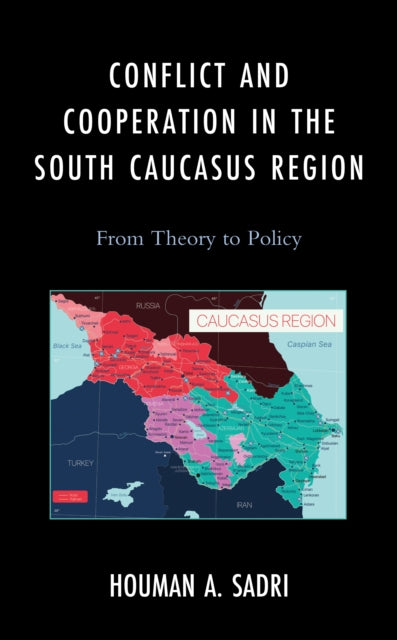
Houman A. Sadri
Conflict and Cooperation in the South Caucasus Region: From Theory to Policy
Conflict and Cooperation in the South Caucasus Region: From Theory to Policy
We can order this item for you. Delivery usually takes about 4 to 6 weeks.
This item is not held in our immediate stock. We will order it for you after checkout.
Estimated delivery: About 4 to 6 weeks
- Condition: Brand new
- UK Delivery times: Usually arrives within 2 - 3 working days
- UK Shipping: Fee starts at £3.89. Subject to product weight & dimension
Bulk ordering. Want 15 or more copies? Get a personalised quote and bigger discounts. Learn more about bulk orders.
Couldn't load pickup availability
- More about Conflict and Cooperation in the South Caucasus Region: From Theory to Policy
Conflict and Cooperation in the South Caucasus Region combines IR theory and policy to analyze the distinctive challenges of the region and offer practical policy options for policymakers. It covers Armenia, Azerbaijan, and Georgia's history since independence, the 2008 Russian invasion of Georgia, and the Armenian-Azeri Wars, and explores the application of IR prominent theories. The remainder of the 21st Century holds threats to Armenia, Azerbaijan, and Georgia, and the main sources of threats are the Armenian-Azeri Wars and the completion of energy pipelines.
Format: Hardback
Length: 416 pages
Publication date: 15 December 2023
Publisher: Lexington Books
Conflict and Cooperation in the South Caucasus Region: From Theory to Policy is a comprehensive book that combines international relations (IR) theory and policy in a readable format. Author Houman A. Sadri explores the unique challenges of the South Caucasus region and provides a survey of relevant IR theories. Armenia, Azerbaijan, and Georgia, which gained independence in the early 1990s, have experienced significant conflicts and cooperation since then. The 2008 Russian invasion of Georgia and the Armenian-Azeri Wars garnered global attention and impacted markets, but the completion of energy pipelines highlighted the complexity of cooperation in connecting the regional and global political economy.
The book has three main purposes: to provide a survey of the major developments of the Caucasus States, to analyze the application of IR prominent theories, and to offer practical policy options for policymakers seeking to understand the South Caucasus region.
In the first part of the book, Sadri provides a historical overview of the South Caucasus region, including its geographical, political, and economic characteristics. He discusses the various conflicts that have occurred in the region, including the Nagorno-Karabakh conflict, the Armenian-Azeri Wars, and the Russian invasion of Georgia. Sadri also analyzes the role of international actors, such as the United States, Russia, and the European Union, in the South Caucasus region.
In the second part of the book, Sadri applies IR prominent theories to the South Caucasus region. He discusses the theories of realism, liberalism, and constructivism and how they have been applied to the region. He also examines the role of identity politics in the South Caucasus region and how it has influenced the conflicts and cooperation in the region.
In the third part of the book, Sadri offers practical policy options for policymakers seeking to understand the South Caucasus region. He discusses the importance of regional cooperation, the need for conflict resolution, and the role of international institutions in the region. He also provides recommendations for policymakers to address the main sources of threats in the region, such as territorial disputes, ethnic conflicts, and economic inequality.
One of the key strengths of Conflict and Cooperation in the South Caucasus Region is its comprehensive coverage of the region's history, politics, and economics. Sadri provides a detailed analysis of the various conflicts and cooperation that have occurred in the region, and he offers insightful commentary on the role of international actors in the region.
However, the book also has some limitations. For example, Sadri does not provide a detailed analysis of the role of religion in the South Caucasus region, which has been a significant factor in the conflicts and cooperation in the region. He also does not provide a comprehensive analysis of the role of the media in the South Caucasus region, which has been a significant source of propaganda and misinformation.
Despite these limitations, Conflict and Cooperation in the South Caucasus Region is a valuable resource for policymakers, scholars, and anyone interested in the region. It provides a comprehensive overview of the major developments of the Caucasus States, analyzes the application of IR prominent theories, and offers practical policy options for policymakers seeking to understand the region.
In conclusion, Conflict and Cooperation in the South Caucasus Region is a comprehensive book that combines international relations (IR) theory and policy in a readable format. Author Houman A. Sadri explores the unique challenges of the South Caucasus region and provides a survey of relevant IR theories. The book has three main purposes: to provide a survey of the major developments of the Caucasus States, to analyze the application of IR prominent theories, and to offer practical policy options for policymakers seeking to understand the South Caucasus region. While the book has some limitations, it is a valuable resource for policymakers, scholars, and anyone interested in the region.
Dimension: 229 x 152 (mm)
ISBN-13: 9781666929393
UK and International shipping information
UK and International shipping information
We deliver throughout the United Kingdom and to 128 countries and territories worldwide, including the United States, Australia, Canada, Germany, Spain and France.