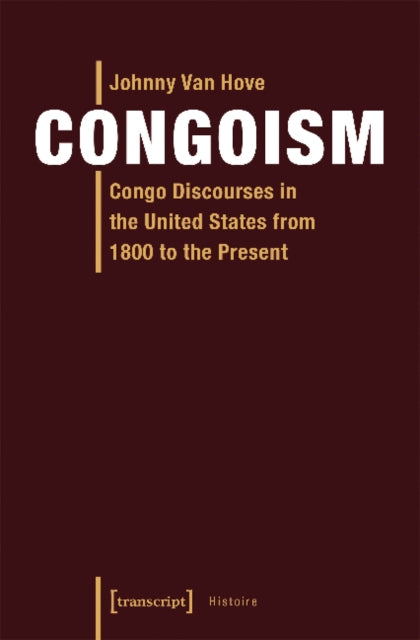
Johnny Van Hove
Congoism - Congo Discourses in the United States from 1800 to the Present
Congoism - Congo Discourses in the United States from 1800 to the Present
💎 Earn 185 Points (£1.85) on this item.
We can order this item for you. Delivery usually takes about 4 to 6 weeks.
This item is not held in our immediate stock. We will order it for you after checkout.
Estimated delivery: About 4 to 6 weeks
YOU SAVE £7.83
- Condition: Brand new
- UK Delivery times: Usually arrives within 2 - 3 working days
- UK Shipping: Fee starts at £2.39. Subject to product weight & dimension
Bulk ordering. Want 15 or more copies? Get a personalised quote and bigger discounts. Learn more about bulk orders.
Couldn't load pickup availability
- More about Congoism - Congo Discourses in the United States from 1800 to the Present
U.S. intellectual elites have used dismissive Congo discourses to justify plundering, according to Johnny Van Hove's book, which traces these discourses and offers a theorization of Central West Africa and a wake-up call for contemporary writers on international history and politics.
Format: Paperback / softback
Length: 360 pages
Publication date: 08 December 2021
Publisher: Transcript Verlag
The plundering of the Democratic Republic of the Congo has been justified by U.S. intellectual elites through a series of dismissive discourses. In his groundbreaking book, Johnny Van Hove delves into these discourses in extensive detail, revealing how U.S. intellectuals, along with their influential European counterparts, have exploited the Congo for their own purposes. By examining the works of intellectuals such as W.E.B. Du Bois, Joseph Conrad, and David Van Reybrouck, the book offers a comprehensive theorization of Central West Africa, serves as a case study of normalized narratives on the Other, and serves as a powerful wake-up call for all contemporary writers engaged in the study of international history and politics.
The Congo has been a subject of intense scrutiny and debate among U.S. intellectual elites, who have sought to justify its plundering through a range of dismissive discourses. These discourses have been carefully crafted and disseminated to shape public opinion and obscure the true nature of the conflict in the region.
One of the most prominent discourses is the notion that the Congo is a "failed state" or a "failed society." This narrative suggests that the Congo is incapable of governing itself and that its people are incapable of leading meaningful lives. It is often used to justify the intervention of foreign powers, such as the United States, in the region, as a means of "helping" the Congolese people.
Another discursive strategy employed by U.S. intellectuals is the portrayal of the Congolese people as "primitive" or "uncivilized." This narrative is used to justify the exploitation of the Congo's natural resources and the displacement of its population. It is often accompanied by the claim that the Congolese people are "ungrateful" or "unwilling to work" and that their culture is "backward" or "barbaric."
U.S. intellectual elites have also used the Congo as a testing ground for new military technologies and strategies. This has led to the deployment of advanced weapons and the use of military force to achieve political objectives. The Congolese people have borne the brunt of this violence, with countless lives lost and communities destroyed.
Despite these dismissive discourses, there have been a few U.S. intellectuals who have challenged these narratives and called for a more nuanced and empathetic understanding of the Congo. One such figure is W.E.B. Du Bois, a prominent African-American writer and activist who spent much of his life advocating for the rights of African Americans and the African diaspora. Du Bois recognized the importance of understanding the Congo's complex history and culture and called for a more equitable and peaceful resolution to the conflict in the region.
Joseph Conrad, another influential writer, also wrote about the Congo, using his novels to explore the complex social and political dynamics of the region. Conrad's work was deeply influenced by his experiences in the Congo, and he portrayed the Congolese people as complex and nuanced individuals with their own unique cultures and traditions.
David Van Reybrouck, a historian and anthropologist, has also written extensively about the Congo, challenging the dominant narratives and highlighting the resilience and creativity of the Congolese people. Van Reybrouck's work has been instrumental in shaping a more nuanced and empathetic understanding of the Congo and its people.
In conclusion, the plundering of the Democratic Republic of the Congo has been justified by U.S. intellectual elites through a series of dismissive discourses that portray the Congolese people as "failed states" or "primitive" and justify the exploitation of the Congo's natural resources and the displacement of its population. However, there have been a few U.S. intellectuals who have challenged these narratives and called for a more nuanced and empathetic understanding of the Congo. By examining the works of W.E.B. Du Bois, Joseph Conrad, and David Van Reybrouck, we can gain a deeper appreciation of the complex history and culture of the Congo and work towards a more just and peaceful resolution to the conflict in the region.
Weight: 666g
Dimension: 226 x 147 x 15 (mm)
ISBN-13: 9783837640373
This item can be found in:
UK and International shipping information
UK and International shipping information
UK Delivery and returns information:
- Delivery within 2 - 3 days when ordering in the UK.
- Shipping fee for UK customers from £2.39. Fully tracked shipping service available.
- Returns policy: Return within 30 days of receipt for full refund.
International deliveries:
Shulph Ink now ships to Australia, Belgium, Canada, France, Germany, Ireland, Italy, India, Luxembourg Saudi Arabia, Singapore, Spain, Netherlands, New Zealand, United Arab Emirates, United States of America.
- Delivery times: within 5 - 10 days for international orders.
- Shipping fee: charges vary for overseas orders. Only tracked services are available for most international orders. Some countries have untracked shipping options.
- Customs charges: If ordering to addresses outside the United Kingdom, you may or may not incur additional customs and duties fees during local delivery.