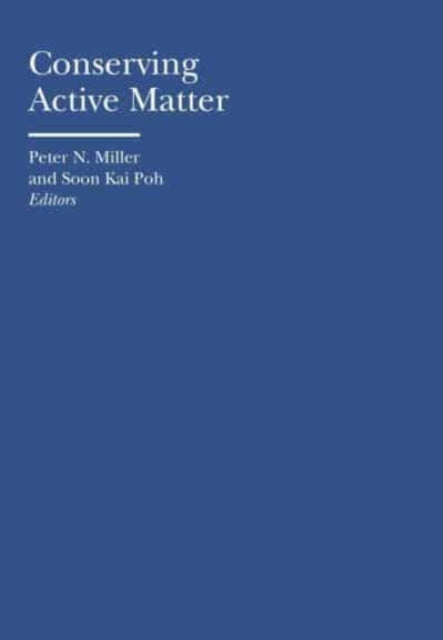
Peter N. Miller,Soon Kai Poh
Conserving Active Matter
Conserving Active Matter
💎 Earn 230 Points (£2.30) on this item.
YOU SAVE £5.98
- Condition: Brand new
- UK Delivery times: Usually arrives within 2 - 3 working days
- UK Shipping: Fee starts at £3.89. Subject to product weight & dimension
Bulk ordering. Want 15 or more copies? Get a personalised quote and bigger discounts. Learn more about bulk orders.
Couldn't load pickup availability
- More about Conserving Active Matter
This volume explores the future of conservation and its connection to the human sciences, highlighting the need for new tools and categories to address the challenges of new materials and scale of change.
Format: Hardback
Length: 400 pages
Publication date: 22 June 2022
Publisher: Bard Graduate Center, Exhibitions Department
This volume brings together the findings from a five-year research project that seeks to reimagine the relationship between conservation knowledge and the humanistic study of the material world. The project, "Cultures of Conservation," was supported by the Andrew W. Mellon Foundation and included events, seminars, and an artist-in-residence. The effort to conserve things amid change is part of the human struggle with the nature of matter. For as long as people have made things and kept things, they have also cared for and repaired them. Today, conservators use a variety of tools and categories developed over the last one hundred and fifty years to do this work, but in the coming decades, new kinds of materials and a new scale of change will pose unprecedented challenges. Looking ahead to this moment from the perspectives of history, philosophy, materials science, and anthropology, this volume explores new possibilities for both conservation and the humanities in the rethinking of active matter.
Conservation is an essential aspect of our relationship with the natural world, as it helps us preserve the materials and artifacts that have shaped our history and culture. However, as our society continues to evolve and the pace of change quickens, the challenges facing conservationists become increasingly complex. In this essay, we will explore the future of conservation and its connection to the human sciences.
One of the key challenges facing conservationists in the coming decades is the increasing use of new and innovative materials. These materials, such as plastics, composites, and nanotechnology, are often cheaper, stronger, and more durable than traditional materials, making them more appealing to manufacturers and consumers. However, these new materials also have unique properties that can make them difficult to preserve and restore. For example, plastics can degrade over time and release harmful chemicals into the environment, while composites can be difficult to repair if they are damaged.
Another challenge facing conservationists is the scale of change that is occurring in our world. Climate change, urbanization, and population growth are all contributing to the destruction of natural habitats and the loss of cultural heritage. As a result, conservationists must work to preserve not only individual artifacts and objects, but also entire ecosystems and cultural landscapes.
To address these challenges, conservationists are increasingly turning to the human sciences for help. The human sciences, including history, philosophy, sociology, and anthropology, can provide valuable insights into the ways in which people have interacted with the natural world over time and the values that have shaped their relationships with it. By incorporating these insights into conservation practices, conservationists can develop more effective and sustainable strategies for preserving the materials and artifacts that are important to us.
One example of how the human sciences are being used to address conservation challenges is the development of cultural heritage management programs. These programs aim to preserve the cultural heritage of communities that are at risk of displacement or extinction. By working with local communities and stakeholders, cultural heritage management programs can develop strategies for preserving and promoting cultural heritage, while also addressing the social and economic issues that contribute to its destruction.
Another example of how the human sciences are being used to address conservation challenges is the development of conservation education programs. These programs aim to teach people about the importance of conservation and the ways in which they can contribute to its preservation. By providing people with the knowledge and skills they need to preserve the natural world, conservation education programs can help build a more sustainable and resilient society.
In conclusion, the future of conservation is bright, but it will require a collaborative effort between conservationists, the human sciences, and other stakeholders. By working together
Together, the human sciences and conservation can create a more sustainable and resilient world by developing new strategies for preserving the materials and artifacts that are important to us. By incorporating the insights of history, philosophy, sociology, and anthropology into conservation practices, conservationists can develop more effective and sustainable strategies for preserving the natural world. By providing people with the knowledge and skills they need to preserve the natural world, conservation education programs can help build a more sustainable and resilient society. Together, we can create a future where the human and natural worlds thrive in harmony.
Weight: 865g
Dimension: 261 x 143 x 38 (mm)
ISBN-13: 9781941792322
UK and International shipping information
UK and International shipping information
We deliver throughout the United Kingdom and to 128 countries and territories worldwide, including the United States, Australia, Canada, Germany, Spain and France.