Michael Mark Cohen
Conspiracy of Capital: Law, Violence, and American Popular Radicalism in the Age of Monopoly
Conspiracy of Capital: Law, Violence, and American Popular Radicalism in the Age of Monopoly
💎 Earn 376 Points (£3.76) on this item.
YOU SAVE £9.77
- Condition: Brand new
- UK Delivery times: Usually arrives within 2 - 3 working days
- UK Shipping: Fee starts at £2.39. Subject to product weight & dimension
Bulk ordering. Want 15 or more copies? Get a personalised quote and bigger discounts. Learn more about bulk orders.
Couldn't load pickup availability
- More about Conspiracy of Capital: Law, Violence, and American Popular Radicalism in the Age of Monopoly
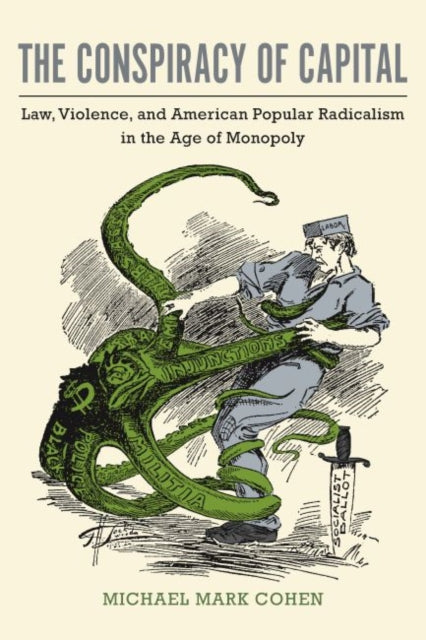
A broad coalition of American dissidents challenged corporate capitalism between the 1880s and 1920s, leading to an escalating class conflict. Monopoly capitalists and their allies responded by expanding conspiracy laws and promoting conspiracy theories, resulting in a revolutionary mass culture. Michael Mark Cohen's book "The Conspiracy of Capital" offers a new history of American radicalism and the alliance between the modern business corporation and national security state.
\n Format: Hardback
\n Length: 320 pages
\n Publication date: 30 July 2019
\n Publisher: University of Massachusetts Press
\n
Between the 1880s and 1920s, a broad coalition of American dissidents, including rabble-rousing cartoonists, civil liberties lawyers, socialist detectives, union organizers, and revolutionary martyrs, forged a culture of popular radicalism that directly challenged an emergent corporate capitalism. Monopoly capitalists and their allies in government responded by expanding conspiracy laws and promoting conspiracy theories in an effort to destroy this anti-capitalist movement. The result was an escalating class conflict in which each side came to view the other as a criminal conspiracy.
In this detailed cultural history, Michael Mark Cohen argues that a legal, ideological, and representational politics of conspiracy contributed to the formation of a genuinely revolutionary mass culture in the United States, starting with the 1886 Haymarket bombing. Drawing on a wealth of primary sources, The Conspiracy of Capital offers a new history of American radicalism and the alliance between the modern business corporation and national security state through a comprehensive reassessment of the role of conspiracy laws and conspiracy theories in American social movements.
The rise of corporate capitalism in the late 19th century brought with it a new set of challenges for American society. The concentration of wealth and power in the hands of a few large corporations led to widespread economic inequality, exploitation of workers, and a lack of political representation for the working class. This created a fertile ground for the growth of radicalism, as many people began to seek alternative solutions to these problems.
One of the most significant movements to emerge from this period was the labor movement. Led by figures such as Samuel Gompers and John L. Lewis, labor unions sought to improve the working conditions and wages of workers by organizing strikes and protests. However, the government and corporate interests often responded with violence and repression, leading to the passage of laws such as the Taft-Hartley Act in 1947 that weakened the power of labor unions.
At the same time, a new wave of radicalism was emerging in the arts and culture. Artists and writers began to challenge the dominant social and political norms of the time, using their work to promote social justice and equality. This included the rise of socialist and communist movements, as well as the emergence of anarchism and other anti-establishment ideologies.
One of the most significant figures in this period was the cartoonist and social critic John Swinton. Swinton's cartoons, which were published in newspapers such as the New York World and the Chicago Tribune, often depicted the corrupt and exploitative practices of corporate capitalism and the government. His work helped to popularize the idea of conspiracy theories, which claimed that powerful individuals and organizations were working together to undermine the interests of the working class and promote their own selfish interests.
The government and corporate interests responded to this growing radicalism with a series of measures designed to suppress it. In 1919, the Espionage Act was passed, making it a crime to engage in "seditious" or "disloyal" activity. This law was used to prosecute labor organizers and other radicals who were advocating for social and political change.
At the same time, the government began to promote conspiracy theories about the labor movement and other radical movements. These theories claimed that labor unions were controlled by communist agents and that socialist and communist ideologies were a threat to American democracy. These theories were widely disseminated through the media and by government agencies, such as the FBI and the CIA.
The result of these measures was an escalating class conflict in which each side came to view the other as a criminal conspiracy. The labor movement was portrayed as a threat to national security, while the government and corporate interests were portrayed as defenders of the American way of life. This conflict continued to shape American politics and society for decades to come.
In conclusion, the history of conspiracy laws and conspiracy theories in American social movements is a complex and fascinating subject. While these laws and theories were initially used to suppress radicalism and promote corporate capitalism, they ultimately contributed to the formation of a revolutionary mass culture that challenged the dominant social and political norms of the time. The legacy of this period continues to be felt today, as we continue to struggle with the challenges of economic inequality and political repression.
\n \n
Dimension: 229 x 152 (mm)\n
ISBN-13: 9781625344007\n \n
UK and International shipping information
UK and International shipping information
UK Delivery and returns information:
- Delivery within 2 - 3 days when ordering in the UK.
- Shipping fee for UK customers from £2.39. Fully tracked shipping service available.
- Returns policy: Return within 30 days of receipt for full refund.
International deliveries:
Shulph Ink now ships to Australia, Belgium, Canada, France, Germany, Ireland, Italy, India, Luxembourg Saudi Arabia, Singapore, Spain, Netherlands, New Zealand, United Arab Emirates, United States of America.
- Delivery times: within 5 - 10 days for international orders.
- Shipping fee: charges vary for overseas orders. Only tracked services are available for most international orders. Some countries have untracked shipping options.
- Customs charges: If ordering to addresses outside the United Kingdom, you may or may not incur additional customs and duties fees during local delivery.