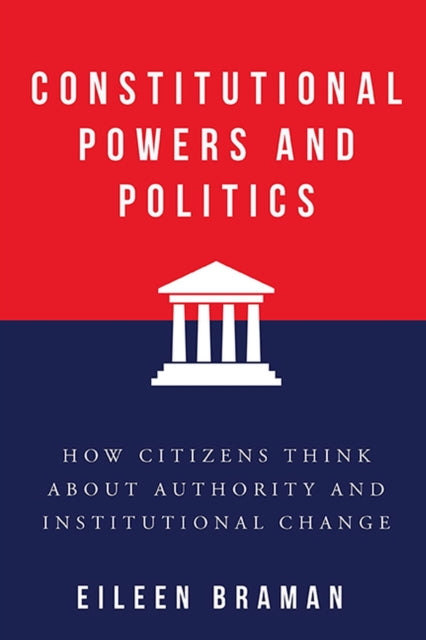
Eileen Braman
Constitutional Powers and Politics: How Citizens Think about Authority and Institutional Change
Constitutional Powers and Politics: How Citizens Think about Authority and Institutional Change
💎 Earn 131 Points (£1.31) on this item.
YOU SAVE £1.57
- Condition: Brand new
- UK Delivery times: Usually arrives within 2 - 3 working days
- UK Shipping: Fee starts at £2.39. Subject to product weight & dimension
Bulk ordering. Want 15 or more copies? Get a personalised quote and bigger discounts. Learn more about bulk orders.
Couldn't load pickup availability
- More about Constitutional Powers and Politics: How Citizens Think about Authority and Institutional Change
Eileen Braman's book explores how American citizens think about government, why they may support potentially risky changes, and how politicians can channel discontent toward meaningful reform. She highlights that Americans value institutions that deliver personal and societal gains and are more supportive of fundamental constitutional change when they perceive potential losses.
Format: Paperback / softback
Length: 258 pages
Publication date: 30 October 2023
Publisher: University of Virginia Press
In recent years, the relationship between public opinion and the actions of institutions like the Supreme Court has come under increasing scrutiny. In this timely book, Eileen Braman delves into the complex dynamics of how American citizens perceive and think about government across all three branches. Applying a rigorous political scientific methodology, Braman explores why citizens may support potentially risky changes to our governing system.
As Braman emphasizes, Americans value institutions that they perceive as delivering personal and societal gains. Conversely, citizens who see these institutions as delivering potential losses are more supportive of fundamental constitutional change. In the face of growing resentment of government and recurring warnings of constitutional crisis, Braman offers a hopeful note: her findings suggest that politicians can channel discontent toward meaningful reform and the healthy evolution of our democratic system.
Braman's research reveals that Americans are deeply divided on issues of governance, with different groups holding varying views on the role of government in society. She identifies several factors that influence public opinion, including political ideology, social norms, and media coverage. Braman also examines how these factors interact with each other to shape public attitudes toward government.
One of the key findings of the book is that Americans are more likely to support constitutional change when they perceive it as a means to protect their personal and societal gains. For example, citizens who believe that the government is too powerful or inefficient are more likely to support measures that limit government power or increase government accountability. Similarly, citizens who fear that the government is not doing enough to address social or economic issues are more likely to support policies that promote social welfare or economic growth.
However, Braman also notes that public opinion can be influenced by a range of other factors, including political polarization, media bias, and public perception of the legitimacy of the institution. For example, citizens who are highly partisan or who rely on conservative media outlets are more likely to oppose constitutional change that they perceive as liberal or progressive. Similarly, citizens who believe that the Supreme Court is not legitimate or impartial may be less supportive of constitutional changes that they perceive as undermining the court's authority.
Despite these challenges, Braman offers several recommendations for policymakers and citizens alike. She suggests that policymakers should focus on building public trust and legitimacy by engaging with the public and addressing their concerns. Citizens, on the other hand, should be more informed and engaged in the political process, and should seek out information from a range of sources to develop a more nuanced understanding of government and policy issues.
In conclusion, The Relationship Between Public Opinion and the Actions of Institutions like the Supreme Court is a thought-provoking and timely book that offers valuable insights into the complex dynamics of American politics and governance. By applying a rigorous political scientific methodology, Braman explores why citizens may support potentially risky changes to our governing system and offers recommendations for policymakers and citizens alike to promote meaningful reform and the healthy evolution of our democratic system.
Weight: 412g
Dimension: 152 x 229 x 20 (mm)
ISBN-13: 9780813950204
UK and International shipping information
UK and International shipping information
UK Delivery and returns information:
- Delivery within 2 - 3 days when ordering in the UK.
- Shipping fee for UK customers from £2.39. Fully tracked shipping service available.
- Returns policy: Return within 30 days of receipt for full refund.
International deliveries:
Shulph Ink now ships to Australia, Belgium, Canada, France, Germany, Ireland, Italy, India, Luxembourg Saudi Arabia, Singapore, Spain, Netherlands, New Zealand, United Arab Emirates, United States of America.
- Delivery times: within 5 - 10 days for international orders.
- Shipping fee: charges vary for overseas orders. Only tracked services are available for most international orders. Some countries have untracked shipping options.
- Customs charges: If ordering to addresses outside the United Kingdom, you may or may not incur additional customs and duties fees during local delivery.