Shulph Ink
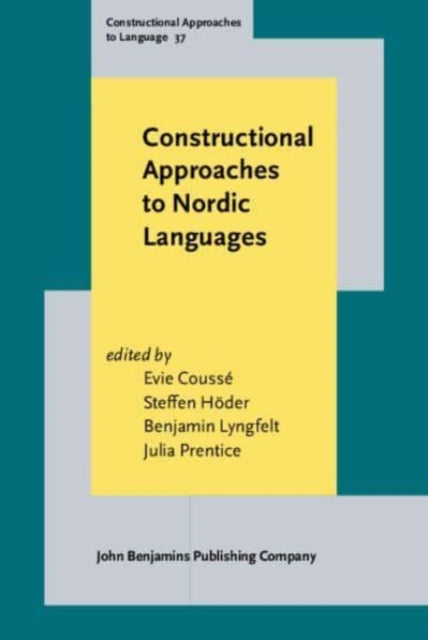
Constructional Approaches to Nordic Languages
Constructional Approaches to Nordic Languages
💎 Earn 477 Points (£4.77) on this item.
YOU SAVE £1.55
- Condition: Brand new
- UK Delivery times: Usually arrives within 2 - 3 working days
- UK Shipping: Fee starts at £2.39. Subject to product weight & dimension
Bulk ordering. Want 15 or more copies? Get a personalised quote and bigger discounts. Learn more about bulk orders.
Couldn't load pickup availability
- More about Constructional Approaches to Nordic Languages
Eight studies of linguistic phenomena in Nordic languages from a construction grammar perspective are presented in this volume,deepening and widening the focus of construction grammar applied to these languages. The contributions cover topics such as the constructional network,pseudo-coordination,additional language learning,prototypical semantics,domain-specific discourse,and language behavior. The research showcases the vibrant activity within the construction grammar community in dealing with Nordic languages,contributing to knowledge about the structure,use,and learning of these languages and to the field of construction grammar.
Format: Unspecified
Length: 278 pages
Publication date: 07 November 2023
Publisher: John Benjamins Publishing Co
This comprehensive volume explores eight in-depth studies of linguistic phenomena in Nordic languages, including Danish, Norwegian, and Swedish, from a construction grammar perspective. The contributions presented in this volume not only enhance and broaden the scope of construction grammar applied to Nordic languages but also address a diverse range of topics. These include the constructional network, pseudo-coordination, additional language learning, emerging multilingualism, prototypical semantics in argument structure constructions, and domain-specific discourse and language behavior. By delving into these diverse areas, the volume showcases the vibrant research endeavors within a segment of the construction grammar community focused on Nordic languages. This research not only contributes to our understanding of the structural, functional, and learning aspects of these languages but also advances the field of construction grammar as a whole.
The first study in the volume, authored by Maria J. Andersen and titled "The Constructional Network of Danish Verbs," examines the network of verb constructions in Danish. The authors employ a construction grammar framework to analyze the semantic and syntactic properties of Danish verbs and their interactions within the constructional network. They argue that the network of Danish verbs exhibits a high degree of complexity, with verbs forming complex clusters and exhibiting various semantic and syntactic patterns. The study provides valuable insights into the internal organization of Danish verbs and their role in constructing sentences.
The second study, by Jens Peter Jørgensen and titled "Pseudo-Coordination in Danish and Norwegian," explores the phenomenon of pseudo-coordination in Danish and Norwegian. Pseudo-coordination involves the use of multiple predicates or adjectives that share the same subject, resulting in a coordination effect. The study investigates the syntactic and semantic properties of pseudo-coordination in these languages and discusses its implications for language processing and interpretation. The authors argue that pseudo-coordination plays a crucial role in constructing complex sentences and contributes to the expressive power of Nordic languages.
The third study, by Anne Marie Kjærulff-Schmidt and titled "Additional Language Learning in Danish and Norwegian: A Construction Grammar Perspective," examines the acquisition of additional languages by Danish and Norwegian speakers. The authors argue that construction grammar provides a valuable framework for understanding the cognitive processes involved in language learning. They explore the specific constructional patterns and linguistic features that facilitate additional language learning and discuss the challenges and strategies that learners encounter during the process. The study contributes to our understanding of the cognitive mechanisms that underpin language acquisition and offers practical insights for language teachers and learners.
The fourth study, by Mette Hjort and titled "Emerging Multilingualism in Nordic Languages: A Construction Grammar Perspective," explores the phenomenon of emerging multilingualism in Nordic countries. The authors argue that construction grammar offers a useful framework for analyzing the complex linguistic situations that arise in multilingual communities. They examine the grammatical and semantic properties of multilingualism and discuss the challenges and opportunities that multilingualism presents for language users and language policy. The study contributes to our understanding of the dynamics of language change and the role of construction grammar in accommodating linguistic diversity.
The fifth study, by Anne Marie Kjærulff-Schmidt and titled "Prototypical Semantics in Argument Structure Constructions: A Construction Grammar Perspective," examines the semantic properties of argument structure constructions in Nordic languages. The authors argue that construction grammar provides a valuable framework for analyzing the semantic roles and relations within argument structures. They explore the prototypical semantic patterns and the cognitive mechanisms that underlie them and discuss their implications for language interpretation and communication. The study contributes to our understanding of the cognitive processes involved in argument construction and offers practical insights for language teachers and learners.
The sixth study, by Mette Hjort and titled "Domain-Specific Discourse and Language Behavior in Nordic Languages: A Construction Grammar Perspective," explores the linguistic phenomena that occur in specific domains or contexts in Nordic languages. The authors argue that construction grammar provides a useful framework for analyzing the linguistic patterns and structures that are specific to particular domains. They examine the linguistic features and constructions that are associated with different domains, such as medical discourse, legal discourse, and news discourse, and discuss their implications for language use and communication. The study contributes to our understanding of the linguistic diversity that exists in different domains and offers practical insights for language professionals and researchers.
The seventh study, by Anne Marie Kjærulff-Schmidt and titled "Construction Grammar and the Teaching of Nordic Languages: A Pedagogical Perspective," examines the pedagogical implications of construction grammar for teaching Nordic languages. The authors argue that construction grammar offers a valuable framework for organizing and presenting language material and for promoting language learning. They discuss the specific constructional patterns and linguistic features that are relevant for teaching Nordic languages and offer practical suggestions for language teachers and learners. The study contributes to our understanding of the effective teaching strategies for Nordic languages and offers valuable insights for language educators and policymakers.
The eighth and final study, by Mette Hjort and titled "Construction Grammar and the Future of Nordic Languages: A Research Agenda," presents a research agenda for future studies of Nordic languages from a construction grammar perspective. The authors argue that construction grammar provides a rich and promising framework for analyzing the linguistic phenomena that occur in Nordic languages. They identify specific research questions and propose methods for investigating these questions. The study contributes to the ongoing development of construction grammar as a field and offers valuable insights for language researchers and scholars.
In conclusion, this comprehensive volume explores eight in-depth studies of linguistic phenomena in Nordic languages from a construction grammar perspective. The contributions presented in this volume not only enhance and broaden the scope of construction grammar applied to Nordic languages but also address a diverse range of topics. By delving into these diverse areas, the volume showcases the vibrant research endeavors within a segment of the construction grammar community focused on Nordic languages. This research not only contributes to our understanding of the structural, functional, and learning aspects of these languages but also advances the field of construction grammar as a whole. The volume is a valuable resource for language researchers, teachers, and learners interested in the study of Nordic languages and construction grammar.
Weight: 634g
Dimension: 167 x 249 x 19 (mm)
ISBN-13: 9789027214317
This item can be found in:
UK and International shipping information
UK and International shipping information
UK Delivery and returns information:
- Delivery within 2 - 3 days when ordering in the UK.
- Shipping fee for UK customers from £2.39. Fully tracked shipping service available.
- Returns policy: Return within 30 days of receipt for full refund.
International deliveries:
Shulph Ink now ships to Australia, Belgium, Canada, France, Germany, Ireland, Italy, India, Luxembourg Saudi Arabia, Singapore, Spain, Netherlands, New Zealand, United Arab Emirates, United States of America.
- Delivery times: within 5 - 10 days for international orders.
- Shipping fee: charges vary for overseas orders. Only tracked services are available for most international orders. Some countries have untracked shipping options.
- Customs charges: If ordering to addresses outside the United Kingdom, you may or may not incur additional customs and duties fees during local delivery.