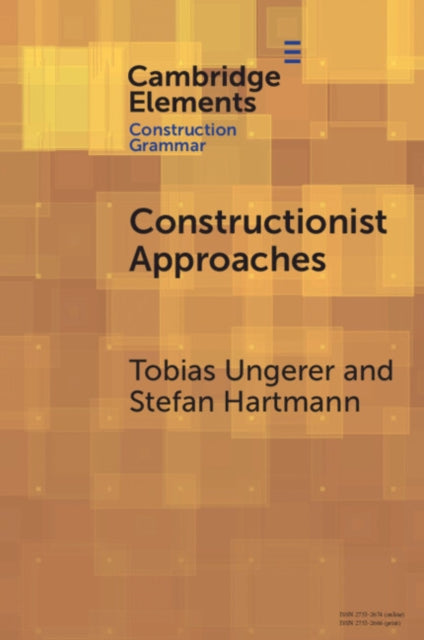
TobiasUngerer,StefanHartmann
Constructionist Approaches: Past, Present, Future
Constructionist Approaches: Past, Present, Future
💎 Earn 84 Points (£0.84) on this item.
We can order this item for you. Delivery usually takes about 4 to 6 weeks.
This item is not held in our immediate stock. We will order it for you after checkout.
Estimated delivery: About 4 to 6 weeks
YOU SAVE £1.01
- Condition: Brand new
- UK Delivery times: Usually arrives within 2 - 3 working days
- UK Shipping: Fee starts at £2.39. Subject to product weight & dimension
Bulk ordering. Want 15 or more copies? Get a personalised quote and bigger discounts. Learn more about bulk orders.
Couldn't load pickup availability
- More about Constructionist Approaches: Past, Present, Future
Construction Grammar (CxG) is a family of approaches that view constructions as the basic units of language. It discusses the commonalities and differences between the major constructionist approaches, the organization of constructional networks, and ongoing research on linguistic creativity, multimodality, and individual differences.
Format: Paperback / softback
Length: 75 pages
Publication date: 20 July 2023
Publisher: Cambridge University Press
Construction Grammar (CxG) has evolved into a vast and multifaceted family of approaches, all of which share the common belief that constructions, which are form-meaning pairs at different levels of abstraction and complexity, constitute the fundamental building blocks of language. This Element provides a comprehensive overview of the origins and current state of constructionist approaches, with a particular focus on core concepts such as constructions. At the same time, it delves into the latest research trends and unresolved questions, offering a deep exploration of these topics. It examines the similarities and distinctions between the major constructionist frameworks, the structure of constructional networks, and ongoing research in linguistic creativity, multimodality, and individual differences. Additionally, this title is also accessible as Open Access on Cambridge Core.
The study of construction grammar (CxG) has expanded significantly over the years, becoming a diverse and comprehensive family of approaches that share a common focus on constructions as the primary units of language. These constructions, which represent form-meaning pairs at various levels of abstraction and complexity, are considered the fundamental building blocks of language.
The origins of construction grammar can be traced back to the early works of Noam Chomsky, who proposed the transformational-generative grammar framework in the 1950s. This framework, which was based on the idea of transformational rules, sought to explain the grammatical structure of natural languages by mapping them onto a hierarchical tree structure. However, Chomsky's approach was criticized for its rigidity and lack of flexibility, leading to the development of alternative constructionist frameworks.
One of the most prominent constructionist approaches is the Head-Driven Phrase Structure Grammar (HPSG) framework, developed by David Hill and colleagues in the 1980s. HPSG emphasizes the role of heads, which are semantic roles or functions, in determining the grammatical structure of a sentence. It proposes that the head of a phrase acts as the governor of its arguments, which are the elements that contribute to its meaning. HPSG has been widely used in the study of natural languages, particularly in the analysis of complex sentence structures and the representation of semantic relations.
Another influential constructionist approach is the Construction Grammar (CxG) framework, developed by Paul Postal and colleagues in the 1990s. CxG takes a more holistic approach to construction, considering both the form and the meaning of constructions. It proposes that constructions are organized into constructional networks, which are sets of constructions that share similar meanings and functions. CxG also emphasizes the role of cognitive factors in language processing, such as attention and memory, and how they contribute to the construction of meaning.
Construction grammar has had a significant impact on the field of linguistics, leading to a re-evaluation of traditional grammar theories and a greater appreciation of the role of cognitive processes in language production and comprehension. It has also influenced the development of other linguistic frameworks, such as Functional Grammar and Cognitive Grammar, which incorporate constructionist principles into their approaches.
Despite its many contributions, construction grammar is not without its challenges. One of the main criticisms is that it can be difficult to apply to languages that do not have a rich inventory of constructional patterns, such as some African languages or Austronesian languages. Additionally, some constructionist approaches may be overly complex and difficult to understand for non-linguists.
Despite these challenges, construction grammar continues to be an active area of research, with many researchers working to refine and expand its theoretical framework and apply it to new languages and domains. The study of construction grammar has the potential to shed light on the nature of language and how it is produced and understood by humans, and it has the potential to have a significant impact on language teaching and learning.
In conclusion, construction grammar has evolved into a broad and diverse family of approaches that share a common belief in the importance of constructions as the fundamental units of language. While it has faced challenges, it has had a significant impact on the field of linguistics and has influenced the development of other linguistic frameworks. Construction grammar continues to be an active area of research, with many researchers working to refine and expand its theoretical framework and apply it to new languages and domains.
ISBN-13: 9781009308731
This item can be found in:
UK and International shipping information
UK and International shipping information
UK Delivery and returns information:
- Delivery within 2 - 3 days when ordering in the UK.
- Shipping fee for UK customers from £2.39. Fully tracked shipping service available.
- Returns policy: Return within 30 days of receipt for full refund.
International deliveries:
Shulph Ink now ships to Australia, Belgium, Canada, France, Germany, Ireland, Italy, India, Luxembourg Saudi Arabia, Singapore, Spain, Netherlands, New Zealand, United Arab Emirates, United States of America.
- Delivery times: within 5 - 10 days for international orders.
- Shipping fee: charges vary for overseas orders. Only tracked services are available for most international orders. Some countries have untracked shipping options.
- Customs charges: If ordering to addresses outside the United Kingdom, you may or may not incur additional customs and duties fees during local delivery.