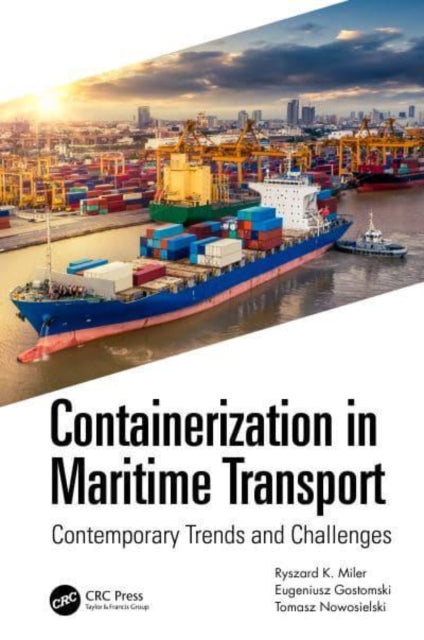
Ryszard K.Miler,EugeniuszGostomski,TomaszNowosielski
Containerization in Maritime Transport: Contemporary Trends and Challenges
Containerization in Maritime Transport: Contemporary Trends and Challenges
💎 Earn 589 Points (£5.89) on this item.
We can order this item for you. Delivery usually takes about 4 to 6 weeks.
This item is not held in our immediate stock. We will order it for you after checkout.
Estimated delivery: About 4 to 6 weeks
YOU SAVE £7.00
- Condition: Brand new
- UK Delivery times: Usually arrives within 2 - 3 working days
- UK Shipping: Fee starts at £2.39. Subject to product weight & dimension
Bulk ordering. Want 15 or more copies? Get a personalised quote and bigger discounts. Learn more about bulk orders.
Couldn't load pickup availability
- More about Containerization in Maritime Transport: Contemporary Trends and Challenges
Containerization is optimizing handling processes in intermodality and maritime transport, stimulating the development of global trade. It discusses technological advances, economic aspects, and ecological considerations to develop efficient and safe green supply chains.
Format: Hardback
Length: 308 pages
Publication date: 16 December 2022
Publisher: Taylor & Francis Ltd
Containerization, a revolutionary concept in the realm of logistics and transportation, has emerged as a game-changer in the global trade landscape. By optimizing the handling processes across intermodal and maritime transport, particularly in shipping, containerization has brought forth
Containerization is a revolutionary concept in logistics and transportation that has significantly optimized the handling of goods across intermodal and maritime transport, particularly in shipping. It has brought about a remarkable improvement in the efficiency and effectiveness of cargo handling, leading to the growth of modern global trade. With the advancement of globalization, which involves longer distances and increasing cargo volumes, the maritime industry has been compelled to adopt containerization as a crucial solution. This has resulted in a significant increase in the number of container ships in operation, as ship owners seek to capitalize on the benefits it offers.
One of the primary advantages of containerization is its ability to optimize the volume and distance of shipping. Containers are standardized units that can be easily loaded, transported, and unloaded, reducing the need for manual handling and minimizing the risk of damage to goods. This efficiency has allowed for the transportation of larger quantities of cargo over longer distances, resulting in reduced transportation costs and increased profitability for ship owners.
Another significant benefit of containerization is its ability to facilitate intermodal transportation. Containers can be transported by land, sea, or air, making it possible to combine different modes of transportation to create efficient and cost-effective supply chains. This flexibility has enabled businesses to source goods from different parts of the world and deliver them to their customers in a timely and cost-effective manner.
Containerization has also had a profound impact on the organization of international trade. It has streamlined the customs clearance process, reducing the time and costs associated with importing and exporting goods. By standardizing the packaging and labeling of goods, containerization has made it easier for customs authorities to identify and inspect shipments, reducing the risk of illegal trade and fraud.
However, containerization has not come without its challenges. One of the primary challenges is the environmental impact of maritime transport. Container ships emit significant amounts of greenhouse gases, contributing to climate change and air pollution. Efforts are being made to address this issue, including the use of cleaner fuels, the implementation of emissions regulations, and the development of more sustainable shipping practices.
Another challenge is the congestion of ports and container terminals. The increasing demand for container shipping has led to a shortage of container capacity, resulting in delays and increased transportation costs. To address this issue, governments and shipping companies are investing in the expansion of port infrastructure and the development of new container terminals.
In conclusion, containerization has revolutionized the way to handle processes in terms of intermodality and efficient cargo handling, and maritime transport, in particular, it provides further optimization of shipping processes in terms of volume and distance. It has become the most significant factor stimulating the development of modern global trade. With the progress of globalization taken into account (longer distances and increasing cargo volumes), it can be seen that cargo becomes predestined to be transported by sea, which encourages ship owners to enlarge their fleets of container ships. Containerization in Maritime Transport: Contemporary Trends and Challenges addresses the key challenges to maritime transport and containerization, beginning with economic and managerial factors, through organizational, technical, operational, information and IT challenges, and ending with ecological challenges—ideally to lessen the environmental impacts of maritime transport.
Features:
Discusses the latest technological advances in shipping, including augmented reality (AR), virtual reality (VR), artificial intelligence (AI), 5G networks, smart camera and computer vision systems, and digital twin technology.
Presents ecological considerations and solutions that are indispensable to develop efficient and safe green supply chains.
Examines the economic aspects of shipping with regard to transport and container handling costs in international trade.
Weight: 676g
Dimension: 163 x 240 x 23 (mm)
ISBN-13: 9781032360713
This item can be found in:
UK and International shipping information
UK and International shipping information
UK Delivery and returns information:
- Delivery within 2 - 3 days when ordering in the UK.
- Shipping fee for UK customers from £2.39. Fully tracked shipping service available.
- Returns policy: Return within 30 days of receipt for full refund.
International deliveries:
Shulph Ink now ships to Australia, Belgium, Canada, France, Germany, Ireland, Italy, India, Luxembourg Saudi Arabia, Singapore, Spain, Netherlands, New Zealand, United Arab Emirates, United States of America.
- Delivery times: within 5 - 10 days for international orders.
- Shipping fee: charges vary for overseas orders. Only tracked services are available for most international orders. Some countries have untracked shipping options.
- Customs charges: If ordering to addresses outside the United Kingdom, you may or may not incur additional customs and duties fees during local delivery.