SteveChan,HuiyunFeng,KaiHe,WeixingHu
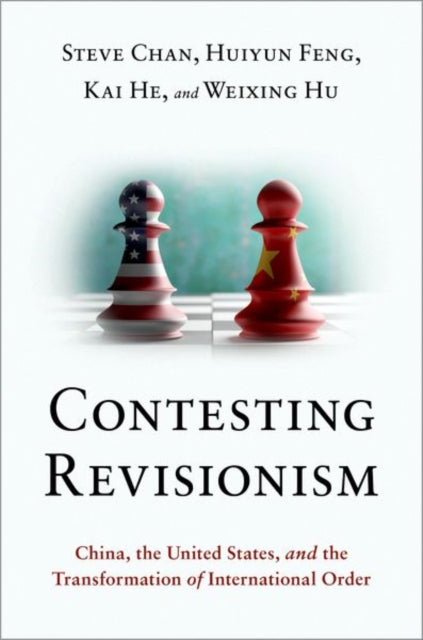
Contesting Revisionism: China, the United States, and the Transformation of International Order
Contesting Revisionism: China, the United States, and the Transformation of International Order
💎 Earn 100 Points (£1.00) on this item.
YOU SAVE £5.89
- Condition: Brand new
- UK Delivery times: Usually arrives within 2 - 3 working days
- UK Shipping: Fee starts at £2.39. Subject to product weight & dimension
Bulk ordering. Want 15 or more copies? Get a personalised quote and bigger discounts. Learn more about bulk orders.
Couldn't load pickup availability
- More about Contesting Revisionism: China, the United States, and the Transformation of International Order
Revisionism is the motivation that drives a state to challenge the existing norms, rules, and institutions of international order. This book offers a critique of the existing discourse on revisionism and investigates the origin and evolution of the foreign policy orientations of revisionist states. It introduces an ensemble of indicators to discern and compare the extent of revisionist tendencies on the part of contemporary China and the United States. The authors argue that hard revisionism relying on war and conquest is less viable and likely in today's world, and that soft revisionism seeking to promote institutional change is more relevant and likely. They conclude with policy recommendations for enhancing international stability and diminishing tension in Sino-American relations.
Format: Paperback / softback
Length: 224 pages
Publication date: 12 October 2021
Publisher: Oxford University Press Inc
Rewritten text:
Introduction:
Contesting Revisionism delves into the complex dynamics of states that challenge the established norms, rules, and institutions of international order, known as revisionism. The book offers a critical examination of the prevailing discourse on revisionism and explores the historical roots and evolving foreign policy orientations of revisionist states. Moreover, it presents a set of indicators to gauge and compare the extent of revisionist tendencies in contemporary China and the United States. By questioning the assumption of historical repetition, the authors argue that hard revisionism, characterized by war and conquest, is less viable and likely in today's interconnected world. Instead, soft revisionism, aimed at promoting institutional change, emerges as a more relevant and promising approach.
Chapter 1:
The authors begin by defining the concept of revisionism and distinguishing it from other forms of state behavior. They explore the historical roots of revisionism, tracing its origins to the aftermath of World War II and the emergence of new political ideologies. The chapter also examines the theoretical frameworks that have been used to understand revisionist behavior, including realism, liberalism, and constructivism.
Chapter 2:
In this chapter, the authors examine the foreign policy orientations of revisionist states in the past. They analyze the case studies of several countries, including the Soviet Union, the United States, and China, to identify the factors that have influenced their revisionist tendencies. The chapter highlights the role of ideology, national security concerns, and economic interests in shaping revisionist policies.
Chapter 3:
Building on the previous chapters, the authors introduce an ensemble of indicators to discern and compare the extent of revisionist tendencies on the part of contemporary China and the United States. These indicators include measures of military spending, foreign policy assertiveness, regional alliances, and diplomatic rhetoric. The chapter analyzes the data collected from these indicators and discusses the implications for understanding the dynamics of Sino-American relations.
Chapter 4:
In this chapter, the authors challenge the facile assumption that past episodes will repeat in the future. They argue that hard revisionism, relying on war and conquest, is less viable and likely in today's interconnected world. Instead, soft revisionism, seeking to promote institutional change, emerges as a more relevant and likely approach. The chapter explores the factors that contribute to the rise international order, including the role of international institutions, norms, and rules.
Chapter 5:
Focusing on contemporary Sino-American relations, the authors conclude that much of the current discourse based on power transition theory is problematic. They argue that a dominant power is not inevitably committed to the defense of international order, nor does a rising power always have a revisionist agenda to challenge this order. The transformation of international order does not necessarily require a power transition between China and the US., nor does a possible power transition necessarily augur war. Instead, the authors suggest that a more nuanced and complex understanding of the dynamics of Sino-American relations is necessary to enhance international stability and diminish tension.
Chapter 6:
In the final chapter, the authors present a series of policy recommendations for enhancing international stability and diminishing tension in Sino-American relations. They emphasize the importance of dialogue, cooperation, and mutual respect between China and the United States. They advocate for building trust through diplomatic channels, promoting regional stability, and addressing common challenges such as climate change and pandemics. The authors also suggest the need for a more balanced and equitable international system that promotes the interests of all states.
Conclusion:
Contesting Revisionism offers a valuable contribution to the study of international relations by providing a comprehensive and nuanced analysis of the factors that drive states to challenge the existing international order. The book the book challenges the assumption of historical repetition and argues that soft revisionism, seeking to promote institutional change, is more relevant and likely in today's interconnected world. By examining the historical roots. The authors provide a valuable contribution to the study of international relations by providing a comprehensive and nuanced analysis of the factors that drive states to challenge the existing international order. The book challenges the assumption of historical repetition and argues that soft revisionism, seeking to promote institutional change, is more relevant and likely in today's interconnected world. By examining the historical roots and evolving foreign policy orientations of revisionist states, the authors offer a valuable contribution to the study of international relations. The book challenges the assumption of historical repetition and argues that soft revisionism, seeking to promote institutional change, is more relevant and likely in today's interconnected world. By examining the historical roots and evolving foreign policy orientations of revisionist states, the authors offer a valuable contribution to the study of international relations. The book challenges the assumption of historical repetition and argues that soft revisionism, seeking to promote institutional change, is more relevant and likely in today's interconnected world. By examining the historical roots and evolving foreign policy orientations of revisionist states, the authors offer a valuable contribution to the study of international relations. The book challenges the assumption of historical repetition and argues that soft revisionism, seeking to promote institutional change, is more relevant and likely in today's interconnected world. By examining the historical roots and evolving foreign policy orientations of revisionist states, the authors offer a valuable contribution to the study of international relations. The book challenges the assumption of historical repetition and argues that soft revisionism, seeking to promote institutional change, is more relevant and likely in today's interconnected world. By examining the historical roots and evolving foreign policy orientations of revisionist states, the authors offer a valuable contribution to the study of international relations.
Weight: 342g
Dimension: 157 x 237 x 15 (mm)
ISBN-13: 9780197580301
This item can be found in:
UK and International shipping information
UK and International shipping information
UK Delivery and returns information:
- Delivery within 2 - 3 days when ordering in the UK.
- Shipping fee for UK customers from £2.39. Fully tracked shipping service available.
- Returns policy: Return within 30 days of receipt for full refund.
International deliveries:
Shulph Ink now ships to Australia, Belgium, Canada, France, Germany, Ireland, Italy, India, Luxembourg Saudi Arabia, Singapore, Spain, Netherlands, New Zealand, United Arab Emirates, United States of America.
- Delivery times: within 5 - 10 days for international orders.
- Shipping fee: charges vary for overseas orders. Only tracked services are available for most international orders. Some countries have untracked shipping options.
- Customs charges: If ordering to addresses outside the United Kingdom, you may or may not incur additional customs and duties fees during local delivery.