Shulph Ink
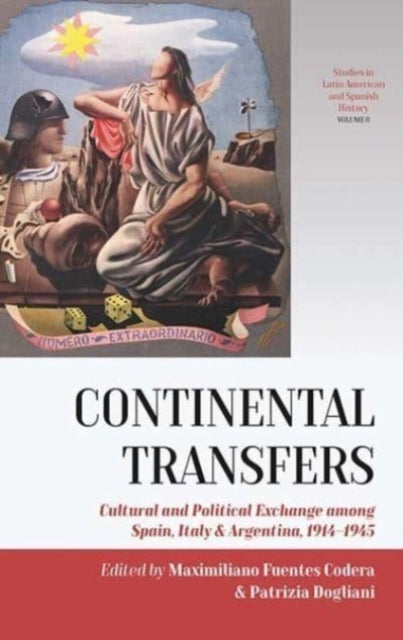
Continental Transfers: Cultural and Political Exchange among Spain, Italy and Argentina, 1914-1945
Continental Transfers: Cultural and Political Exchange among Spain, Italy and Argentina, 1914-1945
💎 Earn 521 Points (£5.21) on this item.
We can order this item for you. Delivery usually takes about 4 to 6 weeks.
This item is not held in our immediate stock. We will order it for you after checkout.
Estimated delivery: About 4 to 6 weeks
- Condition: Brand new
- UK Delivery times: Usually arrives within 2 - 3 working days
- UK Shipping: Fee starts at £2.39. Subject to product weight & dimension
Bulk ordering. Want 15 or more copies? Get a personalised quote and bigger discounts. Learn more about bulk orders.
Couldn't load pickup availability
- More about Continental Transfers: Cultural and Political Exchange among Spain, Italy and Argentina, 1914-1945
During the first half of the twentieth century, Spain, Italy, and Argentina were intertwined in various ways, shaped by distinctive national histories. This collection explores these connections through the lens of "Latinity," highlighting cases of reciprocal exchange such as the influence of Italian Socialism on Hispanophone leftists, the roots of Argentine liberalism in Machiavelli and Spanish Nationalist thinkers, and the web of connections among Italian Fascism, Argentine Nacionalismo, and Spanish Francoism.
Format: Hardback
Length: 212 pages
Publication date: 13 May 2022
Publisher: Berghahn Books
Spanning thousands of miles and shaped by distinct national histories, Spain, Italy, and Argentina were intricately connected in various ways during the first half of the twentieth century. This collection brings together scholars from each nation to explore these intricate historical ties, particularly during the two World Wars. By employing the concept of "Latinity" as a novel analytical framework, it offers a comprehensive and dynamic perspective on cases of reciprocal exchange, encompassing the influence of Italian Socialism on Hispanophone leftists, the roots of Argentine liberalism in Machiavelli and Spanish Nationalist thinkers, and the intricate web of connections between Italian Fascism, Argentine Nacionalismo, and Spanish Francoism.
Introduction:
The countries of Spain, Italy, and Argentina have a rich and complex history that spans centuries. Despite their geographical separation and distinct national narratives, they were intertwined in various ways during the first half of the twentieth century. This collection aims to shed light on these intricate connections, exploring the influence of political ideologies, cultural exchanges, and historical events on shaping the political landscapes of these nations.
Spain:
Spain, with its diverse cultural heritage and historical experiences, played a significant role in shaping the political dynamics of its neighboring countries. The Spanish Civil War (1936-1939) was a pivotal moment in Spanish history, marked by the rise of fascism and the establishment of a dictatorship under Francisco Franco. However, Spain's influence extended beyond its borders, as its political and cultural ideologies had a profound impact on neighboring nations.
For instance, Spanish nationalism and the concept of "la patria" (the homeland) influenced the political movements of countries like Argentina and Chile. The idea of a unified nation-state, with a strong central government and a shared cultural heritage, resonated with Argentinean and Chilean leaders, who sought to establish their own national identities and assert their sovereignty. Spanish literature, music, and art also played a significant role in shaping Argentinean and Chilean cultural identities, contributing to a sense of national pride and identity.
In addition, Spain's involvement in the European theater of World War II had significant consequences for its neighboring countries. The Spanish Civil War and the subsequent Francoist regime provided a breeding ground for fascist ideologies and authoritarianism, which later spread to other parts of the world. The Spanish military intervention in the Greek Civil War (1946-1949) and the Portuguese Colonial War (1961-1974) also had a lasting impact on the political and social landscapes of these countries.
Italy:
Italy, another Mediterranean nation with a rich history and cultural heritage, also had a significant impact on its neighboring countries. Italian Socialism, particularly during the interwar period, had a profound influence on the political movements of Hispanophone leftists. The ideas of social justice, equality, and worker empowerment resonated with Latin American leaders, who sought to establish socialist regimes in their respective countries.
For example, the Cuban Revolution (1959) was heavily influenced by Italian Socialism, with Fidel Castro and other Cuban leaders drawing inspiration from Italian socialist thinkers like Antonio Gramsci and Karl Marx. Italian literature, music, and art also played a significant role in shaping Cuban cultural identity, contributing to a sense of national pride and identity.
However, Italian fascism also had a significant impact on the political landscape of Argentina and other Latin American countries. The rise. Benito Mussolini's rise to power in Italy and his alliance with Adolf ******'s **** Germany led to the establishment of fascist regimes in several Latin American countries, including Argentina, Chile, and Peru. The policies of fascism, including authoritarianism, nationalism, and militarism, had a profound impact on the political and social landscapes of these countries, leading to the suppression of civil liberties, the persecution of political opponents, and the establishment of authoritarian regimes.
Argentina:
Argentina, a nation with a rich history of political instability and social unrest, also had a significant impact on its neighboring countries. Argentine liberalism, particularly during the late nineteenth and early twentieth centuries, was influenced by a range of political and cultural factors, including Spanish Nationalist thinkers, Italian fascism, and the ideas of the French Revolution.
For instance, the Argentinean Constitution of 1853, which established a federal government and guaranteed civil liberties, was heavily influenced by Spanish Nationalist thinkers. The ideas of democracy, social justice, and individual rights also resonated with Argentinean liberals, who sought to establish a more democratic and inclusive political system. Argentine liberalism also had a significant impact on the political movements of other Latin American countries, particularly during the early twentieth century.
However, Argentine liberalism also faced challenges and setbacks, particularly during the late nineteenth and early twentieth centuries. The rise of authoritarianism and the establishment of military dictators. Juan Perón and his wife, Eva Perón, led to the establishment of a dictatorship in Argentina, which had a profound impact on the political and social landscapes of the country. The policies of Perón's regime, including nationalization of industries, the establishment of welfare programs, and the suppression of civil liberties, had a significant impact on the political and social landscapes of Argentina and other Latin American countries, leading to the establishment of authoritarian regimes.
Conclusion:
In conclusion, the countries of Spain, Italy, and Argentina were intertwined in a variety of ways during the first half of the twentieth century, shaped by distinctive national histories, political ideologies, cultural exchanges, and historical events. This collection brings together scholars from each nation to explore these complex historical connections, shedding light on the influence of political ideologies, cultural exchanges, and historical events on shaping the political landscapes of these nations. By employing the concept of "Latinity" as a novel analytical framework, it offers a comprehensive and dynamic perspective on cases of reciprocal exchange, encompassing the influence of Italian Socialism on Hispanophone leftists, the roots of Argentine liberalism in Machiavelli and Spanish Nationalist thinkers, and the intricate web of connections between Italian Fascism, Argentine Nacionalismo, and Spanish Francoism.
Dimension: 229 x 152 (mm)
ISBN-13: 9781800733398
UK and International shipping information
UK and International shipping information
UK Delivery and returns information:
- Delivery within 2 - 3 days when ordering in the UK.
- Shipping fee for UK customers from £2.39. Fully tracked shipping service available.
- Returns policy: Return within 30 days of receipt for full refund.
International deliveries:
Shulph Ink now ships to Australia, Belgium, Canada, France, Germany, Ireland, Italy, India, Luxembourg Saudi Arabia, Singapore, Spain, Netherlands, New Zealand, United Arab Emirates, United States of America.
- Delivery times: within 5 - 10 days for international orders.
- Shipping fee: charges vary for overseas orders. Only tracked services are available for most international orders. Some countries have untracked shipping options.
- Customs charges: If ordering to addresses outside the United Kingdom, you may or may not incur additional customs and duties fees during local delivery.