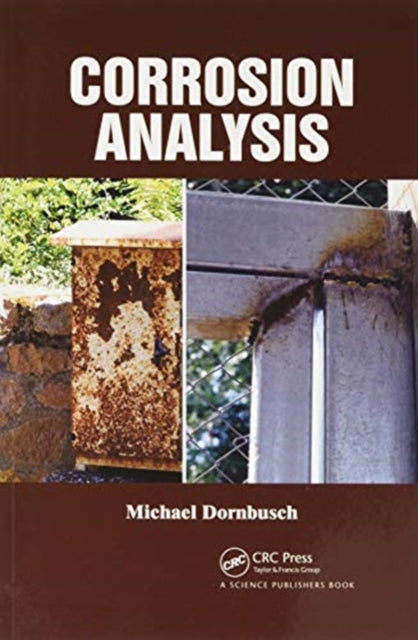
Michael Dornbusch
Corrosion Analysis
Corrosion Analysis
YOU SAVE £4.75
- Condition: Brand new
- UK Delivery times: Usually arrives within 2 - 3 working days
- UK Shipping: Fee starts at £3.89. Subject to product weight & dimension
Bulk ordering. Want 15 or more copies? Get a personalised quote and bigger discounts. Learn more about bulk orders.
Couldn't load pickup availability
- More about Corrosion Analysis
The book provides an overview of electrochemical and spectroscopic methods used in corrosion research, correlating them with industrial test methods for organic coatings and conversion layers.
Format: Paperback / softback
Length: 328 pages
Publication date: 31 March 2021
Publisher: Taylor & Francis Ltd
The book provides a comprehensive overview of various electrochemical and spectroscopic methods employed in corrosion research. In addition to their proper application and interpretation, these methods are closely linked to industrial testing procedures for organic coatings and conversion layers.
The first chapter delves into the fundamentals of electrochemistry, covering topics such as electrode materials, electrochemical cells, and electrochemical reactions. It explains the principles behind electrochemical measurements and their applications in corrosion research.
The second chapter explores spectroscopic techniques, including infrared spectroscopy, ultraviolet-visible spectroscopy, X-ray photoelectron spectroscopy, and Raman spectroscopy. It discusses the advantages and limitations of each method and how they are used to analyze the composition, structure, and properties of corrosion products and coatings.
The third chapter focuses on the application of electrochemical and spectroscopic methods in studying the corrosion behavior of metals and alloys. It discusses the factors that influence corrosion, such as temperature, humidity, pH, and chemical species present in the environment. The chapter also covers the methods used to evaluate the corrosion resistance of materials, such as electrochemical impedance spectroscopy, potentiodynamic polarization, and electrochemical cyclic voltammetry.
The fourth chapter explores the use of electrochemical and spectroscopic methods in monitoring the degradation and performance of coatings and conversion layers. It discusses the techniques used to detect the presence of degradation products, such as water, oxygen, and carbon dioxide, and the methods used to evaluate the durability and longevity of coatings.
The fifth chapter discusses the theoretical aspects of electrochemical and spectroscopic methods in corrosion research. It covers the principles of electrochemistry, including the redox reactions, electron transfer processes, and surface chemistry. The chapter also discusses the theoretical models used to interpret the data obtained from electrochemical and spectroscopic measurements.
The final chapter provides an overview of the current trends and developments in electrochemical and spectroscopic methods in corrosion research. It discusses the emerging technologies and techniques, such as electrochemical sensors, microelectrodes, and machine learning, that are being used to improve the accuracy and efficiency of corrosion analysis.
In conclusion, the book offers a comprehensive and up-to-date introduction to electrochemical and spectroscopic methods in corrosion research. It is an invaluable resource for researchers, engineers, and students interested in understanding the mechanisms of corrosion, developing new corrosion-resistant materials, and improving the performance of existing coatings and conversion layers.
The book provides a comprehensive and up-to-date introduction to electrochemical and spectroscopic methods in corrosion research. It is an invaluable resource for researchers, engineers, and students interested in understanding the mechanisms of corrosion, developing new corrosion-resistant materials, and improving the performance of existing coatings and conversion layers.
The first chapter delves into the fundamentals of electrochemistry, covering topics such as electrode materials, electrochemical cells, and electrochemical reactions. It explains the principles behind electrochemical measurements and their applications in corrosion research.
The second chapter explores spectroscopic techniques, including infrared spectroscopy, ultraviolet-visible spectroscopy, X-ray photoelectron spectroscopy, and Raman spectroscopy. It discusses the advantages and limitations of each method and how they are used to analyze the composition, structure, and properties of corrosion products and coatings.
The third chapter focuses on the application of electrochemical and spectroscopic methods in studying the corrosion behavior of metals and alloys. It discusses the factors that influence corrosion, such as temperature, humidity, pH, and chemical species present in the environment. The chapter also covers the methods used to evaluate the corrosion resistance of materials, such as electrochemical impedance spectroscopy, potentiodynamic polarization, and electrochemical cyclic voltammetry.
The fourth chapter explores the use of electrochemical and spectroscopic methods in monitoring the degradation and performance of coatings and conversion layers. It discusses the techniques used to detect the presence of degradation products, such as water, oxygen, and carbon dioxide, and the methods used to evaluate the durability and longevity of coatings.
The fifth chapter discusses the theoretical aspects of electrochemical and spectroscopic methods in corrosion research. It covers the principles of electrochemistry, including the redox reactions, electron transfer processes, and surface chemistry. The chapter also discusses the theoretical models used to interpret the data obtained from electrochemical and spectroscopic measurements.
The final chapter provides an overview of the current trends and developments in electrochemical and spectroscopic methods in corrosion research. It discusses the emerging technologies and techniques, such as electrochemical sensors, microelectrodes, and machine learning, that are being used to improve the accuracy and efficiency of corrosion analysis.
Weight: 621g
Dimension: 234 x 156 (mm)
ISBN-13: 9780367780814
UK and International shipping information
UK and International shipping information
We deliver throughout the United Kingdom and to 128 countries and territories worldwide, including the United States, Australia, Canada, Germany, Spain and France.