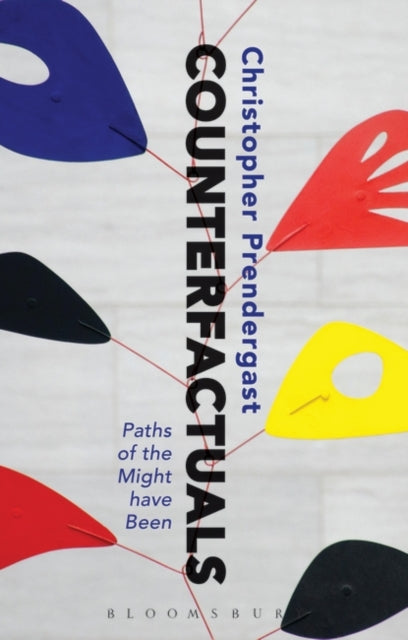
Christopher Prendergast
Counterfactuals: Paths of the Might have Been
Counterfactuals: Paths of the Might have Been
💎 Earn 107 Points (£1.07) on this item.
YOU SAVE £4.53
- Condition: Brand new
- UK Delivery times: Usually arrives within 2 - 3 working days
- UK Shipping: Fee starts at £2.39. Subject to product weight & dimension
Bulk ordering. Want 15 or more copies? Get a personalised quote and bigger discounts. Learn more about bulk orders.
Couldn't load pickup availability
- More about Counterfactuals: Paths of the Might have Been
Counterfactuals are a way of thinking about the past or the future that assumes that something different could have happened than what actually did happen. They can be useful in many fields, such as science, history, and philosophy, but they can also be dangerous if people use them to escape reality or to make excuses for their behavior.
\n Format: Paperback / softback
\n Length: 272 pages
\n Publication date: 04 April 2019
\n Publisher: Bloomsbury Publishing PLC
\n
Counterfactuals are a fascinating concept that has been explored in various disciplines, including philosophy, history, cosmology, biology, cognitive psychology, jurisprudence, economics, art history, literary theory, and even everyday human life. They are scenarios that imagine what would have happened if a certain event or condition had not occurred. While some may argue that counterfactuals are useless and exist only in the realm of fantasy, they actually serve a valuable purpose in helping us understand the world and make informed decisions.
In philosophy, counterfactuals are used to explore the nature of free will, determinism, and the possibility of alternate universes. For example, one might consider what would have happened if a particular decision had been made differently. Counterfactuals can also help us understand the consequences of our actions and the potential outcomes of different choices.
In history, counterfactuals are used to analyze historical events and understand how they might have unfolded differently. By examining what might have happened if certain events had not occurred, historians can gain a deeper understanding of the past and how it has shaped the present.
In cosmology, counterfactuals are used to explore the possibility of alternate universes and the laws of physics that govern the universe. By imagining what would have happened if the Big Bang had occurred differently or if the universe had different physical laws, scientists can gain a better understanding of the universe and its origins.
In biology, counterfactuals are used to explore the evolution of species and the factors that have influenced their survival. By examining what would have happened if certain events had not occurred, scientists can gain a better understanding of the mechanisms that drive evolution and how species have adapted to their environments.
In cognitive psychology, counterfactuals are used to study decision-making and the factors that influence our choices. By imagining what would have happened if we had made different choices, researchers can gain a better understanding of how we make decisions and how we can improve our decision-making skills.
In jurisprudence, counterfactuals are used to analyze legal cases and determine the outcome of different legal decisions. By examining what would have happened if certain events had not occurred, judges can gain a better understanding of the law and how it applies to different situations.
In economics, counterfactuals are used to analyze economic policies and their effects on the economy. By imagining what would have happened if certain policies had not been implemented, economists can gain a better understanding of the economic consequences of different policies and how they can improve economic outcomes.
In art history, counterfactuals are used to analyze artistic works and understand their historical context. By examining what would have happened if certain events had not occurred, art historians can gain a better understanding of the artistic movements and how they have influenced society.
In literary theory, counterfactuals are used to analyze literary works and understand their meaning and significance. By examining what would have happened if certain events had not occurred, literary scholars can gain a better understanding of the literary movements and how they have shaped literature.
In everyday human life, counterfactuals are used to imagine what might have happened if we had made different choices or if certain events had not occurred. They can be used to reflect on our past decisions and to learn from our mistakes. They can also be used to imagine different scenarios and to plan for the future.
Despite their usefulness, counterfactuals can also be treacherous. They can lead us to overestimate our ability to control the future or to underestimate the importance of certain events. They can also be used to justify our actions or to blame others for our mistakes.
In conclusion, counterfactuals are a fascinating concept that has been explored in various disciplines and has a valuable purpose in helping us understand the world and make informed decisions. While they can be treacherous, they can also be used to gain a deeper understanding of the past, present, and future. Whether as help or hindrance, and with many variations across cultures, counterfactual thinking and imagining are fundamental to what it is to be human.
\n Weight: 360g\n
Dimension: 138 x 214 x 26 (mm)\n
ISBN-13: 9781350090095\n \n
UK and International shipping information
UK and International shipping information
UK Delivery and returns information:
- Delivery within 2 - 3 days when ordering in the UK.
- Shipping fee for UK customers from £2.39. Fully tracked shipping service available.
- Returns policy: Return within 30 days of receipt for full refund.
International deliveries:
Shulph Ink now ships to Australia, Belgium, Canada, France, Germany, Ireland, Italy, India, Luxembourg Saudi Arabia, Singapore, Spain, Netherlands, New Zealand, United Arab Emirates, United States of America.
- Delivery times: within 5 - 10 days for international orders.
- Shipping fee: charges vary for overseas orders. Only tracked services are available for most international orders. Some countries have untracked shipping options.
- Customs charges: If ordering to addresses outside the United Kingdom, you may or may not incur additional customs and duties fees during local delivery.