Dr. ManuSehgal
Creating an Early Colonial Order: Conquest and Contestation in South Asia, c.1775-1807
Creating an Early Colonial Order: Conquest and Contestation in South Asia, c.1775-1807
💎 Earn 262 Points (£2.62) on this item.
- Condition: Brand new
- UK Delivery times: Usually arrives within 2 - 3 working days
- UK Shipping: Fee starts at £2.39. Subject to product weight & dimension
Bulk ordering. Want 15 or more copies? Get a personalised quote and bigger discounts. Learn more about bulk orders.
Couldn't load pickup availability
- More about Creating an Early Colonial Order: Conquest and Contestation in South Asia, c.1775-1807
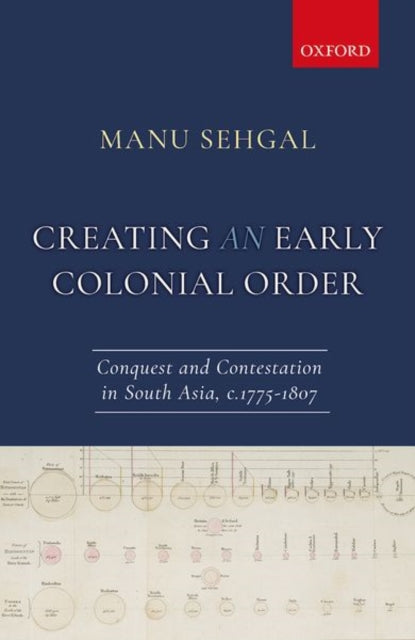
The East India Company's violent conquest of South Asia in the eighteenth century established a unique colonial order characterized by financial crises, new laws, ideological innovations, sovereignty changes, and the military's dominance over civilian power. This order was followed by the authoritarian British Raj, which continues to influence postcolonial South Asian polities. Manu Sehgal's book is the first full-length study of how coercive structures of authority originated in this early, missing chapter of modern South Asian history.
Format: Hardback
Length: 336 pages
Publication date: 13 December 2021
Publisher: OUP India
By the end of the eighteenth century, a profound transformation had taken place in South Asia, marked by the emergence of war-making and the violent conquest orchestrated by the East India Company. This period witnessed the establishment of an early colonial order that was characterized by a unique set of features. Firstly, the political economy of conquest became central to this order, with repeated financial crises, a new regime of laws, and ideological innovations that justified expensive warfare. The concept of sovereignty underwent a significant shift, with military power being prioritized over civilian authority. Furthermore, this early colonial order gave rise to an authoritarian and militarily dominant British Raj, which continued to exert a profound influence on postcolonial South Asian polities.
To understand the origins and consequences of this early colonial order, Manu Sehgal has undertaken an important intervention in historiographical debates. Through a meticulous examination of a diverse range of archival documents and subsequent studies, Sehgal sheds light on the overlooked chapter of modern South Asia's history. This work stands as the first comprehensive study of how coercive structures of authority emerged from this early period, providing a valuable contribution to our understanding of the region's complex past.
The establishment of the early colonial order in South Asia had far-reaching consequences that continue to shape the region today. The political economy of conquest, characterized by financial instability and the pursuit of territorial expansion, led to the exploitation of resources and the displacement of local populations. The new regime of laws, designed to maintain control and suppress resistance, further entrenched inequality and oppression. Moreover, the ideological innovations that justified warfare created a culture of militarism and violence that permeated society.
The authoritarian and militarily dominant British Raj that followed this early colonial order further solidified the dominance of military over civilian power. The Raj's policies of colonization, land confiscation, and the imposition of taxes on local communities exacerbated the economic and social disparities that had been established. The legacy of the Raj's rule continues to be felt in South Asia, with its impact on political institutions, social structures, and cultural identities.
In conclusion, the eighteenth century marked a pivotal period in South Asia's history, characterized by war-making, the East India Company's conquest, and the establishment of an early colonial order. This order was marked by a political economy of conquest, the prioritization of military power, the emergence of authoritarianism, and the profound influence of the British Raj. Manu Sehgal's important intervention in historiographical debates sheds light on the origins and consequences of this early colonial order, providing a valuable contribution to our understanding of the region's complex past. The legacy of this period continues to shape South Asia's political, economic, and social landscape, and it is essential to confront its historical implications to move towards a more inclusive and equitable future.
Weight: 412g
Dimension: 150 x 221 x 28 (mm)
ISBN-13: 9780190124502
This item can be found in:
UK and International shipping information
UK and International shipping information
UK Delivery and returns information:
- Delivery within 2 - 3 days when ordering in the UK.
- Shipping fee for UK customers from £2.39. Fully tracked shipping service available.
- Returns policy: Return within 30 days of receipt for full refund.
International deliveries:
Shulph Ink now ships to Australia, Belgium, Canada, France, Germany, Ireland, Italy, India, Luxembourg Saudi Arabia, Singapore, Spain, Netherlands, New Zealand, United Arab Emirates, United States of America.
- Delivery times: within 5 - 10 days for international orders.
- Shipping fee: charges vary for overseas orders. Only tracked services are available for most international orders. Some countries have untracked shipping options.
- Customs charges: If ordering to addresses outside the United Kingdom, you may or may not incur additional customs and duties fees during local delivery.