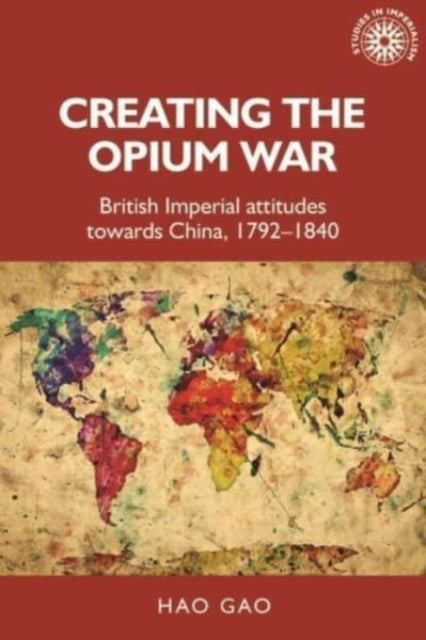
Hao Gao
Creating the Opium War: British Imperial Attitudes Towards China, 1792-1840
Creating the Opium War: British Imperial Attitudes Towards China, 1792-1840
💎 Earn 132 Points (£1.32) on this item.
We can order this item for you. Delivery usually takes about 4 to 6 weeks.
This item is not held in our immediate stock. We will order it for you after checkout.
Estimated delivery: About 4 to 6 weeks
YOU SAVE £3.45
- Condition: Brand new
- UK Delivery times: Usually arrives within 2 - 3 working days
- UK Shipping: Fee starts at £2.39. Subject to product weight & dimension
Bulk ordering. Want 15 or more copies? Get a personalised quote and bigger discounts. Learn more about bulk orders.
Couldn't load pickup availability
- More about Creating the Opium War: British Imperial Attitudes Towards China, 1792-1840
Creating the Opium War explores British imperial attitudes towards China from the Macartney embassy to the outbreak of the Opium War, revealing how the idea of war was created out of changing British perceptions of the country.
Format: Paperback / softback
Length: 224 pages
Publication date: 30 March 2022
Publisher: Manchester University Press
Creating the Opium War delves into the intricate tapestry of British imperial attitudes towards China during their initial encounters, spanning from the Macartney embassy to the outbreak of the Opium War, a momentous event that irrevocably shaped the course of relations between China and the West for the ensuing century. This groundbreaking work pioneers a novel approach by seamlessly merging the political history of Sino-western relations with the cultural studies of British representations of China, offering a fresh perspective on the origins of this conflict. Focusing on a pivotal period (1792–1840), which scholars like Kitson and Markley have recently recognized as of equal significance to the American and French Revolutions, the book uncovers the intricate process by which the notion of war against China emerged from evolving British perceptions of the country. Through a meticulous examination of a vast array of primary materials, some of which are presented in greater detail than ever before, this study unveils the intricate web of factors that contributed to the buildup of tensions and ultimately led to the outbreak of the Opium War.
The Macartney embassy marked the initial foray into Chinese territory by a British envoy, and it set the stage for a series of diplomatic interactions that would shape the future relationship between the two nations. The embassy's mission was to establish peaceful trade relations and secure British interests in China, but it quickly became entangled in complex political negotiations. The British government, driven by a desire for economic expansion and access to Chinese markets, sought to establish trade agreements that would favor British merchants. However, the Chinese government, wary of foreign influence and concerned about the potential impact of Western technology and culture on its society, resisted these attempts.
The tensions between the two countries escalated further with the arrival of British naval forces in Chinese waters in 1839. The British claimed that their ships were engaged in peaceful trade missions, but the Chinese government viewed them as an invasion. The Opium War, which erupted in 1839, was a result of these escalating tensions. The British government, supported by private British merchants who stood to profit from the opium trade, launched a military campaign against China to force the country to open its borders and allow the import of opium.
The Opium War was a devastating conflict that lasted for over a decade and had far-reaching consequences for both China and the West. The Chinese government was forced to cede territory and pay heavy reparations to the British, which contributed to the country's economic and political instability. The war also led to the spread of Western culture and technology in China, which had a profound impact on the country's society and economy.
On the other hand, the Opium War also had significant consequences for the British Empire. The war strained relations with other European powers, particularly France and Russia, and it led to a decline in British prestige and influence in the region. The war also exposed the brutality and corruption of the British military, which was criticized by many in Britain and abroad.
The aftermath of the Opium War marked a turning point in Sino-western relations. The Chinese government, under the leadership of Qianlong Emperor, implemented a series of reforms aimed at modernizing the country and reducing its dependence on foreign trade. The Chinese government also began to restrict the import of opium, which had become a major source of income for British merchants.
In conclusion, Creating the Opium War is a groundbreaking work that offers a fresh perspective on the origins of the Sino-western conflict. By merging political history with cultural studies, the book sheds light on the complex web of factors that led to the outbreak of the Opium War and its long-lasting consequences for China and the West. The book's focus on a pivotal period in Sino-western relations, which scholars have recently recognized as of equal significance to the American and French Revolutions, makes it an essential read for anyone interested in understanding the complex dynamics of this historical relationship.
Weight: 344g
Dimension: 156 x 233 x 15 (mm)
ISBN-13: 9781526163653
UK and International shipping information
UK and International shipping information
UK Delivery and returns information:
- Delivery within 2 - 3 days when ordering in the UK.
- Shipping fee for UK customers from £2.39. Fully tracked shipping service available.
- Returns policy: Return within 30 days of receipt for full refund.
International deliveries:
Shulph Ink now ships to Australia, Belgium, Canada, France, Germany, Ireland, Italy, India, Luxembourg Saudi Arabia, Singapore, Spain, Netherlands, New Zealand, United Arab Emirates, United States of America.
- Delivery times: within 5 - 10 days for international orders.
- Shipping fee: charges vary for overseas orders. Only tracked services are available for most international orders. Some countries have untracked shipping options.
- Customs charges: If ordering to addresses outside the United Kingdom, you may or may not incur additional customs and duties fees during local delivery.