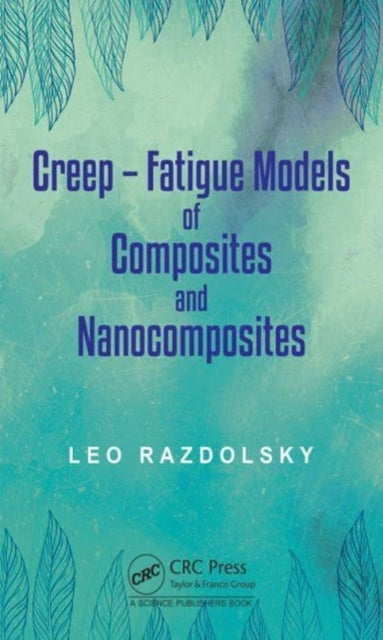
Leo Razdolsky
Creep: Fatigue Models of Composites and Nanocomposites
Creep: Fatigue Models of Composites and Nanocomposites
💎 Earn 811 Points (£8.11) on this item.
We can order this item for you. Delivery usually takes about 4 to 6 weeks.
This item is not held in our immediate stock. We will order it for you after checkout.
Estimated delivery: About 4 to 6 weeks
YOU SAVE £9.63
- Condition: Brand new
- UK Delivery times: Usually arrives within 2 - 3 working days
- UK Shipping: Fee starts at £2.39. Subject to product weight & dimension
Bulk ordering. Want 15 or more copies? Get a personalised quote and bigger discounts. Learn more about bulk orders.
Couldn't load pickup availability
- More about Creep: Fatigue Models of Composites and Nanocomposites
The application of composites and nanocomposites has been increasing in industries such as aerospace, automotive, marine, and civil engineering. The study of structural strength under cyclic loading has gained much attention, especially in aircraft manufacturing, power engineering, aviation, and rocket technology. New phenomenological cyclic creep – fatigue models have been developed to describe the fatigue life and behavior of time-dependent composites and nanocomposites. These models reflect the oscillatory nature of the fatigue process and are supported by practical design examples.
Format: Hardback
Length: 228 pages
Publication date: 04 August 2023
Publisher: Taylor & Francis Ltd
In recent years, the application of composites and nanocomposites has witnessed a remarkable surge in industries like aerospace, automotive, marine, and civil engineering. This field is considered one of the most complex and critical aspects of the mechanics of deformable solids, primarily due to the emergence of several specific phenomena and analytical factors associated with cyclic loading. The primary challenges revolve around the development of fatigue damage and the assessment of cyclic and structural instability in composite and nanocomposite materials. The study of structural strength under cyclic loading has garnered significant attention, particularly in areas such as aircraft manufacturing, power engineering, aviation, and rocket technology. Cyclic loading significantly reduces the creep-fatigue lifespan across the entire frequency range. It becomes evident that traditional design criteria, such as endurance limit, static creep limits, and long-term static strength, may not be sufficient to predict the fatigue life of these materials. Consequently, new aspects have emerged in the realm of high-temperature strength, including cyclical creep and long-term cyclic strength. These developments have led to the creation of innovative methods and tools for determining the resistance of composites and nanocomposites materials and the progression of continuum damage under cyclic loading.
One particularly relevant area is the intensification of creep by high-frequency cyclic loading in composite materials, which often occurs at high temperatures. Most studies in this field are experimental, and the direct use of the number of cycles to define damage models cannot fully escape the empirical relation that accurately predicts multi-stress level fatigue life. To address these challenges, the book presents novel phenomenological cyclic creep – fatigue models that aim to describe the fatigue life and behavior of time-dependent composites and nano. These models incorporate advanced mathematical techniques and consider the influence of various factors, such as microstructure, damage initiation, and growth, on the fatigue performance of these materials. By employing these models, researchers and practitioners can gain a deeper understanding of the fatigue behavior of composites and nanocomposites and develop more accurate and reliable prediction methods.
In conclusion, the application of composites and nanocomposites has revolutionized various industries, and the study of structural strength under cyclic loading has become increasingly important. The development of new phenomenological cyclic creep – fatigue models has provided valuable insights into the fatigue life and behavior of time-dependent composites and nano. These models offer a promising approach for improving the design and performance of these materials in demanding applications. As research in this field continues to advance, it is anticipated that composites and nanocomposites will play an even more significant role in shaping the future of transportation, energy, and other industries.
Dimension: 234 x 156 (mm)
ISBN-13: 9781032213019
This item can be found in:
UK and International shipping information
UK and International shipping information
UK Delivery and returns information:
- Delivery within 2 - 3 days when ordering in the UK.
- Shipping fee for UK customers from £2.39. Fully tracked shipping service available.
- Returns policy: Return within 30 days of receipt for full refund.
International deliveries:
Shulph Ink now ships to Australia, Belgium, Canada, France, Germany, Ireland, Italy, India, Luxembourg Saudi Arabia, Singapore, Spain, Netherlands, New Zealand, United Arab Emirates, United States of America.
- Delivery times: within 5 - 10 days for international orders.
- Shipping fee: charges vary for overseas orders. Only tracked services are available for most international orders. Some countries have untracked shipping options.
- Customs charges: If ordering to addresses outside the United Kingdom, you may or may not incur additional customs and duties fees during local delivery.