Shulph Ink
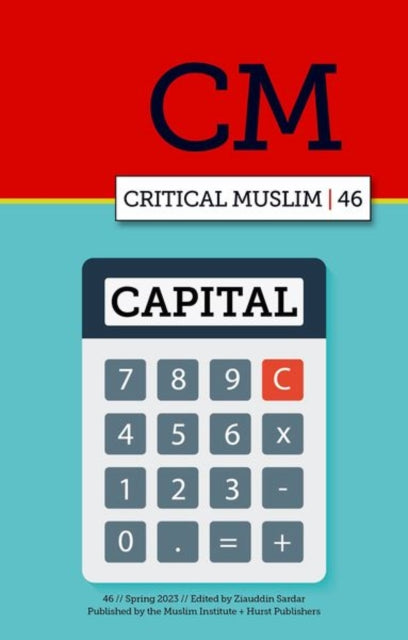
Critical Muslim 46: Capital
Critical Muslim 46: Capital
We can order this item for you. Delivery usually takes about 4 to 6 weeks.
This item is not held in our immediate stock. We will order it for you after checkout.
Estimated delivery: About 4 to 6 weeks
YOU SAVE £4.04
- Condition: Brand new
- UK Delivery times: Usually arrives within 2 - 3 working days
- UK Shipping: Fee starts at £3.89. Subject to product weight & dimension
Bulk ordering. Want 15 or more copies? Get a personalised quote and bigger discounts. Learn more about bulk orders.
Couldn't load pickup availability
- More about Critical Muslim 46: Capital
This issue explores the 300th birthday of Adam Smith and considers capital as acquisition, mentality, a place to live, and a severely unjust basis upon which we seem to exist. It asks if the system can hold and what might lie beyond a capital state of mind.
Format: Paperback / softback
Length: 256 pages
Publication date: 29 June 2023
Publisher: C Hurst & Co Publishers Ltd
Adam Smith, often referred to as the "Father of Capitalism," is celebrating his 300th birthday in 2023. Capital is commonly believed to be the driving force behind the world's economy, but this issue delves into the fact that it is not the sole framework we can employ to organize interactions, transactions, and the pursuit of our livelihoods. As we navigate the complexities of our ever-evolving world, capitalism oscillates between being hailed as a hero and vilified as a villain. This issue explores capital in various aspects, including its acquisition, mentality, role in shaping our living spaces, and its perceived unjust foundation upon which our existence seems to rest. Amidst the ongoing permacrisis that engulfs our planet, capitalism appears to be inadequate for addressing the challenges we face. It vacillates between being a savior and a perpetrator, adding further complexity to our global landscape.
This issue delves into the question of whether the current capital system can sustain itself and what possibilities exist beyond a capital-centric mindset. It encourages us to consider alternative structures and frameworks that can better align with our values, aspirations, and the needs of our interconnected world.
One aspect of capital that this issue examines is its acquisition. Capital is often seen as a means of accumulating wealth and power, but it can also be viewed as a tool for social and economic empowerment. By understanding the mechanisms of capital acquisition and distribution, we can explore how individuals and communities can leverage capital to achieve their goals and promote social justice.
Another dimension of capital is its mentality. Capitalism has been associated with individualism, competition, and a pursuit of profit at all costs. However, this issue challenges the notion that capital is solely driven by these motives and suggests that other factors, such as values, culture, and social norms, also play a significant role in shaping how capital is perceived and used.
Capital also plays a crucial role in shaping our living spaces. The development of cities, infrastructure, and technological advancements are all driven by capital investment. However, this issue raises concerns about the environmental impact of capital-driven development and the unequal distribution of its benefits. It encourages us to consider alternative approaches to urban planning and development that prioritize sustainability, social equity, and community well-being.
Furthermore, this issue explores the perceived unjust basis upon which capital exists. Capitalism is often criticized for perpetuating inequality, exploitation, and the concentration of wealth in the hands of a few. It raises questions about the role of government, regulation, and social policies in ensuring that capital is used for the benefit of society as a whole rather than just a select few.
In conclusion, as we celebrate the 300th birthday of Adam Smith, it is important to recognize that capital is not the only structure we can use to organize our interactions, transactions, and the business of conducting our lives. The permacrisis that engulfs our planet highlights the limitations of capitalism and encourages us to explore alternative frameworks that can better align with our values, aspirations, and the needs of our interconnected world. By examining capital in various aspects, including its acquisition, mentality, role in shaping our living spaces, and its perceived unjust basis, we can develop a more comprehensive understanding of the challenges we face and work towards creating a more just and sustainable future.
Dimension: 216 x 138 (mm)
ISBN-13: 9781805260479
UK and International shipping information
UK and International shipping information
We deliver throughout the United Kingdom and to 128 countries and territories worldwide, including the United States, Australia, Canada, Germany, Spain and France.