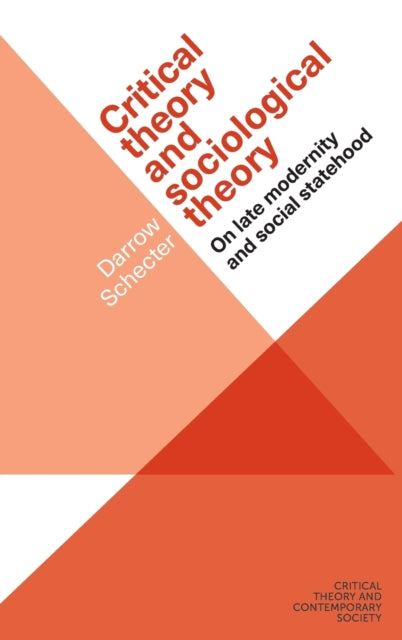
Darrow Schecter
Critical Theory and Sociological Theory: On Late Modernity and Social Statehood
Critical Theory and Sociological Theory: On Late Modernity and Social Statehood
💎 Earn 354 Points (£3.54) on this item.
We can order this item for you. Delivery usually takes about 4 to 6 weeks.
This item is not held in our immediate stock. We will order it for you after checkout.
Estimated delivery: About 4 to 6 weeks
YOU SAVE £9.20
- Condition: Brand new
- UK Delivery times: Usually arrives within 2 - 3 working days
- UK Shipping: Fee starts at £2.39. Subject to product weight & dimension
Bulk ordering. Want 15 or more copies? Get a personalised quote and bigger discounts. Learn more about bulk orders.
Couldn't load pickup availability
- More about Critical Theory and Sociological Theory: On Late Modernity and Social Statehood
Populism, neoliberalism, and globalization pose significant challenges to democracy in the twenty-first century. This book investigates how the conditions of democratic statehood have been altered since 1945 and demonstrates the importance of a sociological approach to address these challenges. It emphasizes the need to complement and update the formal mechanisms of democratic statehood to ensure its sustainability.
Format: Hardback
Length: 256 pages
Publication date: 29 July 2019
Publisher: Manchester University Press
Democracy in the twenty-first century is confronted with a multitude of significant challenges, including populism, neoliberalism, and globalization. This book delves into these challenges by examining how the conditions of democratic statehood have undergone significant transformations at crucial historical junctures since 1945. It underscores that the formal mechanisms of democratic statehood, such as elections, have consistently been complemented by civic, cultural, educational, socio-economic, and constitutional institutions that serve as intermediaries between citizens and state authority. By reinterpreting critical theory in a contemporary context, the book highlights the urgent need for a sociological approach to address conceptual deficiencies and propose innovative ways to complement and update the formal mechanisms of democratic statehood in the present day.
Populism, neoliberalism, and globalization are just a few of the enormous difficulties that democracy confronts in the twenty-first century. This book explores these difficulties by looking at how the conditions of democratic statehood have changed at important historical turning points since 1945. It emphasizes that the formal institutions of democratic statehood, such as elections, have always been supported by civic, cultural, educational, socioeconomic, and constitutional institutions that act as intermediaries between citizens and state authority. By reinterpreting critical theory in a contemporary light, the book underscores the urgent need for a sociological perspective to address conceptual gaps and propose innovative ways to complement and update the formal institutions of democratic statehood in the present day.
The book demonstrates that the conditions of democratic statehood have been altered at several key historical intervals since 1945, including the rise of authoritarianism, the decline of labor movements, and the emergence of new technologies. It argues that these changes have had a profound impact on the functioning of democratic states and that a sociological approach is necessary to understand the challenges and opportunities that democracy faces in the twenty-first century.
One of the key findings of the book is that the formal mechanisms of democratic statehood, such as elections, are not sufficient to ensure the stability and legitimacy of democratic systems. Instead, civic, cultural, educational, socioeconomic, and constitutional institutions are essential to mediate between citizens and state authority. These institutions play a crucial role in shaping public opinion, promoting social cohesion, and protecting individual rights and freedoms.
However, the book also notes that these institutions have been under threat in recent years, particularly in the context of populism, neoliberalism, and globalization. Populism has been characterized by the rise of authoritarian leaders who use populist rhetoric to appeal to the concerns of ordinary people and undermine the legitimacy of democratic institutions. Neoliberalism has promoted market-driven economic policies that have led to inequality, social exclusion, and the concentration of wealth in the hands of a few. Globalization has facilitated the spread of authoritarianism and the erosion of national sovereignty.
In response to these challenges, the book proposes a number of innovative strategies for complementing and updating the formal mechanisms of democratic statehood. One of these strategies is the promotion of civic education and engagement. By educating citizens about the importance of democratic institutions and their role in shaping society, we can help to promote a more informed and engaged electorate. This can also help to counter the rise of populism by promoting a sense of shared responsibility and belonging among citizens.
Another strategy is the promotion of social cohesion and inclusion. By addressing the root causes of social inequality and promoting social mobility, we can help to reduce social tensions and promote a sense of shared prosperity. This can also help to counter the rise of populism by promoting a sense of shared identity and belonging among citizens.
Finally, the book proposes the promotion of constitutionalism and the rule of law. By ensuring that democratic institutions are accountable to the people and that individual rights and freedoms are protected, we can help to promote the stability and legitimacy of democratic systems. This can also help to counter the rise of authoritarianism by promoting a sense of shared responsibility and accountability among citizens.
In conclusion, democracy in the twenty-first century faces a number of significant challenges, including populism, neoliberalism, and globalization. This book demonstrates that a sociological approach is necessary to understand these challenges and propose innovative strategies for complementing and updating the formal mechanisms of democratic statehood. By promoting civic education, social cohesion, inclusion, constitutionalism, and the rule of law, we can help to ensure the stability and legitimacy of democratic systems and promote a more prosperous and inclusive society.
Weight: 512g
Dimension: 163 x 240 x 25 (mm)
ISBN-13: 9781526105844
UK and International shipping information
UK and International shipping information
UK Delivery and returns information:
- Delivery within 2 - 3 days when ordering in the UK.
- Shipping fee for UK customers from £2.39. Fully tracked shipping service available.
- Returns policy: Return within 30 days of receipt for full refund.
International deliveries:
Shulph Ink now ships to Australia, Belgium, Canada, France, Germany, Ireland, Italy, India, Luxembourg Saudi Arabia, Singapore, Spain, Netherlands, New Zealand, United Arab Emirates, United States of America.
- Delivery times: within 5 - 10 days for international orders.
- Shipping fee: charges vary for overseas orders. Only tracked services are available for most international orders. Some countries have untracked shipping options.
- Customs charges: If ordering to addresses outside the United Kingdom, you may or may not incur additional customs and duties fees during local delivery.