Nicholas de Villiers
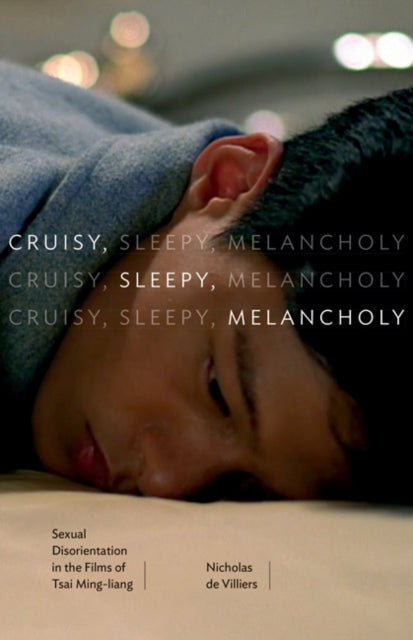
Cruisy, Sleepy, Melancholy: Sexual Disorientation in the Films of Tsai Ming-liang
Cruisy, Sleepy, Melancholy: Sexual Disorientation in the Films of Tsai Ming-liang
💎 Earn 97 Points (£0.97) on this item.
YOU SAVE £2.53
- Condition: Brand new
- UK Delivery times: Usually arrives within 2 - 3 working days
- UK Shipping: Fee starts at £2.39. Subject to product weight & dimension
Bulk ordering. Want 15 or more copies? Get a personalised quote and bigger discounts. Learn more about bulk orders.
Couldn't load pickup availability
- More about Cruisy, Sleepy, Melancholy: Sexual Disorientation in the Films of Tsai Ming-liang
Cruisy,Sleepy,Melancholy offers a critical analysis of the queerness in the films of Taiwanese auteur Tsai Ming-liang, exploring the sexuality of migrants, tourists, diasporic individuals, and others who are displaced. It challenges the binary division between heterosexuality and homosexuality and the Orientalist binary division of Asia versus the West, and reveals striking connections between sexuality, space, and cinema.
Format: Paperback / softback
Length: 216 pages
Publication date: 08 November 2022
Publisher: University of Minnesota Press
A BRILLIANT APPROACH TO THE QUEERNESS OF ONE OF TAIWAN'S GREATEST AUTHORS: TSAI MING-LIANG
Taiwanese filmmaker Tsai Ming-liang is a major force in Taiwan cinema and global moving image art. His films have been screened at major international film festivals, including the Cannes Film Festival, the Venice Biennale, and the Toronto International Film Festival, and have won numerous awards, including the Golden Lion at the Venice Biennale and the Palme d'Or at the Cannes Film Festival. Tsai is known for his unique and experimental style, which often explores themes of queerness, sexuality, and identity.
One of Tsai's most notable films is "Cruisy, Sleepy, Melancholy." This film is a critical figure in queer Sinophone cinema and the first director ever commissioned to create a film for the permanent collection of the Louvre. Tsai's films have been praised for their innovative use of space, time, and narrative, and for their ability to challenge traditional notions of sexuality and gender.
In "Cruisy, Sleepy, Melancholy," Tsai explores the queerness of characters who are migrants, tourists, diasporic, or otherwise displaced. Through their lack of fixed identities, these characters offer a clear challenge to the binary division between heterosexuality and homosexuality, as well as the Orientalist binary division of Asia versus the West. Tsai's films also explore the ways in which sexuality and identity are shaped by the social and political context in which they are produced.
Nicholas de Villiers argues that Tsai expands and revises the notion of queerness by engaging with the sexuality of characters who are migrants, tourists, diasporic, or otherwise displaced. Through their lack of fixed identities, these characters offer a clear challenge to the binary division between heterosexuality and homosexuality, as well as the Orientalist binary division of Asia versus the West. Ultimately, de Villiers explores how Tsai's films help us understand queerness in terms of spatial, temporal, and sexual disorientation.
Cruisy, Sleepy, Melancholy makes an important addition to scholarly work on Tsai in English. It draws on extensive interviews with the director, while also offering a complete reappraisal of Tsai's body of work. Contributing to queer film theory and the aesthetics of displacement, Cruisy, Sleepy, Melancholy reveals striking connections between sexuality, space, and cinema.
One of the key themes in Tsai's films is the idea of the "queer gaze." The queer gaze is a term coined by queer theorist Eve Kosofsky Sedgwick to describe the way in which queer people see the world. Tsai's films often use the queer gaze to explore the ways in which sexuality and identity are constructed and performed. For example, in "Cruisy, Sleepy, Melancholy," Tsai uses the queer gaze to explore the ways in which the characters' bodies are perceived and represented.
Tsai's films also often explore the ways in which sexuality and identity are shaped by the social and political context in which they are produced. For example, in "Cruisy, Sleepy, Melancholy," Tsai explores the ways in which the characters' experiences of migration and displacement shape their sexual identities. Tsai's films also often explore the ways in which sexuality and identity are shaped by the cultural and historical context in which they are produced. For example, in "Cruisy, Sleepy, Melancholy," Tsai explores the ways in which the characters' experiences of colonialism and imperialism shape their sexual identities.
In addition to his films, Tsai is also a prolific writer and artist. His writing has been published in numerous journals and magazines, and his art has been exhibited in galleries and museums around the world. Tsai's writing and art often explore the same themes as his films, and they often use the same techniques to explore them.
One of the most striking aspects of Tsai's films is their use of space. Tsai's films often use a wide range of spaces, including public spaces, private spaces, and natural spaces. Tsai's use of space is often used to create a sense of tension and disorientation, and to explore the ways in which sexuality and identity are shaped by the social and political context in which they are produced.
For example, in "Cruisy, Sleepy, Melancholy," Tsai uses a wide range of spaces, including public spaces, private spaces, and natural spaces. Tsai's use of space is often used to create a sense of tension and disorientation, and to explore the ways in which sexuality and identity are shaped by the social and political context in which they are produced.
In conclusion, Tsai Ming-liang is a major force in Taiwan cinema and global moving image art. His films have been praised for their innovative use of space, time, and narrative, and for their ability to challenge traditional notions of sexuality and gender. Cruisy, Sleepy, Melancholy is a critical figure in queer Sinophone cinema and the first director ever commissioned to create a film for the permanent collection of the Louvre. Tsai's films explore the queerness of characters who are migrants, tourists, diasporic, or otherwise displaced, and they offer a clear challenge to the binary division between heterosexuality and homosexuality, as well as the Orientalist binary division of Asia versus the West. Cruisy, Sleepy, Melancholy makes an important addition to scholarly work on Tsai in English, and it reveals striking connections between sexuality, space, and cinema.
Weight: 306g
Dimension: 138 x 215 x 18 (mm)
ISBN-13: 9781517913182
This item can be found in:
UK and International shipping information
UK and International shipping information
UK Delivery and returns information:
- Delivery within 2 - 3 days when ordering in the UK.
- Shipping fee for UK customers from £2.39. Fully tracked shipping service available.
- Returns policy: Return within 30 days of receipt for full refund.
International deliveries:
Shulph Ink now ships to Australia, Belgium, Canada, France, Germany, Ireland, Italy, India, Luxembourg Saudi Arabia, Singapore, Spain, Netherlands, New Zealand, United Arab Emirates, United States of America.
- Delivery times: within 5 - 10 days for international orders.
- Shipping fee: charges vary for overseas orders. Only tracked services are available for most international orders. Some countries have untracked shipping options.
- Customs charges: If ordering to addresses outside the United Kingdom, you may or may not incur additional customs and duties fees during local delivery.