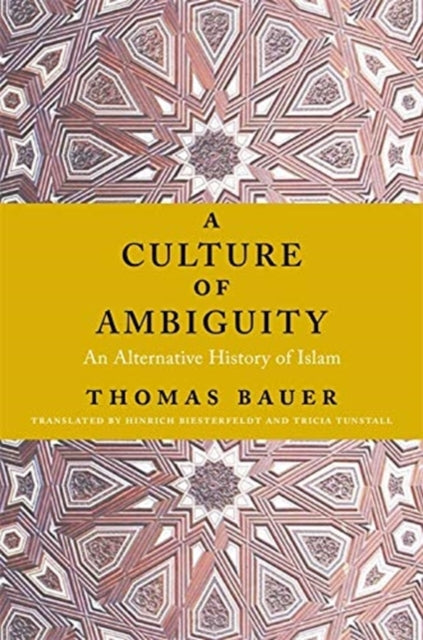
Thomas Bauer
Culture of Ambiguity: An Alternative History of Islam
Culture of Ambiguity: An Alternative History of Islam
💎 Earn 120 Points (£1.20) on this item.
YOU SAVE £5.93
- Condition: Brand new
- UK Delivery times: Usually arrives within 2 - 3 working days
- UK Shipping: Fee starts at £2.39. Subject to product weight & dimension
Bulk ordering. Want 15 or more copies? Get a personalised quote and bigger discounts. Learn more about bulk orders.
Couldn't load pickup availability
- More about Culture of Ambiguity: An Alternative History of Islam
Islamic cultures are often portrayed as dogmatic and intolerant, but Thomas Bauer's book "A Culture of Ambiguity" challenges this dichotomy by exploring the tension between ambiguity and certainty in Islamic history, culture, and thought. He argues that classical Islamic culture was relatively tolerant of ambiguity and complexity, in contrast to present-day fundamentalism and European history. The book offers an interdisciplinary model for investigating the tolerance of ambiguity across cultures and eras and was awarded the prestigious Leibniz Prize.
Format: Paperback / softback
Length: 336 pages
Publication date: 08 June 2021
Publisher: Columbia University Press
In the Western imagination, Islamic cultures are often portrayed as being dominated by rigid religious norms that lack any nuance or flexibility. This perception has led to the perpetuation of stereotypes that portray Islam as a religion that promotes intolerance, violence, and backwardness. However, those who challenge these stereotypes have presented a different narrative, highlighting the "Golden Age" of medieval Islam, which was characterized by rationality, tolerance, and even proto-secularism.
Understanding Islamic history, culture, and thought beyond this dichotomy is a complex and multifaceted task. In his book, "A Culture of Ambiguity," Thomas Bauer seeks to reconceptualize classical and modern Islam by exploring differing attitudes toward ambiguity. Over the course of many centuries, he examines the tension between two competing strands within Islam: one that seeks to eliminate all uncertainties and establish absolute, unquestionable truths, and another that embraces ambiguity and accepts complexity.
Bauer's exploration spans a wide range of cultural and linguistic ambiguities, encompassing premodern Islamic textual and cultural forms such as law, Quranic exegesis, and literary genres. He also delves into attitudes toward religious minorities and foreigners, highlighting the relative absence of conflict between religious and secular discourses in classical Islamic culture. This contrast is particularly striking when compared to both present-day fundamentalism and much of European history.
One of the key insights that Bauer offers is the notion that Islam's encounter with the modern West and its demand for certainty played a significant role in shaping both Islamicist and secular liberal ideologies. While Islamicist movements sought to preserve traditional Islamic values and beliefs, they often rejected ambiguity and sought to establish a clear distinction between Islam and the West. On the other hand, secular liberal ideologies, influenced by Enlightenment thinkers, embraced ambiguity and sought to promote tolerance, freedom, and individual rights.
However, Bauer argues that these ideologies also rejected their own cultural traditions in favor of a Western-centric worldview. Islamicist movements, for example, often sought to eliminate any elements of Islamic culture that were perceived as incompatible with their strict interpretation of Islam, while secular liberal ideologies often downplayed or ignored the rich cultural heritage of Islam.
In conclusion, "A Culture of Ambiguity" is a groundbreaking work that offers a fresh perspective on Islamic history, culture, and thought. By exploring differing attitudes toward ambiguity, Bauer challenges the stereotypes and misconceptions that have been perpetuated in the Western imagination. He provides a nuanced and comprehensive account of Islamic history, highlighting the complex and multifaceted nature of the religion. Through his interdisciplinary model, Bauer offers an insightful framework for investigating the tolerance of ambiguity across cultures and eras. This book is a valuable resource for scholars, students, and anyone interested in understanding Islam and its place in the world today.
Weight: 494g
Dimension: 157 x 236 x 22 (mm)
ISBN-13: 9780231170659
This item can be found in:
UK and International shipping information
UK and International shipping information
UK Delivery and returns information:
- Delivery within 2 - 3 days when ordering in the UK.
- Shipping fee for UK customers from £2.39. Fully tracked shipping service available.
- Returns policy: Return within 30 days of receipt for full refund.
International deliveries:
Shulph Ink now ships to Australia, Belgium, Canada, France, Germany, Ireland, Italy, India, Luxembourg Saudi Arabia, Singapore, Spain, Netherlands, New Zealand, United Arab Emirates, United States of America.
- Delivery times: within 5 - 10 days for international orders.
- Shipping fee: charges vary for overseas orders. Only tracked services are available for most international orders. Some countries have untracked shipping options.
- Customs charges: If ordering to addresses outside the United Kingdom, you may or may not incur additional customs and duties fees during local delivery.