Shulph Ink
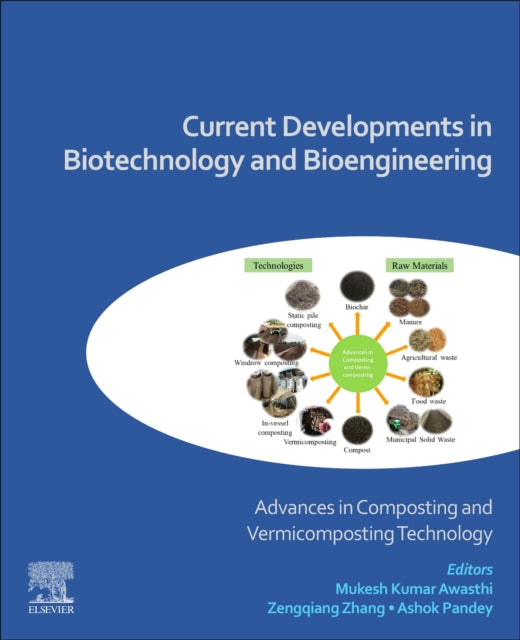
Current Developments in Biotechnology and Bioengineering: Advances in Composting and Vermicomposting Technology
Current Developments in Biotechnology and Bioengineering: Advances in Composting and Vermicomposting Technology
💎 Earn 980 Points (£9.80) on this item.
- Condition: Brand new
- UK Delivery times: Usually arrives within 2 - 3 working days
- UK Shipping: Fee starts at £2.39. Subject to product weight & dimension
Bulk ordering. Want 15 or more copies? Get a personalised quote and bigger discounts. Learn more about bulk orders.
Couldn't load pickup availability
- More about Current Developments in Biotechnology and Bioengineering: Advances in Composting and Vermicomposting Technology
Composting and vermicomposting are widely used biological processes for managing waste, with advancements in technology including greenhouse gas mitigation, resistant genes, and value-added materials recovery. This book covers models, global case studies, opportunities, and challenges, and applies LCA and economic evaluation to composting technologies.
Format: Paperback / softback
Length: 388 pages
Publication date: 06 September 2022
Publisher: Elsevier - Health Sciences Division
Composting and vermicomposting are increasingly popular biological methods for managing the waste generated by communities and agricultural activities, which have witnessed significant growth in recent years. Advances in Composting and Vermicomposting Technology provides a comprehensive overview of the most significant research conducted in this field over the past few years. This book encompasses both conventional and cutting-edge advancements in composting and vermicomposting technologies, offering valuable insights into greenhouse gas emission mitigation and resistant gene management. Additionally, it delves into the recovery of Value-Added Materials in composting sectors. Furthermore, the book includes models, upgradation options, global case studies, opportunities, and challenges associated with the advancement of composting technology. It also discusses the application of Life Cycle Assessment (LCA) and considerations in economic evaluation of composting technologies and other organic waste treatment strategies.
Composting and vermicomposting have emerged as effective and sustainable solutions for managing waste, particularly organic waste, generated by communities and agricultural activities. These processes involve the decomposition of organic matter, such as food scraps, yard waste, and animal manure, by microorganisms, such as bacteria, fungi, and earthworms. The resulting compost or vermicompost is a nutrient-rich soil amendment that can be used to improve soil fertility, promote plant growth, and reduce the environmental impact of waste disposal.
One of the key advantages of composting and vermicomposting is that they can help to reduce the amount of waste that ends up in landfills. By converting organic waste into valuable soil amendments, we can reduce the demand for landfills and the associated environmental costs, such as greenhouse gas emissions and pollution. Additionally, composting and vermicomposting can help to conserve natural resources, such as water and soil, by reducing the need for chemical fertilizers and pesticides.
Another benefit of composting and vermicomposting is that they can improve the quality of soil. Compost contains a wide range of nutrients, including nitrogen, phosphorus, and potassium, which are essential for plant growth. Vermicompost, on the other hand, is rich in organic matter, which can help to improve soil structure, increase water-holding capacity, and promote the growth of beneficial microorganisms.
Composting and vermicomposting can also be used to promote sustainable agriculture. By using compost and vermicompost as soil amendments, farmers can reduce their reliance on chemical fertilizers and pesticides, which can have negative impacts on the environment and human health. Additionally, composting and vermicomposting can help to improve soil fertility, which can lead to increased crop yields and reduced food waste.
There are several different methods of composting and vermicomposting, each with its own advantages and disadvantages. Conventional composting involves the use of a compost bin or pile, where organic matter is mixed with soil and allowed to decompose over time. This method can be effective, but it can also require a significant amount of space and labor. Vermicomposting, on the other hand, involves the use of worms to decompose organic matter. This method is more efficient and can be done in a smaller space, but it can require more maintenance and attention.
In recent years, there have been significant advancements in composting and vermicomposting technology. These advancements have led to the development of new technologies and methods that are more efficient, effective, and sustainable. For example, some researchers have developed new composting systems that use less space and labor, while others have developed new technologies that can more effectively manage greenhouse gas emissions.
In conclusion, composting and vermicomposting are widely used biological processes for the management of the wastes produced by the communities and agricultural activities, which have experienced substantial growth during the last few years. Advances in Composting and Vermicomposting Technology summarizes the most important work conducted during the last few years under one cover. The book includes conventional and recent advancements in composting and vermicomposting technologies, information regarding mitigation of greenhouse gases emission and resistant genes, and finally recovery of Value-Added Materials in the composting sectors. Furthermore, it includes models and available upgradation, global case studies, opportunities and challenges (technical constraints, Institutional constraints and social constraints) associated with the composting technology advancement and finally, application of LCA and considerations in economic evaluation of composting technologies and other organic waste treatment strategies.
Weight: 450g
Dimension: 235 x 191 (mm)
ISBN-13: 9780323918749
This item can be found in:
UK and International shipping information
UK and International shipping information
UK Delivery and returns information:
- Delivery within 2 - 3 days when ordering in the UK.
- Shipping fee for UK customers from £2.39. Fully tracked shipping service available.
- Returns policy: Return within 30 days of receipt for full refund.
International deliveries:
Shulph Ink now ships to Australia, Belgium, Canada, France, Germany, Ireland, Italy, India, Luxembourg Saudi Arabia, Singapore, Spain, Netherlands, New Zealand, United Arab Emirates, United States of America.
- Delivery times: within 5 - 10 days for international orders.
- Shipping fee: charges vary for overseas orders. Only tracked services are available for most international orders. Some countries have untracked shipping options.
- Customs charges: If ordering to addresses outside the United Kingdom, you may or may not incur additional customs and duties fees during local delivery.