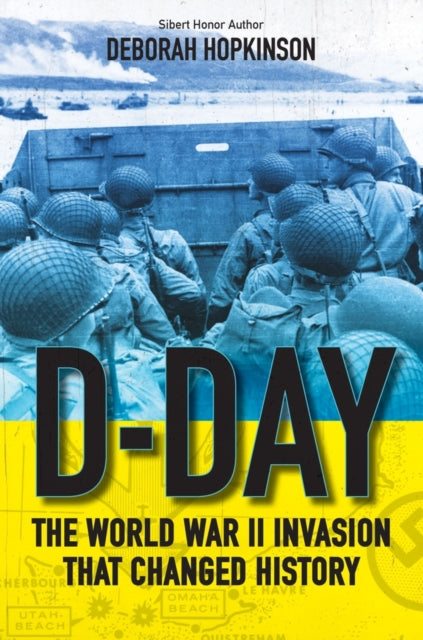
Deborah Hopkinson
D-Day: The World War II Invasion That Changed History
D-Day: The World War II Invasion That Changed History
💎 Earn 32 Points (£0.32) on this item.
YOU SAVE £1.56
- Condition: Brand new
- UK Delivery times: Usually arrives within 2 - 3 working days
- UK Shipping: Fee starts at £2.39. Subject to product weight & dimension
Bulk ordering. Want 15 or more copies? Get a personalised quote and bigger discounts. Learn more about bulk orders.
Couldn't load pickup availability
- More about D-Day: The World War II Invasion That Changed History
D-Day, one of the largest military endeavors in history, involved years of planning, secrecy, and various specialists. Author Deborah Hopkinson weaves together official documents, personal narratives, and archival photos to provide an action-packed and authentic account of the invasion.
\n Format: Paperback / softback
\n Length: 400 pages
\n Publication date: 03 January 2019
\n Publisher: Scholastic
\n
The World War II invasion known as D-Day was one of the most significant military endeavors in history. It involved years of meticulous planning, absolute secrecy, and the involvement of not only soldiers but also sailors, paratroopers, and numerous specialists. Acclaimed author Deborah Hopkinson skillfully weaves together the contributions of key players in D-Day in a masterful tapestry of official documents, personal narratives, and archival photographs, resulting in an action-packed and authentic account.
The invasion of Normandy, which took place on June 6, 1944, marked the beginning of the European theater of World War II and was a pivotal moment in the conflict. It involved the deployment of over 156,000 troops from the United States, Britain, and Canada, along with thousands of aircraft and naval vessels. The goal of D-Day was to establish a foothold in Western Europe and ultimately drive the German forces out of the continent.
The planning for D-Day began in the early 1940s, when the Allies assessed the feasibility of an invasion of France. They considered several options, including a landing on the French coast in the south, but ultimately settled on a landing in the northern part of the country, near the town of Normandy. The decision to land in Normandy was made in part because it was believed that the German defenses in the south were stronger, and in part because it was hoped that the surprise of the landing would catch the German forces off guard.
The secrecy surrounding D-Day was absolute, with the details of the operation kept top secret even from the troops themselves. The soldiers were trained to carry out their roles in a manner that would minimize their exposure to enemy fire and maximize their chances of success. They were also given new equipment, including amphibious vehicles that would allow them to land on the beaches.
The invasion of Normandy was a complex operation that involved a coordinated effort from a variety of military units. The United States Army, in particular, played a key role in the operation, with the 1st and 29th Infantry Divisions, along with the 4th and 9th Armored Divisions, being the primary forces involved. The British Army also played a significant role, with the 3rd Infantry Division, the 1st Airborne Division, and the Royal Navy providing support.
The invasion of Normandy was not without its challenges. The beaches where the troops were landing were heavily fortified, and the German forces put up fierce resistance. The soldiers faced intense gunfire, mortar rounds, and rocket attacks, and many were killed or wounded in the initial stages of the operation. However, the sheer number of troops and the surprise of the landing eventually overwhelmed the German defenses, and the Allies were able to establish a foothold in Western Europe.
The invasion of Normandy was a significant turning point in the war, and it paved the way for the eventual liberation of Europe. It also demonstrated the effectiveness of combined arms warfare, in which different military units worked together to achieve a common goal. The operation was a testament to the bravery and sacrifice of the soldiers who took part in it, and it remains one of the most iconic battles of World War II.
In conclusion, the invasion of Normandy was one of the most significant military endeavors in history, and it played a crucial role in the outcome of World War II. The planning for the operation involved years of secrecy and coordination between a variety of military units, and the soldiers who took part in it faced intense and deadly resistance. However, their bravery and sacrifice ultimately allowed the Allies to establish a foothold in Western Europe and pave the way for the eventual liberation of the continent. The operation remains a testament to the human spirit war and the indomitable spirit of the people who fought for freedom and democracy.
\n Weight: 276g\n
Dimension: 153 x 133 x 25 (mm)\n
ISBN-13: 9781407191355\n \n
This item can be found in:
UK and International shipping information
UK and International shipping information
UK Delivery and returns information:
- Delivery within 2 - 3 days when ordering in the UK.
- Shipping fee for UK customers from £2.39. Fully tracked shipping service available.
- Returns policy: Return within 30 days of receipt for full refund.
International deliveries:
Shulph Ink now ships to Australia, Belgium, Canada, France, Germany, Ireland, Italy, India, Luxembourg Saudi Arabia, Singapore, Spain, Netherlands, New Zealand, United Arab Emirates, United States of America.
- Delivery times: within 5 - 10 days for international orders.
- Shipping fee: charges vary for overseas orders. Only tracked services are available for most international orders. Some countries have untracked shipping options.
- Customs charges: If ordering to addresses outside the United Kingdom, you may or may not incur additional customs and duties fees during local delivery.