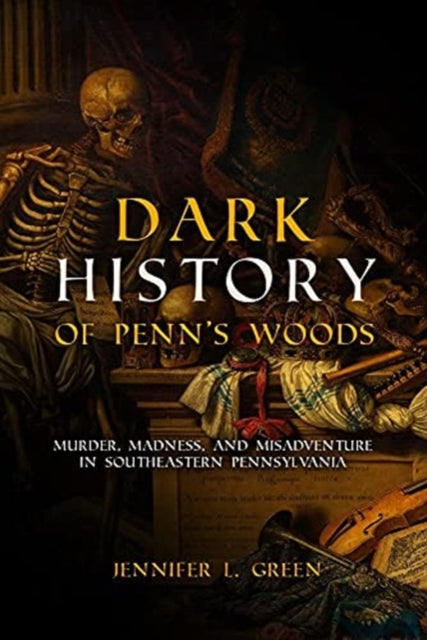
Jennifer L. Green
Dark History of Penn's Woods: Murder, Madness, and Misadventure in Southeastern Pennsylvania
Dark History of Penn's Woods: Murder, Madness, and Misadventure in Southeastern Pennsylvania
💎 Earn 45 Points (£0.45) on this item.
YOU SAVE £3.80
- Condition: Brand new
- UK Delivery times: Usually arrives within 2 - 3 working days
- UK Shipping: Fee starts at £2.39. Subject to product weight & dimension
Bulk ordering. Want 15 or more copies? Get a personalised quote and bigger discounts. Learn more about bulk orders.
Couldn't load pickup availability
- More about Dark History of Penn's Woods: Murder, Madness, and Misadventure in Southeastern Pennsylvania
In the early 1600s, when European settlers sailed into the Delaware Bay, Pennsylvania's history of strange and macabre events began. The Philadelphia area became a melting pot of different cultures and beliefs, leading to cultural tensions and a level of violence unseen anywhere else in the world. Chester County, Pennsylvania, outstripped even London in the amount of murders and assaults committed, and a judicial system hailed as the best and fairest in the world made the decision to hang a man for burglary a century later. Jennifer L. Green transports readers through three centuries of murder, disease, witchcraft, cannibalism, and botched executions in Chester and Delaware counties, using archival evidence and research to explain how such historical oddities and tragedies occurred.
Format: Paperback / softback
Length: 144 pages
Publication date: 15 December 2021
Publisher: Casemate Publishers
In the early 1600s, when ships under the command of European settlers first sailed into the Delaware Bay,Pennsylvanias documented history of strange and macabre events began. Contrary to the growth of other colonies like Massachusetts and Virginia,the Philadelphia area became a melting pot of different cultures and beliefs that all served to shape the way its people related to the supernatural,to the treatment of their dead,and toward each other. While it provided a refuge for those seeking religious liberty and economic prosperity,cultural tensions also shaped the colony in sinister ways,leading to a level of violence in the eighteenth century unseen anywhere else in the world. How,in a place that was eighty percent pacifist,did Chester County,Pennsylvania,outstrip even London in the amount of murders and assaults committed? How did a judicial system hailed at the end of the 1600s as the best and fairest in the world,in which the death penalty only applied in cases of murder and treason,make the decision a century later to hang a man for burglary? Under what circumstances was it considered perfectly reasonable,even expected,to eat the dead?
Jennifer L. Green transports readers through three centuries of murder,disease,witchcraft,cannibalism and botched executions in Chester and Delaware counties,using archival evidence and research to explain how such historical oddities and tragedies occurred.
The early 1600s saw the arrival of European settlers in the Delaware Bay, marking the beginning of Pennsylvanias documented history of strange and macabre events. Contrary to the growth of other colonies like Massachusetts and Virginia, the Philadelphia area became a melting pot of different cultures and beliefs, which shaped the way its people related to the supernatural, the treatment of their dead, and towards each other. While it provided a refuge for those seeking religious liberty and economic prosperity, cultural tensions also shaped the colony in sinister ways, leading to a level of violence in the eighteenth century unseen anywhere else in the world.
In Chester County, Pennsylvania, for example, the amount of murders and assaults committed outstripped even London, despite the region being known for its pacifist nature. How did this happen in a place that was eighty percent pacifist? The answer lies in the complex interplay of cultural, social, and economic factors that shaped the colony.
Cultural tensions played a significant role in Chester County. The colony was home to a diverse population, including Quakers, Catholics, and Protestants, each with their own beliefs and practices. This diversity led to conflicts and tensions, particularly over religious matters. The Quakers, known for their emphasis on peace and nonviolence, were often at odds with the more aggressive Protestants and Catholics, who sought to impose their beliefs on the local population.
Economic prosperity also contributed to cultural tensions in Chester County. The colony was a major producer of tobacco and other crops, which attracted a large influx of immigrants. These immigrants brought with them their own customs and beliefs, often clashing with the established norms of the colony. For example, some immigrants practiced cannibalism, which was considered taboo and illegal in the United States.
The judicial system in Chester County was hailed as the best and fairest in the world at the end of the 1600s. However, a century later, it made a decision that would shock the world: to hang a man for burglary. This decision was made in response to a series of high-profile burglaries that had occurred in the colony. The judicial system had been strict in its application of the death penalty, only applying it in cases of murder and treason. However, in this case, the judges felt that the severity of the crime warranted the death penalty.
The decision to hang a man for burglary was controversial and led to widespread criticism. Many people believed that the judicial system had overstepped its bounds and that the death penalty was not the appropriate punishment for a burglary. Others argued that the decision was influenced by cultural tensions and the desire to assert authority over the local population.
Despite the controversy, the decision to hang a man for burglary remained in place for over a century. It was only in the late 1800s that the death penalty was abolished in Pennsylvania, and the practice of cannibalism was also outlawed.
In conclusion, the history of Chester County, Pennsylvania, is a complex and fascinating tale of murder, disease, witchcraft, cannibalism, and botched executions. The colony was shaped by cultural tensions, economic prosperity, and the judicial system, which led to a level of violence in the eighteenth century unseen anywhere else in the world. The decision to hang a man for burglary, despite the colony being known for its pacifist nature, highlights the complex interplay of cultural, social, and economic factors that shaped the colony.
Weight: 234g
Dimension: 151 x 229 x 15 (mm)
ISBN-13: 9781955041003
This item can be found in:
UK and International shipping information
UK and International shipping information
UK Delivery and returns information:
- Delivery within 2 - 3 days when ordering in the UK.
- Shipping fee for UK customers from £2.39. Fully tracked shipping service available.
- Returns policy: Return within 30 days of receipt for full refund.
International deliveries:
Shulph Ink now ships to Australia, Belgium, Canada, France, Germany, Ireland, Italy, India, Luxembourg Saudi Arabia, Singapore, Spain, Netherlands, New Zealand, United Arab Emirates, United States of America.
- Delivery times: within 5 - 10 days for international orders.
- Shipping fee: charges vary for overseas orders. Only tracked services are available for most international orders. Some countries have untracked shipping options.
- Customs charges: If ordering to addresses outside the United Kingdom, you may or may not incur additional customs and duties fees during local delivery.