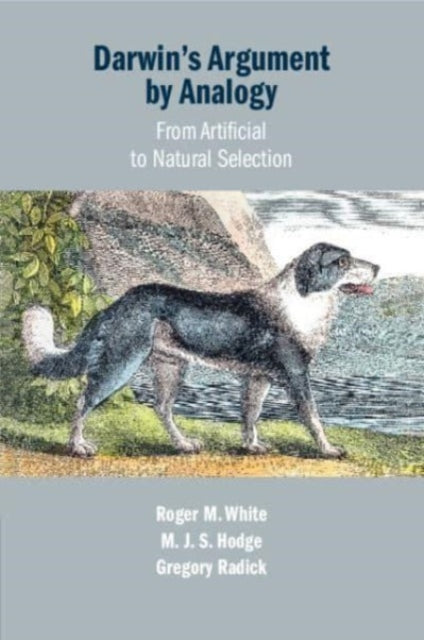
Roger M.White,M. J. S.Hodge,GregoryRadick
Darwin's Argument by Analogy: From Artificial to Natural Selection
Darwin's Argument by Analogy: From Artificial to Natural Selection
💎 Earn 122 Points (£1.22) on this item.
We can order this item for you. Delivery usually takes about 4 to 6 weeks.
This item is not held in our immediate stock. We will order it for you after checkout.
Estimated delivery: About 4 to 6 weeks
YOU SAVE £1.46
- Condition: Brand new
- UK Delivery times: Usually arrives within 2 - 3 working days
- UK Shipping: Fee starts at £2.39. Subject to product weight & dimension
Bulk ordering. Want 15 or more copies? Get a personalised quote and bigger discounts. Learn more about bulk orders.
Couldn't load pickup availability
- More about Darwin's Argument by Analogy: From Artificial to Natural Selection
Charles Darwin's theory of natural selection was based on an analogy with artificial selection, but there has been no consensus on how this analogical argument works. This book offers an original perspective on Darwin's argument, restoring to view the intellectual traditions he took for granted and offering new appreciations of his argument, metaphors, and legacies for science after the Origin.
Format: Paperback / softback
Length: 259 pages
Publication date: 19 October 2023
Publisher: Cambridge University Press
Charles Darwin presented his theory of natural selection in On the Origin of Species (1859). Traditionally, Darwin's argument for this theory has been interpreted as drawing an analogy with artificial selection. However, there has been no agreement on how this analogy is supposed to function, and there has also been some doubt that analogical arguments are generally weak. This book offers an innovative perspective on Darwin's argument, restoring the intellectual traditions that Darwin assumed in arguing as he did. From this perspective, new insights emerge regarding Darwin's argument, the metaphors derived from it, the broader traditions the argument touched upon, and its legacies for science after the Origin.
Darwin's argument for natural selection is often seen as analogous to artificial selection. However, the exact mechanism of this analogy has been a subject of debate. Some scholars argue that analogies are inherently weak and cannot provide a solid foundation for scientific theories. This book aims to address this issue by exploring new insights into the history of analogical argumentation, from ancient Greek philosophers to Darwin's own writings.
By examining Darwin's public and private writings, the book seeks to understand the intellectual context in which he developed his theory. It reveals that Darwin drew on a wide range of intellectual traditions, including evolutionary biology, genetics, and philosophy. These traditions provided him with the tools and frameworks to argue for natural selection in a way that was both compelling and scientifically rigorous.
One of the key insights of the book is that Darwin's argument for natural selection was not based solely on analogy but also on empirical evidence. He observed the natural world and collected data on the distribution of traits among different species. Through his observations and experiments, Darwin was able to demonstrate that certain traits, such as the ability to adapt to changing environments, were more likely to be passed on to future generations than others.
Darwin's use of metaphors was also crucial to his argument. He compared the process of natural selection to the process of artificial selection, which involves selecting individuals with desirable traits to breed them. By doing so, Darwin was able to make his theory more accessible and understandable to a wider audience.
However, the book also highlights the limitations of analogies. While they can be useful tools for explaining complex concepts, they can also lead to misunderstandings and oversimplifications. For example, some scholars argue that analogies can be used to support any hypothesis, regardless of its scientific validity.
In conclusion, this book offers a fresh perspective on Charles Darwin's theory of natural selection. By exploring the history of analogical argumentation and examining Darwin's own writings, it sheds light on the intellectual traditions that shaped his argument and its legacies for science. The book demonstrates that Darwin's theory was not based solely on analogy but also on empirical evidence and that his use of metaphors was instrumental in making his theory more accessible and compelling. However, it also highlights the limitations of analogies and the importance of rigorous scientific testing to validate scientific theories.
Weight: 381g
ISBN-13: 9781108708524
This item can be found in:
UK and International shipping information
UK and International shipping information
UK Delivery and returns information:
- Delivery within 2 - 3 days when ordering in the UK.
- Shipping fee for UK customers from £2.39. Fully tracked shipping service available.
- Returns policy: Return within 30 days of receipt for full refund.
International deliveries:
Shulph Ink now ships to Australia, Belgium, Canada, France, Germany, Ireland, Italy, India, Luxembourg Saudi Arabia, Singapore, Spain, Netherlands, New Zealand, United Arab Emirates, United States of America.
- Delivery times: within 5 - 10 days for international orders.
- Shipping fee: charges vary for overseas orders. Only tracked services are available for most international orders. Some countries have untracked shipping options.
- Customs charges: If ordering to addresses outside the United Kingdom, you may or may not incur additional customs and duties fees during local delivery.