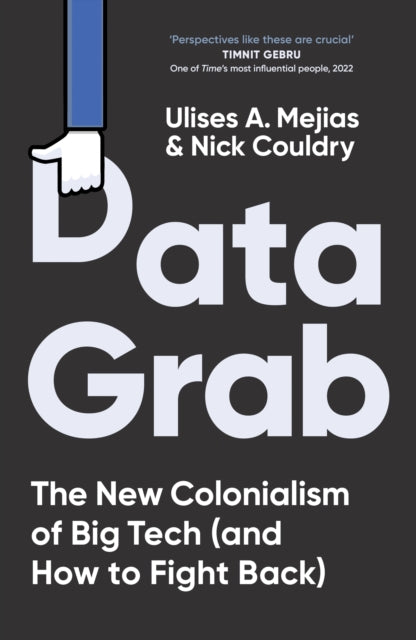
Ulises A. Mejias,Nick Couldry
Data Grab: The new Colonialism of Big Tech and how to fight back
Data Grab: The new Colonialism of Big Tech and how to fight back
💎 Earn 77 Points (£0.77) on this item.
YOU SAVE £6.42
- Condition: Brand new
- UK Delivery times: Usually arrives within 2 - 3 working days
- UK Shipping: Fee starts at £3.89. Subject to product weight & dimension
Bulk ordering. Want 15 or more copies? Get a personalised quote and bigger discounts. Learn more about bulk orders.
Couldn't load pickup availability
- More about Data Grab: The new Colonialism of Big Tech and how to fight back
Big Tech companies are exploiting our data, labor, and connections to control our views, track our movements, record our conversations, and discriminate against us. We must fight back by understanding the emerging future and how history can help us.
Format: Hardback
Length: 320 pages
Publication date: 08 February 2024
Publisher: Ebury Publishing
Your online life is their product.
In the past, colonialism was a landgrab of natural resources, exploitative labor, and private property from countries around the world. It promised to modernize and civilize, but actually sought to control. It stole from native populations and made them sign contracts they didn't understand. It took resources just because they were there.
Colonialism has not disappeared; it has taken on a new form.
In the new world order, data is the new oil. Big Tech companies are grabbing our most basic natural resources: our data. They are exploiting our labor and connections, repackaging our information to control our views, track our movements, record our conversations, and discriminate against us. Every time we unthinkingly click "Accept on Terms and Conditions," we allow our most personal information to be kept indefinitely, repackaged by big Tech companies to control and exploit us for their own profit.
In this searing, cutting-edge guide, two leading global researchers – and founders of the concept of data colonialism – reveal how history can help us both to understand the emerging future and to fight back.
The roots of data colonialism can be traced back to the colonial era, when European powers exploited the resources and labor of colonized countries. In the digital age, these practices have taken on a new form, with big Tech companies controlling vast amounts of personal information and using it to manipulate and control individuals.
One of the key aspects of data colonialism is the extraction of data from individuals without their consent. This is often done through the use of cookies, tracking devices, and other technologies that collect information about our online activities. The data is then sold to advertisers, who use it to target us with personalized ads and to track our movements across the internet.
Another aspect of data colonialism is the exploitation of labor. Big Tech companies rely on the labor of their employees, who are often paid low wages and work in poor conditions. They also rely on the labor of contractors and subcontractors who work in their data centers and other facilities. These workers are often subjected to surveillance and other forms of control, and their labor is used to maintain and expand the infrastructure of big Tech companies.
Data colonialism also involves the control of information and the dissemination of propaganda. Big Tech companies use their control over the internet to control the narrative and shape public opinion. They use algorithms and other technologies to filter and manipulate news and information, and to promote their own agendas and interests.
One of the most significant consequences of data colonialism is the erosion of privacy and the loss of control over our own data. Big Tech companies collect vast amounts of personal information about us, and they use it to track our movements, monitor our behavior, and target us with ads. They also sell our data to third parties, who use it for their own purposes, such as political campaigns or marketing.
Another consequence of data colonialism is the discrimination and marginalization of certain groups. Big Tech companies use their control over data to target certain groups with ads and other forms of discrimination. This can lead to the perpetuation of inequality and the exclusion of certain groups from opportunities and resources.
To fight back against data colonialism, there are several steps that we can take. One of the most important is to increase awareness of the issue and to educate ourselves about the ways in which big Tech companies are exploiting our data. We can also support organizations that are working to protect our privacy and to promote fair and equitable access to the internet.
Another important step is to regulate big Tech companies. Governments and regulatory bodies can implement policies and regulations that protect our privacy and promote fair competition in the digital market. This can include measures such as data privacy laws, antitrust laws, and regulations that limit the power of big Tech companies.
In addition to these steps, we can also take individual actions to protect our privacy and to limit the power of big Tech companies. We can use privacy-protecting tools such as VPNs, ad blockers, and password managers to limit the amount of personal information that we share online. We can also be mindful of the information that we share online and the terms and conditions that we accept.
Finally, we can also work to build a more democratic and inclusive digital society. This can involve promoting the use of open-source software and technologies, and promoting the participation of marginalized groups in the development and governance of the internet.
In conclusion, data colonialism is a form of exploitation and control that is taking place
place in the digital age. Big Tech companies are grabbing our most basic natural resources: our data, exploiting our labor and connections, and repackaging our information to control our views, track our movements, record our conversations, and discriminate against us. This has significant consequences for our privacy, our labor, and our society as a whole. To fight back against data colonialism, we need to increase awareness of the issue, support organizations that are working to protect our privacy, regulate big Tech companies, take individual actions to protect our privacy, and work to build a more democratic and inclusive digital society.
Weight: 524g
Dimension: 164 x 242 x 31 (mm)
ISBN-13: 9780753560204
UK and International shipping information
UK and International shipping information
We deliver throughout the United Kingdom and to 128 countries and territories worldwide, including the United States, Australia, Canada, Germany, Spain and France.