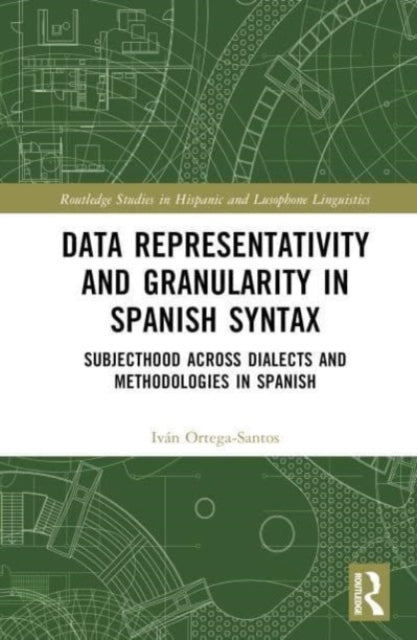
Ivan Ortega-Santos
Data Representativity and Granularity in Spanish Syntax: Subjecthood across Dialects and Methodologies in Spanish
Data Representativity and Granularity in Spanish Syntax: Subjecthood across Dialects and Methodologies in Spanish
💎 Earn 811 Points (£8.11) on this item.
We can order this item for you. Delivery usually takes about 4 to 6 weeks.
This item is not held in our immediate stock. We will order it for you after checkout.
Estimated delivery: About 4 to 6 weeks
YOU SAVE £9.63
- Condition: Brand new
- UK Delivery times: Usually arrives within 2 - 3 working days
- UK Shipping: Fee starts at £2.39. Subject to product weight & dimension
Bulk ordering. Want 15 or more copies? Get a personalised quote and bigger discounts. Learn more about bulk orders.
Couldn't load pickup availability
- More about Data Representativity and Granularity in Spanish Syntax: Subjecthood across Dialects and Methodologies in Spanish
Data Representativity and Granularity in Spanish Syntax explores the dialogue between Generative Grammar, Variationism, and experimental linguistics, focusing on Spanish linguistics. It analyzes and compares data collection methods, examines approaches, and addresses questions about data divergence and research possibilities. The book advocates for methodological crosspollination to avoid forcing data to conform to field-specific expectations and to appreciate language variation. Chapter 2 is available as a downloadable Open Access PDF.
Format: Hardback
Length: 136 pages
Publication date: 26 April 2024
Publisher: Taylor & Francis Ltd
Data Representativity and Granularity in Spanish Syntax: A Dialogue between Generative Grammar, Variationism, and Experimental Linguistics
Data Representativity and Granularity in Spanish Syntax is a groundbreaking volume that explores the interplay between Generative Grammar, Variationism, and experimental linguistics, with a particular focus on Spanish linguistics. By combining formal syntax with empirical data collection, the book analyzes and compares various data collection methods in syntactic theory, shedding light on the diverse approaches that can be taken to gain novel insights in this emerging area.
One of the key questions addressed in the book is the divergence between the data gathered through the standard methodology in each discipline and why it occurs. The authors argue that methodological cross-pollination is essential to avoid forcing data to conform to field-specific expectations and to appreciate language variation for what it has to tell us about linguistic theory. This approach marries the goals of Generative Grammar with data-driven research, providing a comprehensive understanding of the field.
The book is divided into several chapters, each focusing on a specific aspect of data representativity and granularity in Spanish syntax. Chapter 2, for example, examines the case study of subject properties in Spanish, with an emphasis on how differences in data collection and data analysis standards may shape our perception of the object of study. The authors demonstrate how the standard methodology in each discipline diverges in terms of the data collected and the analysis techniques used, and they argue that this divergence can have significant implications for our understanding of language.
Another important aspect of the book is the examination of a wide variety of approaches to gain novel insight in this emerging area. The authors discuss the use of corpus linguistics, experimental methods, and computational linguistics, among others, and they highlight the advantages and disadvantages of each approach. They also provide examples of successful applications of these approaches in Spanish syntax research.
One of the strengths of the book is its clear and accessible writing style. The authors use a combination of formal syntax and empirical data to illustrate their points, making the book accessible to both researchers and students in the field. The book also includes numerous examples and illustrations to help readers understand the concepts discussed.
In addition to its theoretical contributions, Data Representativity and Granularity in Spanish Syntax also has practical implications. The book provides researchers with a framework for designing and implementing data collection methods that are more effective and efficient. It also helps researchers to identify the limitations of existing data collection methods and to develop new approaches that can address these limitations.
Overall, Data Representativity and Granularity in Spanish Syntax is an essential resource for researchers in the area of formal and generative syntax, linguists with an interest in data collection standard in syntax, and graduate or advanced undergraduate students in the field of Spanish linguistics. The book's clear and accessible writing style, combined with its theoretical and practical contributions, makes it a valuable addition to the field.
The book is freely available as a downloadable Open Access PDF at http://www.taylorfrancis.com under a Creative Commons Attribution-Non Commercial-No Derivatives (CC BY-NC-ND) 4.0 license. This allows researchers and students to access the book without any financial barriers, making it accessible to a wide range of individuals.
In conclusion, Data Representativity and Granularity in Spanish Syntax is a groundbreaking volume that explores the interplay between Generative Grammar, Variationism, and experimental linguistics, with a particular focus on Spanish linguistics. By combining formal syntax with empirical data collection, the book analyzes and compares various data collection methods in syntactic theory, shedding light on the diverse approaches that can be taken to gain novel insights in this emerging area. The book's clear and accessible writing style, combined with its theoretical and practical contributions, makes it a valuable addition to the field.
Weight: 439g
Dimension: 234 x 156 (mm)
ISBN-13: 9781032437651
This item can be found in:
UK and International shipping information
UK and International shipping information
UK Delivery and returns information:
- Delivery within 2 - 3 days when ordering in the UK.
- Shipping fee for UK customers from £2.39. Fully tracked shipping service available.
- Returns policy: Return within 30 days of receipt for full refund.
International deliveries:
Shulph Ink now ships to Australia, Belgium, Canada, France, Germany, Ireland, Italy, India, Luxembourg Saudi Arabia, Singapore, Spain, Netherlands, New Zealand, United Arab Emirates, United States of America.
- Delivery times: within 5 - 10 days for international orders.
- Shipping fee: charges vary for overseas orders. Only tracked services are available for most international orders. Some countries have untracked shipping options.
- Customs charges: If ordering to addresses outside the United Kingdom, you may or may not incur additional customs and duties fees during local delivery.