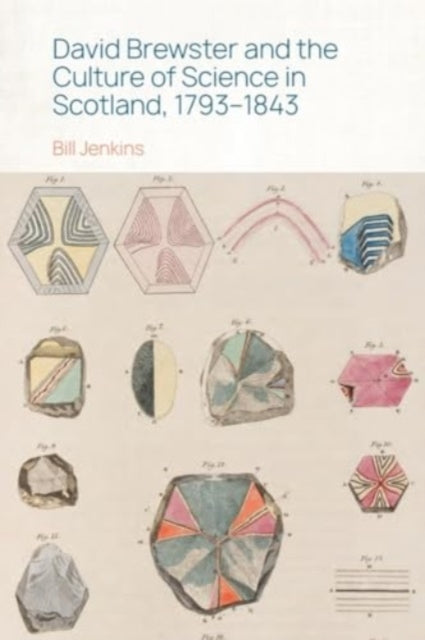
Bill Jenkins
David Brewster and the Culture of Science in Scotland, 1793 1843
David Brewster and the Culture of Science in Scotland, 1793 1843
💎 Earn 364 Points (£3.64) on this item.
We can order this item for you. Delivery usually takes about 4 to 6 weeks.
This item is not held in our immediate stock. We will order it for you after checkout.
Estimated delivery: About 4 to 6 weeks
YOU SAVE £22.14
- Condition: Brand new
- UK Delivery times: Usually arrives within 2 - 3 working days
- UK Shipping: Fee starts at £3.89. Subject to product weight & dimension
Bulk ordering. Want 15 or more copies? Get a personalised quote and bigger discounts. Learn more about bulk orders.
Couldn't load pickup availability
- More about David Brewster and the Culture of Science in Scotland, 1793 1843
The Scottish Enlightenment saw a flourishing of natural sciences, and David Brewster's career explored themes of rupture and continuity in Scottish scientific culture during a period of social and political change.
Format: Hardback
Length: 248 pages
Publication date: 30 November 2024
Publisher: Edinburgh University Press
The decades between the French Revolution and the mid-nineteenth century witnessed a profound transformation in Scottish society and culture, marked by significant advancements in the natural sciences. During this time, the Scottish Enlightenment flourished, giving rise to a distinctive and influential national scientific culture. One notable figure from this era was David Brewster, a natural philosopher who was educated in Edinburgh during the late Enlightenment and went on to become a prominent figure in Victorian science. This book utilizes Brewster's long and eventful career as a lens through which to explore themes of rupture and continuity in Scottish scientific culture during a period of dramatic social and political change.
The Scottish Enlightenment and the Birth of Scottish Scientific Culture
The Scottish Enlightenment, which occurred between the late 17th and early 18th centuries, was a period of significant intellectual and cultural growth in Scotland. It was characterized by a renewed interest in science, philosophy, and the arts, and it led to the development of a distinctive and influential national scientific culture. One of the key figures of the Scottish Enlightenment was David Brewster, a natural philosopher who was educated in Edinburgh during the late Enlightenment and went on to become a prominent figure in Victorian science. Brewster's career spanned several decades and included significant contributions to the natural sciences, including the development of the kaleidoscope, the microscope, and the theory of light.
David Brewster's Career and Contributions to Scottish Scientific Culture
David Brewster was born in Edinburgh in 1781 and grew up in a family that was deeply involved in the intellectual and cultural life of the city. His father, a lawyer, was a member of the Edinburgh Philosophical Society, and his mother was a member of the Edinburgh Literary Society. Brewster's early education was in the local schools, but he later attended the University of Edinburgh, where he studied mathematics and natural philosophy.
Brewster's Contributions to the Natural Sciences
Brewster's contributions to the natural sciences were numerous and significant. He is best known for his development of the kaleidoscope, which he invented in 1816. The kaleidoscope was a device that used mirrors to create a series of repeating patterns, and it became a popular toy and scientific instrument. Brewster's invention of the kaleidoscope was a significant milestone in the development of the natural sciences, as it demonstrated the power of reflection and the ability of light to create complex patterns.
Brewster's Contributions to the Theory of Light
Brewster's contributions to the theory of light were also significant. He developed the theory of polarization, which explained how light waves could be polarized and how this could be used to create optical instruments such as the microscope. Brewster's theory of polarization was a significant advance in the understanding of light and was used in many scientific applications, including the development of the color television.
Brewster's Legacy in Scottish Scientific Culture
Brewster's legacy in Scottish scientific culture is significant and enduring. He is remembered as a pioneer in the natural sciences and as a figure who helped to establish Scotland as a center of scientific innovation. His contributions to the natural sciences have been recognized by numerous awards and honors, including the Royal Society of Edinburgh's Copley Medal and the Royal Society of London's Royal Medal. Brewster's legacy also includes the establishment of the Brewster Institute of Photographic Science, which is a leading research center in the field of photography and imaging.
Conclusion
The decades between the French Revolution and the mid-nineteenth century were a period of radical transformation in Scottish society and culture on many levels. The Scottish Enlightenment had seen a striking blossoming of the natural sciences, with the development of a distinctive and influential national scientific culture. David Brewster was a natural philosopher who was educated in Edinburgh amidst the intellectual ferment of the late Enlightenment and went on to become a prominent figure in Victorian science. This book uses the long and eventful career of Brewster as a lens through which to explore themes of rupture and continuity in Scottish scientific culture in a period of dramatic social and political change. Brewster's contributions to the natural sciences, including the development of the kaleidoscope, the microscope, and the theory of light, have been recognized by numerous awards and honors, and his legacy continues to inspire and influence scientists and researchers around the world.
Dimension: 234 x 156 (mm)
ISBN-13: 9781399528566
UK and International shipping information
UK and International shipping information
We deliver throughout the United Kingdom and to 128 countries and territories worldwide, including the United States, Australia, Canada, Germany, Spain and France.