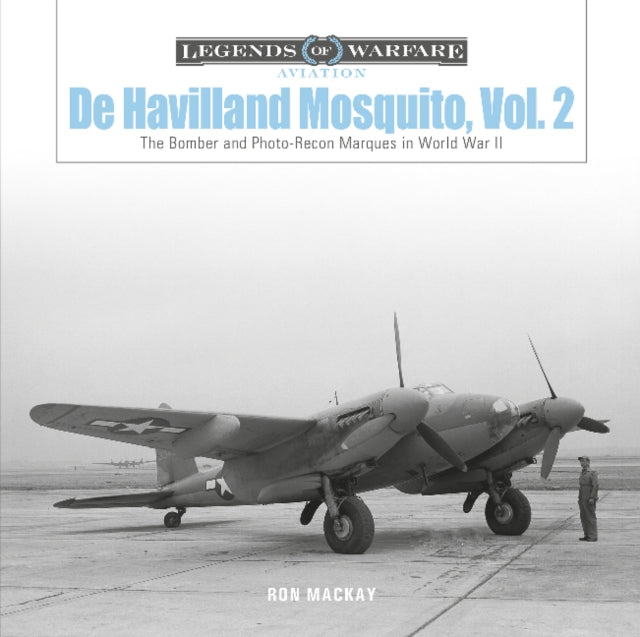
Ron Mackay
De Havilland Mosquito, Vol. 2: The Bomber and Photo-Recon Marques in World War II
De Havilland Mosquito, Vol. 2: The Bomber and Photo-Recon Marques in World War II
💎 Earn 67 Points (£0.67) on this item.
YOU SAVE £5.55
- Condition: Brand new
- UK Delivery times: Usually arrives within 2 - 3 working days
- UK Shipping: Fee starts at £3.89. Subject to product weight & dimension
Bulk ordering. Want 15 or more copies? Get a personalised quote and bigger discounts. Learn more about bulk orders.
Couldn't load pickup availability
- More about De Havilland Mosquito, Vol. 2: The Bomber and Photo-Recon Marques in World War II
The second volume of de Havilland's Wooden Wonder covers the World War II bomber and photoreconnaissance variants of the Mosquito, with pinpoint assaults on specialist targets and operational service between 1942 and 1945.
Format: Hardback
Length: 112 pages
Publication date: 28 September 2021
Publisher: Schiffer Publishing Ltd
The de Havilland Mosquito, a legendary aircraft that played a crucial role in World War II, is the subject of this comprehensive two-volume work. This second volume focuses on the bomber and photoreconnaissance variants of the Mosquito, which were instrumental in the Allied victory.
During the war, Mosquito bomber squadrons conducted relentless attacks on the enemy, day and night. Their pinpoint assaults on specialist targets caused immense destruction to the Axis forces. The Mosquito's operational service between 1942 and 1945 was extensive, spanning the ranks of the RAF, Commonwealth air forces, and US Army Air Force. It also saw postwar use, demonstrating the aircraft's versatility and longevity.
The Mosquito's design was innovative, featuring a wooden structure that made it lightweight and agile. It was equipped with powerful engines that allowed it to reach high speeds and altitudes, making it a formidable weapon in the air. Its unique shape and design also made it difficult for enemy aircraft to detect and intercept.
The Mosquito's photoreconnaissance variants were particularly valuable in the war. They were equipped with high-resolution cameras that could capture detailed images of enemy territory, providing valuable intelligence to the Allied forces. These images were used to plan strategic operations and target enemy installations.
Despite its many successes, the Mosquito faced several challenges during the war. Its wooden construction made it vulnerable to damage, and it was prone to engine failure. Additionally, the aircraft's high-altitude performance made it difficult to operate in certain conditions.
Despite these challenges, the Mosquito remained in service until the end of the war. It was used in a variety of roles, including transport, reconnaissance, and anti-submarine warfare. Its versatility and reliability made it a favorite among pilots and crew members.
In conclusion, the de Havilland Mosquito was a remarkable aircraft that played a crucial role in World War II. Its bomber and photoreconnaissance variants were instrumental in the Allied victory, and its operational service between 1942 and 1945 was extensive. Despite its challenges, the Mosquito remained in service until the end of the war and was used in a variety of roles. Its innovative design and high-performance engines made it a formidable weapon in the air, and its photoreconnaissance variants were particularly valuable in the war. Today, the Mosquito remains a symbol of the bravery and ingenuity of the Allied forces during World War II.
Weight: 750g
Dimension: 236 x 236 x 18 (mm)
ISBN-13: 9780764362378
UK and International shipping information
UK and International shipping information
We deliver throughout the United Kingdom and to 128 countries and territories worldwide, including the United States, Australia, Canada, Germany, Spain and France.