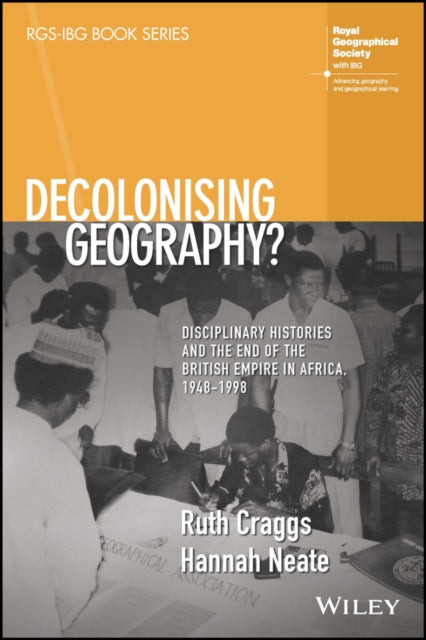
RuthCraggs,HannahNeate
Decolonising Geography? Disciplinary Histories and the End of the British Empire in Africa, 1948-1998
Decolonising Geography? Disciplinary Histories and the End of the British Empire in Africa, 1948-1998
💎 Earn 110 Points (£1.10) on this item.
YOU SAVE £2.88
- Condition: Brand new
- UK Delivery times: Usually arrives within 2 - 3 working days
- UK Shipping: Fee starts at £2.39. Subject to product weight & dimension
Bulk ordering. Want 15 or more copies? Get a personalised quote and bigger discounts. Learn more about bulk orders.
Couldn't load pickup availability
- More about Decolonising Geography? Disciplinary Histories and the End of the British Empire in Africa, 1948-1998
This book explores how colonialism, decolonization, and postcolonialism shaped African geography and geographers. It sheds light on efforts to 'Africanize the discipline' and provides fresh insights into decolonization in the former British Empire in Africa through the professional lives of individual geographers.
Format: Paperback / softback
Length: 288 pages
Publication date: 16 November 2023
Publisher: John Wiley & Sons Inc
This meticulously researched book delves into the complex and multifaceted history of African geography during the period of constitutional decolonisation, spanning from 1948 to 1998. Ruth Craggs and Hannah Neate, two esteemed academic geographers, have undertaken a comprehensive analysis of this critical juncture, shedding light on the ways in which colonialism, decolonisation, and postcolonialism shaped the discipline and its practitioners. Through an innovative biographical approach, the authors humanise and enliven the story of African geography, providing a fresh perspective on the complexities of decolonisation.
The book begins by tracing the historical roots of African geography, highlighting the contributions of early geographers and explorers who laid the foundation for the discipline. It then delves into the period of colonialism, examining the ways in which European powers exploited African resources, imposed their political systems, and marginalised indigenous knowledge systems. The authors argue that colonialism not only disrupted traditional land use practices and social structures but also created a sense of geographical inferiority among Africans, which contributed to their marginalisation in the global academic community.
Decolonisation, however, was not a linear process, and the authors explore the various struggles and resistance movements that emerged during this period. They highlight the role of African geographers in advocating for independence, promoting African knowledge systems, and challenging the colonialist worldview. The book also examines the challenges faced by African geographers in the postcolonial era, including the struggle for political stability, economic development, and the integration of African geographies into the global academic discourse.
One of the key strengths of this book is its interdisciplinary approach, drawing on a range of sources, including historical documents, academic literature, and personal accounts. The authors seamlessly integrate different disciplinary perspectives, such as geography, history, sociology, and political science, to provide a holistic understanding of the decolonising process. This approach not only enhances the academic rigour of the book but also makes it accessible to a broader audience, including students, researchers, and policymakers interested in African studies and global history.
In conclusion, Decolonising Geography? Disciplinary Histories and the End of the British Empire in Africa is a groundbreaking work that offers a fresh and insightful perspective on the history of African geography. By placing the experiences, ideas, and practices of African geographers at the centre of their analysis, Craggs and Neate provide an unprecedented account of historical and contemporary decolonising struggles within the discipline and the academy. This book should be required reading for all those seeking to decolonise the discipline and dislodge it from its Global North histories, institutions, and ideologies. It is a valuable resource for scholars, students, and policymakers alike, as it sheds light on the complex and multifaceted processes that shaped African geography and its practitioners during a critical period of global history.
Weight: 426g
Dimension: 150 x 229 x 19 (mm)
ISBN-13: 9781119549307
UK and International shipping information
UK and International shipping information
UK Delivery and returns information:
- Delivery within 2 - 3 days when ordering in the UK.
- Shipping fee for UK customers from £2.39. Fully tracked shipping service available.
- Returns policy: Return within 30 days of receipt for full refund.
International deliveries:
Shulph Ink now ships to Australia, Belgium, Canada, France, Germany, Ireland, Italy, India, Luxembourg Saudi Arabia, Singapore, Spain, Netherlands, New Zealand, United Arab Emirates, United States of America.
- Delivery times: within 5 - 10 days for international orders.
- Shipping fee: charges vary for overseas orders. Only tracked services are available for most international orders. Some countries have untracked shipping options.
- Customs charges: If ordering to addresses outside the United Kingdom, you may or may not incur additional customs and duties fees during local delivery.