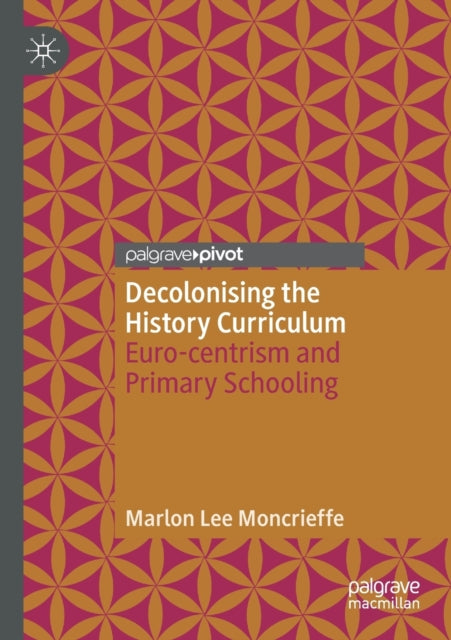
Marlon Lee Moncrieffe
Decolonising the History Curriculum: Euro-centrism and Primary Schooling
Decolonising the History Curriculum: Euro-centrism and Primary Schooling
💎 Earn 206 Points (£2.06) on this item.
We can order this item for you. Delivery usually takes about 4 to 6 weeks.
This item is not held in our immediate stock. We will order it for you after checkout.
Estimated delivery: About 4 to 6 weeks
YOU SAVE £8.70
- Condition: Brand new
- UK Delivery times: Usually arrives within 2 - 3 working days
- UK Shipping: Fee starts at £2.39. Subject to product weight & dimension
Bulk ordering. Want 15 or more copies? Get a personalised quote and bigger discounts. Learn more about bulk orders.
Couldn't load pickup availability
- More about Decolonising the History Curriculum: Euro-centrism and Primary Schooling
This book calls for a reconceptualization and decolonization of the Key Stage 2 national history curriculum to generate new knowledge for all, in the face of imposed Eurocentric starting points and dominant white-cultural attitudes. It presents how teaching and learning Black-British history in schools can be achieved, and centers his Black-British identity and minority-ethnic group experience alongside the immigrant Black-Jamaican perspective of his mother to support a framework of critical thinking of curriculum decolonization.
Format: Paperback / softback
Length: 94 pages
Publication date: 25 November 2021
Publisher: Springer Nature Switzerland AG
This book calls for a radical rethinking and decolonization of the Key Stage 2 national history curriculum. The author employs a diverse range of theories in his research with White-British primary school teachers, aimed at demonstrating how decolonizing the history curriculum can create new knowledge for all, despite the imposed Eurocentric starting points for teaching and learning in history and the dominant white-cultural attitudes in primary school education. Through both narrative and biographical methodologies, the author showcases how teaching and learning Black-British history in schools can be accomplished, while centering his Black-British identity and experiences as a minority-ethnic group alongside the immigrant Black-Jamaican perspective of his mother to provide a framework of critical curriculum decolonization. This book serves as a powerful illustration of the potential for transformative thinking and action to be employed as social justice for minority-ethnic group children who are marginalized in their educational development and learning by the dominant discourses of British history, national building, and national identity.
Introduction:
The Key Stage 2 national history curriculum in the United Kingdom has long been criticized for its Eurocentric bias and lack of representation of diverse histories. This book aims to address these issues by advocating for a reconceptualization and decolonization of the curriculum. The author argues that by decolonizing the history curriculum, we can create a more inclusive and equitable learning environment for all students, regardless of their background or identity.
Theoretical Framework:
The author draws on a range of theories to support his argument. These include postcolonial theory, critical race theory, and decoloniality theory. Postcolonial theory examines the legacies of colonialism and imperialism, while critical race theory focuses on the intersectionality of race, gender, and class in society. Decoloniality theory, on the other hand, seeks to dismantle the structures of power and privilege that perpetuate colonialism.
Research Methodology:
The author conducted his research with White-British primary school teachers to explore the potential of decolonizing the history curriculum. He employed a mixed-methods approach, including interviews, focus groups, and classroom observations. The data collected was analyzed using qualitative and quantitative methods to identify patterns and trends in the teachers' beliefs and practices.
Findings:
The author's research findings suggest that decolonizing the history curriculum can have a significant impact on students' learning outcomes. By challenging the Eurocentric narrative and promoting a more inclusive and diverse perspective, students can develop a deeper understanding of history and a greater appreciation for the contributions of marginalized groups.
Recommendations:
The author makes several recommendations for decolonizing the history curriculum. These include promoting the teaching of Black-British history, the inclusion of diverse voices and perspectives in the curriculum, and the development of critical thinking skills in students. The author also suggests that teachers should be trained to address the challenges of teaching about sensitive topics and that the curriculum should be regularly reviewed and updated to reflect changing societal attitudes and perspectives.
Conclusion:
In conclusion, this book calls for a radical rethinking and decolonization of the Key Stage 2 national history curriculum. By promoting a more inclusive and diverse perspective, we can create a learning environment that is more equitable and reflective of the diverse society we live in. The recommendations made by the author provide a clear roadmap for achieving this goal, and it is up to educators and policymakers to take action to implement these changes.
Weight: 155g
Dimension: 210 x 148 (mm)
ISBN-13: 9783030579470
Edition number: 1st ed. 2020
This item can be found in:
UK and International shipping information
UK and International shipping information
UK Delivery and returns information:
- Delivery within 2 - 3 days when ordering in the UK.
- Shipping fee for UK customers from £2.39. Fully tracked shipping service available.
- Returns policy: Return within 30 days of receipt for full refund.
International deliveries:
Shulph Ink now ships to Australia, Belgium, Canada, France, Germany, Ireland, Italy, India, Luxembourg Saudi Arabia, Singapore, Spain, Netherlands, New Zealand, United Arab Emirates, United States of America.
- Delivery times: within 5 - 10 days for international orders.
- Shipping fee: charges vary for overseas orders. Only tracked services are available for most international orders. Some countries have untracked shipping options.
- Customs charges: If ordering to addresses outside the United Kingdom, you may or may not incur additional customs and duties fees during local delivery.