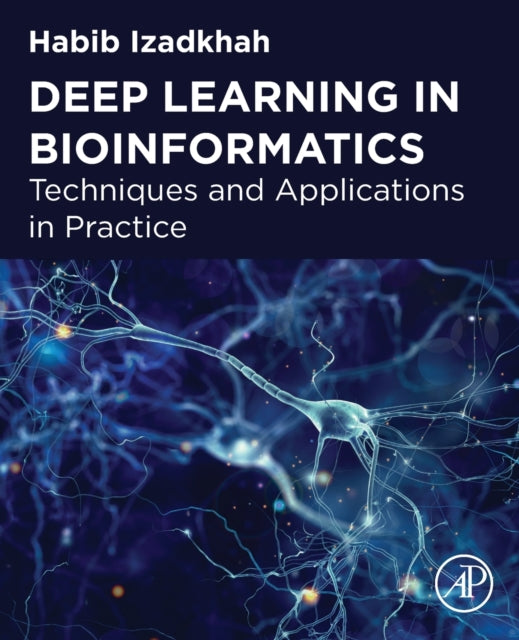
HabibIzadkhah
Deep Learning in Bioinformatics: Techniques and Applications in Practice
Deep Learning in Bioinformatics: Techniques and Applications in Practice
💎 Earn 584 Points (£5.84) on this item.
YOU SAVE £14.08
- Condition: Brand new
- UK Delivery times: Usually arrives within 2 - 3 working days
- UK Shipping: Fee starts at £2.39. Subject to product weight & dimension
Bulk ordering. Want 15 or more copies? Get a personalised quote and bigger discounts. Learn more about bulk orders.
Couldn't load pickup availability
- More about Deep Learning in Bioinformatics: Techniques and Applications in Practice
Deep Learning in Bioinformatics: Techniques and Applications in Practice provides an introduction to the topic, exploring its applications in bioinformatics, including drug discovery, de novo molecular design, sequence analysis, protein structure prediction, gene expression regulation, protein classification, biomedical image processing, and diagnosis.
Format: Paperback / softback
Length: 380 pages
Publication date: 19 January 2022
Publisher: Elsevier Science Publishing Co Inc
Deep Learning in Bioinformatics: Techniques and Applications in Practice delves into the realm of bioinformatics, offering a comprehensive and accessible introduction to this field. It explores the diverse applications of deep learning in addressing critical challenges within bioinformatics, such as drug discovery, de novo molecular design, sequence analysis, protein structure prediction, gene expression regulation, protein classification, biomedical image processing and diagnosis, biomolecule interaction prediction, and systems biology. The book showcases both theoretical and practical successes achieved through deep learning in bioinformatics, highlighting both its strengths and potential limitations. Moreover, it identifies areas for future research and provides valuable insights from renowned experts in the field, including Dr. Izadkhah. By leveraging the power of deep learning, researchers can enhance their understanding of biological processes and develop innovative solutions for various bioinformatics applications.
Deep Learning in Bioinformatics: Techniques and Applications in Practice serves as an invaluable guide for researchers seeking to harness the power of deep learning in their biological and bioinformatics studies. Authored by Dr. Izadkhah, a prominent figure in the field, the book offers a comprehensive and accessible introduction to the realm of bioinformatics. It delves into the diverse applications of deep learning in addressing critical challenges within bioinformatics, including drug discovery, de novo molecular design, sequence analysis, protein structure prediction, gene expression regulation, protein classification, biomedical image processing and diagnosis, biomolecule interaction prediction, and systems biology.
The book begins by providing a clear and concise overview of deep learning, its principles, and its potential applications in bioinformatics. It explains the underlying neural networks and machine learning algorithms used in deep learning and how they can be applied to solve complex biological problems. Through practical examples and case studies, the book demonstrates how deep learning can be utilized to analyze large datasets, identify patterns, and make predictions with high accuracy.
One of the key strengths of Deep Learning in Bioinformatics is its ability to handle large and complex datasets. Traditional bioinformatics methods often struggle with handling large amounts of data, which can be time-consuming and resource-intensive. However, deep learning algorithms can learn from large datasets and extract meaningful information, making it possible to analyze and interpret biological data more efficiently.
Another area where deep learning shines is in protein structure prediction. Protein structures are critical for understanding biological functions and drug discovery. Deep learning algorithms can accurately predict protein structures from amino acid sequences, which can save researchers significant time and resources. This has led to the discovery of new drugs and the development of personalized medicine.
Deep Learning in Bioinformatics also plays a significant role in gene expression regulation and classification. By analyzing gene expression data, deep learning algorithms can identify patterns and regulatory networks that govern gene expression. This information can be used to develop new treatments for diseases and to understand the underlying mechanisms of biological processes.
In addition to these applications, deep learning is also being used in biomedical image processing and diagnosis. Medical images, such as X-rays, CT scans, and MRI images, contain a wealth of information that can be used to diagnose diseases and monitor patient health. Deep learning algorithms can analyze these images and extract meaningful features, which can be used to develop automated diagnostic systems and improve patient care.
However, it is important to note that deep learning in bioinformatics also faces challenges. One of the main challenges is the lack of labeled data, which is essential for training deep learning algorithms. Labeled data is typically expensive and time-consuming to obtain, making it difficult for researchers to train large-scale deep learning models.
To address this challenge, researchers are exploring new methods for generating labeled data, such as synthetic data and transfer learning. Synthetic data can be generated by computer simulations or by combining existing datasets. Transfer learning can be used to transfer knowledge learned from one domain to another, which can help reduce the need for labeled data.
Another challenge is the interpretability of deep learning models. Deep learning models are often complex and difficult to understand, which can make it challenging to interpret the results and make informed decisions. Researchers are exploring new methods for explaining the decisions made by deep learning models, such as visualizations and decision trees.
In conclusion, Deep Learning in Bioinformatics: Techniques and Applications in Practice is a comprehensive and accessible guide for researchers seeking to harness the power of deep learning in their biological and bioinformatics studies. The book offers a comprehensive overview of deep learning, its principles, and its applications in bioinformatics. It showcases both theoretical and practical successes achieved through deep learning in bioinformatics, highlighting both its strengths and potential limitations. By leveraging the power of deep learning, researchers can enhance their understanding of biological processes and develop innovative solutions for various bioinformatics applications. As the field of bioinformatics continues to evolve, it is likely that deep learning will play an increasingly important role in solving complex biological problems and advancing our understanding of the natural world.
Weight: 450g
Dimension: 235 x 191 (mm)
ISBN-13: 9780128238226
This item can be found in:
UK and International shipping information
UK and International shipping information
UK Delivery and returns information:
- Delivery within 2 - 3 days when ordering in the UK.
- Shipping fee for UK customers from £2.39. Fully tracked shipping service available.
- Returns policy: Return within 30 days of receipt for full refund.
International deliveries:
Shulph Ink now ships to Australia, Belgium, Canada, France, Germany, Ireland, Italy, India, Luxembourg Saudi Arabia, Singapore, Spain, Netherlands, New Zealand, United Arab Emirates, United States of America.
- Delivery times: within 5 - 10 days for international orders.
- Shipping fee: charges vary for overseas orders. Only tracked services are available for most international orders. Some countries have untracked shipping options.
- Customs charges: If ordering to addresses outside the United Kingdom, you may or may not incur additional customs and duties fees during local delivery.