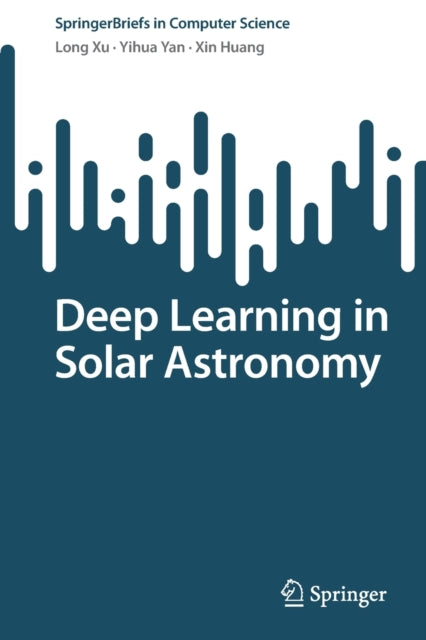
Long Xu,Yihua Yan,Xin Huang
Deep Learning in Solar Astronomy
Deep Learning in Solar Astronomy
We can order this item for you. Delivery usually takes about 4 to 6 weeks.
This item is not held in our immediate stock. We will order it for you after checkout.
Estimated delivery: About 4 to 6 weeks
YOU SAVE £10.10
- Condition: Brand new
- UK Delivery times: Usually arrives within 2 - 3 working days
- UK Shipping: Fee starts at £3.89. Subject to product weight & dimension
Bulk ordering. Want 15 or more copies? Get a personalised quote and bigger discounts. Learn more about bulk orders.
Couldn't load pickup availability
- More about Deep Learning in Solar Astronomy
The volume of data collected in solar astronomy has increased exponentially, and deep learning has been used to extract key information from this data. This book covers deep learning applications in solar astronomy, including image deconvolution, inpainting, image translation, and time series modeling, and is suitable for students and young researchers in astronomy and computer science.
Format: Paperback / softback
Length: 92 pages
Publication date: 28 May 2022
Publisher: Springer Verlag, Singapore
The amount of data being gathered in solar astronomy has experienced an exponential surge in recent years, heralding the arrival of the era of petabyte-scale solar data. In this context, deep learning has emerged as a crucial tool for efficiently extracting valuable insights from the vast volumes of solar observation data. By leveraging the power of deep learning, researchers have been able to tackle complex tasks such as data archiving, classification, object detection, and recognition with remarkable efficiency.
The initial step in astronomical study involves the acquisition of imaging data through various means, such as telescopes and satellites. However, the raw data captured in these observations often requires extensive processing before it can be analyzed and interpreted. This processing involves a series of image-enhancing techniques, including image reconstruction, inpainting, and generation, which aim to improve the quality and clarity of the images.
Within the realm of solar image processing, deep learning has played a pivotal role. One area of focus has been on image deconvolution, a technique used to synthesize aperture imaging from multiple observations. By leveraging deep learning algorithms, researchers have been able to reconstruct high-resolution images from sparse or incomplete data, enabling a more comprehensive understanding of solar phenomena.
Another area of deep learning application in solar astronomy is image inpainting. This technique involves repairing over-saturated solar images caused by light intensity exceeding the threshold of optical lenses. Deep learning algorithms are trained to identify and fill in the missing pixels, restoring the original image quality. This is particularly important for studying regions of the solar corona or chromosphere that are difficult to observe directly, as they are often obscured by intense sunlight.
Furthermore, deep learning has been employed to facilitate image translation among different wavebands and observation devices. For instance, it can be used to convert images captured in the ultraviolet (UV) or extreme ultraviolet (EUV) regions to visible light, allowing researchers to study the solar corona and chromosphere from a broader perspective. Similarly, deep learning can be used to translate images from different telescopes or satellites, enabling a more comprehensive analysis of solar phenomena across different wavelengths.
In addition to image processing, deep learning has also been used to forecast solar bursts and solar activity indices. Time series models, such as long short-term memory (LSTM), are trained to analyze historical data and predict future patterns in solar activity. By leveraging deep learning algorithms, researchers can gain insights into the dynamics of the solar corona, predict the occurrence of solar flares, and monitor the evolution of solar storms.
This book aims to provide a comprehensive overview of the deep learning applications in solar astronomy. It is designed for students and young researchers who are interested in astronomy and computer science, particularly in interdisciplinary research areas that combine these two fields. The book begins by introducing the basics of deep learning and its applications in image processing. It then delves into specific areas of deep learning in solar astronomy, including image deconvolution, image inpainting, image translation, and time series modeling.
Each chapter includes detailed explanations of the underlying algorithms, practical examples, and case studies that illustrate the effectiveness of deep learning in solar astronomy. The book also includes a comprehensive bibliography that provides further resources for those interested in exploring the field further.
In conclusion, the volume of data being collected in solar astronomy has surged in recent years, presenting a significant challenge for researchers. Deep learning has emerged as a powerful tool for efficiently extracting valuable insights from this vast amount of data. By leveraging the power of deep learning, researchers have been able to tackle complex tasks such as data archiving, classification, object detection, and recognition with remarkable efficiency. This book provides a comprehensive overview of the deep learning applications in solar astronomy, making it an invaluable resource for students and young researchers in this field.
Weight: 180g
Dimension: 235 x 155 (mm)
ISBN-13: 9789811927454
Edition number: 1st ed. 2022
UK and International shipping information
UK and International shipping information
We deliver throughout the United Kingdom and to 128 countries and territories worldwide, including the United States, Australia, Canada, Germany, Spain and France.