1
/
of
1
Maxime C. Cohen,Paul-Emile Gras,Arthur Pentecoste,Renyu Zhang
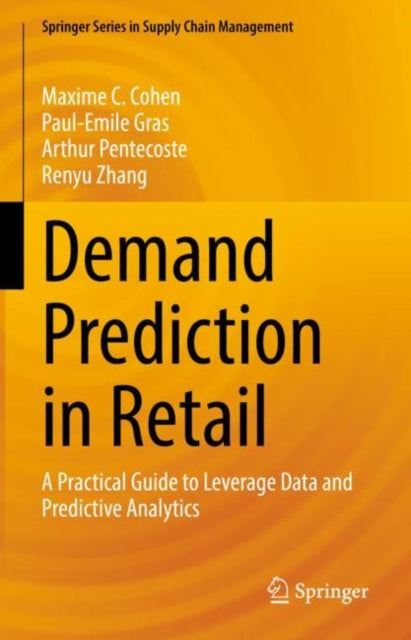
Demand Prediction in Retail: A Practical Guide to Leverage Data and Predictive Analytics
Demand Prediction in Retail: A Practical Guide to Leverage Data and Predictive Analytics
Low Stock: Only 1 copies remaining
Regular price
£74.09 GBP
Regular price
£99.99 GBP
Sale price
£74.09 GBP
Unit price
/
per
Taxes included.
Shipping calculated at checkout.
YOU SAVE £25.90
- Condition: Brand new
- UK Delivery times: Usually arrives within 2 - 3 working days
- UK Shipping: Fee starts at £3.89. Subject to product weight & dimension
Bulk ordering. Want 15 or more copies? Get a personalised quote and bigger discounts. Learn more about bulk orders.
Couldn't load pickup availability
- More about Demand Prediction in Retail: A Practical Guide to Leverage Data and Predictive Analytics
This book provides a comprehensive overview of the process of predicting demand for retailers, illustrating each step with code and implementation details. It can be applied to most retail settings and is intended to help students and practitioners better leverage data for predictive analytics.
Format: Hardback
Length: 155 pages
Publication date: 22 December 2021
Publisher: Springer Nature Switzerland AG
Predicting Demand for Retailers: A Comprehensive Guide
The process of predicting demand for retailers is a complex and multifaceted endeavor that requires a thorough understanding of historical data, statistical analysis, and market trends. This book provides a comprehensive overview of the entire process, from data collection to evaluation and visualization of prediction results.
In the first chapter, the authors introduce the concept of demand prediction and discuss its importance in the retail industry. They explain how retailers can use data to optimize their inventory management, reduce waste, and improve customer satisfaction. The chapter also highlights the challenges that retailers face in predicting demand, such as the complexity of the retail landscape, the variability of customer behavior, and the availability of accurate data.
The second chapter provides an in-depth explanation of the data collection process. The authors discuss the different sources of data that can be used for demand prediction, such as sales data, customer feedback, and social media analytics. They also provide guidance on how to collect and clean the data to ensure its accuracy and relevance.
In the third chapter, the authors introduce the concept of statistical analysis and discuss the different types of models that can be used for demand prediction. They explain how to select the most appropriate model based on the nature of the data and the goals of the prediction. The chapter also provides an overview of the statistical techniques that can be used to analyze the data, such as regression analysis, time series analysis, and machine learning.
In the fourth chapter, the authors discuss the evaluation and visualization of prediction results. They explain how to assess the accuracy of the prediction and identify any potential biases or errors. The chapter also provides guidance on how to communicate the results to stakeholders, such as management and customers, in a clear and effective manner.
Throughout the book, the authors use real-world examples and case studies to illustrate the concepts and techniques presented. They also provide the relevant code and implementation details to demystify how historical data can be leveraged to predict future demand.
The tools and methods presented in this book can be applied to most retail settings, both online and brick-and-mortar, such as fashion, electronics, groceries, and furniture. Whether you are a business analytics student or a supply chain practitioner interested in predicting demand, this book is intended to help you better master the art of leveraging data for predicting demand in retail applications.
In conclusion, this book provides a comprehensive and practical guide.
The process of predicting demand for retailers is a complex and multifaceted endeavor that requires a thorough understanding of historical data, statistical analysis, and market trends. This book provides a comprehensive overview of the entire process, from data collection to evaluation and visualization of prediction results.
In the first chapter, the authors introduce the concept of demand prediction and discuss its importance in the retail industry. They explain how retailers can use data to optimize their inventory management, reduce waste, and improve customer satisfaction. The chapter also highlights the challenges that retailers face in predicting demand, such as the complexity of the retail landscape, the variability of customer behavior, and the availability of accurate data.
The second chapter provides an in-depth explanation of the data collection process. The authors discuss the different sources of data that can be used for demand prediction, such as sales data, customer feedback, and social media analytics. They also provide guidance.
In the third chapter, the authors introduce the concept of statistical analysis and discuss the different types of models that can be used for demand prediction. They explain how to select the most appropriate model based on the nature of the data and the goals of the prediction. The chapter also provides an overview of the statistical techniques that can be used to analyze the data, such as regression analysis, time series analysis, and machine learning.
In the fourth chapter, the authors discuss the evaluation and visualization of prediction results. They explain how to assess the accuracy of the prediction and identify any potential biases or errors. The chapter also provides guidance.
Throughout the book, the authors use real-world examples and case studies to illustrate the concepts and techniques presented. They also provide the relevant code and implementation details to demystify how historical data can be leveraged to predict future demand.
The tools and methods presented in this book can be applied to most retail settings, both online and brick-and-mortar, such as fashion, electronics, groceries.
Whether you are a business analytics student or a supply chain practitioner interested in predicting demand, this book is intended to help you better master the art of leveraging data for predicting demand in retail applications.
In conclusion, this book provides a comprehensive and practical guide to leveraging data for predicting demand in retail applications. It is a valuable resource for students in business analytics and data scientists who are interested in mastering the art of leveraging data for predicting demand in retail applications. It is also a valuable guide for supply chain practitioners who are interested in predicting demand.
Weight: 436g
Dimension: 235 x 155 (mm)
ISBN-13: 9783030858544
Edition number: 1st ed. 2022
UK and International shipping information
UK and International shipping information
We deliver throughout the United Kingdom and to 128 countries and territories worldwide, including the United States, Australia, Canada, Germany, Spain and France.