Shulph Ink
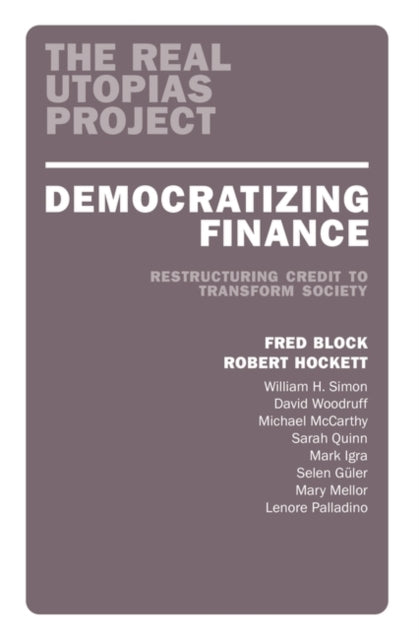
Democratizing Finance: Restructuring Credit to Transform Society
Democratizing Finance: Restructuring Credit to Transform Society
💎 Earn 117 Points (£1.17) on this item.
YOU SAVE £1.40
- Condition: Brand new
- UK Delivery times: Usually arrives within 2 - 3 working days
- UK Shipping: Fee starts at £3.89. Subject to product weight & dimension
Bulk ordering. Want 15 or more copies? Get a personalised quote and bigger discounts. Learn more about bulk orders.
Couldn't load pickup availability
- More about Democratizing Finance: Restructuring Credit to Transform Society
Robert Hockett and Fred Block argue that an entirely different financial system is both desirable and possible. They outline concrete steps that could get us there, such as investing in enterprises or institutions that provide things that the majority of people would prioritize. Democratizing Finance includes six responses that seek to amend, elaborate, and challenge the arguments developed by Hockett and Block.
Format: Paperback / softback
Length: 336 pages
Publication date: 08 February 2022
Publisher: Verso Books
What if our financial system were organized to the benefit of the many rather than simply empowering the few? Robert Hockett and Fred Block argue that an entirely different financial system is both desirable and possible. They outline concrete steps that could get us there. Financial systems move the worlds savings from investment to investment, chasing the highest rates of return. They run on profit. But what if investment went to the enterprises or institutions that provided things that the majority of people would prioritize?
Democratizing Finance includes six responses that seek to amend, elaborate, and challenge the arguments developed by Hockett and Block. Some of the core arguments put forward by other contributors include calls for the rapid elimination of private financial entities, the dilemmas of the politics associated with financial reforms, and the fate of parallel proposals advanced in the US in the 1930s.
The first response, proposed by economist and author James Gustave Speth, suggests that we should move towards a financial system that is publicly owned and controlled. This would involve the creation of a national bank that would provide credit to businesses and institutions that prioritize the needs of the majority of people, such as healthcare, education, and housing. The second response, proposed by political scientist and author Martin Gilens, suggests that we should move towards a financial system that is more democratic and transparent. This would involve the creation of a public financial database that would allow citizens to track the flow of money and identify the sources of funding for political campaigns. The third response, proposed by economist and author Naomi Klein, suggests that we should move towards a financial system that is based on the principles of social justice and sustainability. This would involve the creation of a financial system that is designed to promote economic growth and social well-being, while also protecting the environment and promoting social equality. The fourth response, proposed by economist and author Thomas Piketty, suggests that we should move towards a financial system that is more progressive and redistributive. This would involve the creation of a financial system that is designed to reduce income inequality and promote economic growth, while also providing a safety net for those who are most vulnerable. The fifth response, proposed by economist and author Stephanie Kelton, suggests that we should move towards a financial system that is more decentralized and community-based. This would involve the creation of a financial system that is designed to promote economic growth and social well-being, while also promoting local ownership and control over financial institutions. The sixth response, proposed by economist and author Richard D. Wolff, suggests that we should move towards a financial system that is more democratic and participatory. This would involve the creation of a financial system that is designed to promote economic growth and social well-being, while also promoting citizen participation and engagement in financial decision-making.
In conclusion, Democratizing Finance provides a comprehensive and thoughtful exploration of the arguments for and against a different financial system. While there are many different perspectives on the issue, the book suggests that there are concrete steps that we can take to move towards a financial system that is more democratic, transparent, and sustainable. By prioritizing the needs of the majority of people and promoting economic growth and social well-being, we can create a financial system that is more equitable and just for all.
Weight: 384g
Dimension: 153 x 233 x 25 (mm)
ISBN-13: 9781839762673
UK and International shipping information
UK and International shipping information
We deliver throughout the United Kingdom and to 128 countries and territories worldwide, including the United States, Australia, Canada, Germany, Spain and France.