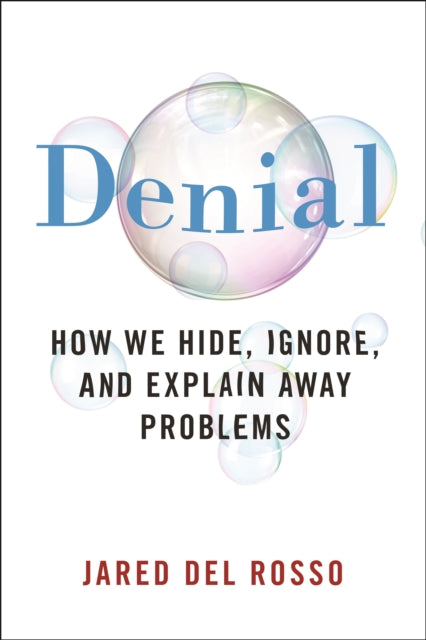
Jared Del Rosso
Denial: How We Hide, Ignore, and Explain Away Problems
Denial: How We Hide, Ignore, and Explain Away Problems
💎 Earn 78 Points (£0.78) on this item.
YOU SAVE £3.31
- Condition: Brand new
- UK Delivery times: Usually arrives within 2 - 3 working days
- UK Shipping: Fee starts at £3.89. Subject to product weight & dimension
Bulk ordering. Want 15 or more copies? Get a personalised quote and bigger discounts. Learn more about bulk orders.
Couldn't load pickup availability
- More about Denial: How We Hide, Ignore, and Explain Away Problems
Denial is a fascinating and enlightening look at the widespread phenomenon of denial in our society, from climate change to fake news. Jared Del Rosso argues that denial is so much a part of our lives that we deny its existence all the time, even when this works against our best interest. He builds a fascinating typology of the forms and meanings of denial, exploring the behavior of those who refuse to acknowledge their actions and what it means to live in a society where such lying, fraud, and corruption is commonplace. He also focuses on the individuals involved but also asks: how could so many people not know what their priests, coaches, or coworkers were doing?
Format: Paperback / softback
Length: 312 pages
Publication date: 29 April 2024
Publisher: New York University Press
From climate change to fake news, an entertaining and enlightening look at the widespread phenomenon of denial in our society Donald Trump won the election; climate change isn't real; America is a color-blind country. Despite overwhelming evidence to the contrary, why do so many of us refuse to admit the truth? In fact, as Jared Del Rosso argues in this thought-provoking book, denial is so much a part of our lives that we deny its existence all the time, even when this works against our best interest, even when we are being choked by its very fumes. Denial is one of those rare books that will change the way you think. In a highly readable style that draws on examples from current events, politics, and pop culture, Del Rosso teases out the complexities of denial, from not noticing that someone has food stuck in their teeth, to companies that engage in widespread fraud, like Enron and Wells Fargo, to the much larger-scale denials of climate change or systemic racism. Drawing on classic studies in the social sciences and his own research of the denial of torture, Del Rosso builds a fascinating typology of the forms and meanings of denial, exploring the behavior of those who refuse to acknowledge their actions, and what it means to live in a society where such lying, fraud, and corruption is commonplace. In wide-ranging examples, Del Rosso explores the causes, strategies, and consequences of denial. When scandal hits and accusations of misconduct are made, he argues that individuals like Harvey Weinstein or Brett Kavanaugh, or organizations like the Catholic Church or Penn State, go through a series of moves to try to avoid accountability. Del Rosso focuses on the individuals involved but also asks: how could so many people not know what their priests, or their coaches, or their teachers were doing? How could so many people not know what was happening in their own communities? Del Rosso's book is a powerful reminder that denial is not just a problem for individuals but for society as a whole. It is a threat to our democracy, our economy, and our very way of life. By understanding the nature of denial, we can work to address it and create a more just and equitable world.
Denial: Why We Refuse to Admit the Truth
In a world where climate change is real, America is a color-blind country, and fake news is rampant, why do so many of us refuse to admit the truth?
According to Jared Del Rosso, denial is a widespread phenomenon that affects our lives in many ways. In his thought-provoking book, "Denial: Why We Refuse to Admit the Truth," Del Rosso explores the complexities of denial, from not noticing that someone has food stuck in their teeth to companies that engage in widespread fraud to the much larger-scale denials of climate change or systemic racism.
Del Rosso draws on classic studies in the social sciences and his own research of the denial of torture to build a fascinating typology of the forms and meanings of denial. He explores the behavior of those who refuse to acknowledge their actions and what it means to live in a society where such lying, fraud, and corruption is commonplace.
The Causes of Denial
Del Rosso argues that denial is a response to fear and uncertainty. When we are faced with a situation that we cannot control or understand, we may choose to deny the truth in order to protect ourselves from the pain and anxiety that comes with facing the truth.
For example, when a scandal hits and accusations of misconduct are made, individuals and organizations may go through a series of moves to try to avoid accountability. They may deny that the misconduct occurred, or they may try to shift the blame to someone else. They may also try to cover up the truth by destroying evidence or lying to the public.
The Strategies of Denial
Del Rosso identifies several strategies of denial. One of the most common is denial of responsibility. Individuals and organizations may deny that they are responsible for the harm that they have caused, even when there is overwhelming evidence to the contrary. They may also deny that they have any control over the situation.
Another strategy of denial is denial of awareness. Individuals and organizations may deny that they were aware of the harm that they were causing, even when there is overwhelming evidence to the contrary. They may also deny that they had any intention of causing harm.
Del Rosso also identifies denial of consequences. Individuals and organizations may deny that the consequences of their actions will be negative, even when there is overwhelming evidence to the contrary. They may also deny that they have any responsibility for the consequences of their actions.
The Consequences of Denial
The consequences of denial can be severe. When denial is used to avoid accountability, it can lead to harm to individuals and society as a whole. For example, when a company engages in widespread fraud, it can result in financial losses for its customers and employees, and it can also damage the company's reputation.
When denial is used to avoid accountability in the context of climate change, it can lead to catastrophic consequences for the planet. Climate change is a global problem that requires urgent action, and denial of its existence can prevent us from taking the necessary steps to address it.
In addition to the consequences for individuals and society, denial can also have a negative impact on our mental health. When we deny the truth, we can experience feelings of anxiety, depression, and guilt. We may also find it difficult to trust others and to make decisions.
Addressing Denial
Addressing denial is a complex task, but it is essential if we are to create a more just and equitable world. Del Rosso suggests that we need to start by acknowledging the truth. We need to be willing to face the pain and anxiety that comes with facing the truth, and we need to be willing to take action to address the harm that has been caused.
Del Rosso also suggests that we need to be willing to listen to others. We need to be willing to hear their perspectives and to understand their experiences. We need to be willing to work together to find solutions to the problems that we face.
In conclusion, denial is a widespread phenomenon that affects our lives in many ways. It is a response to fear and uncertainty, and it can lead to severe consequences for individuals and society as a whole. By acknowledging the truth, listening to others, and taking action to address the harm that has been caused, we can work to address denial and create a more just and equitable world.
Weight: 474g
Dimension: 152 x 229 x 21 (mm)
ISBN-13: 9781479847884
UK and International shipping information
UK and International shipping information
We deliver throughout the United Kingdom and to 128 countries and territories worldwide, including the United States, Australia, Canada, Germany, Spain and France.