AgnesKriza
Depicting Orthodoxy in the Russian Middle Ages: The Novgorod Icon of Sophia, the Divine Wisdom
Depicting Orthodoxy in the Russian Middle Ages: The Novgorod Icon of Sophia, the Divine Wisdom
We can order this item for you. Delivery usually takes about 4 to 6 weeks.
This item is not held in our immediate stock. We will order it for you after checkout.
Estimated delivery: About 4 to 6 weeks
- Condition: Brand new
- UK Delivery times: Usually arrives within 2 - 3 working days
- UK Shipping: Fee starts at £3.89. Subject to product weight & dimension
Bulk ordering. Want 15 or more copies? Get a personalised quote and bigger discounts. Learn more about bulk orders.
Couldn't load pickup availability
- More about Depicting Orthodoxy in the Russian Middle Ages: The Novgorod Icon of Sophia, the Divine Wisdom
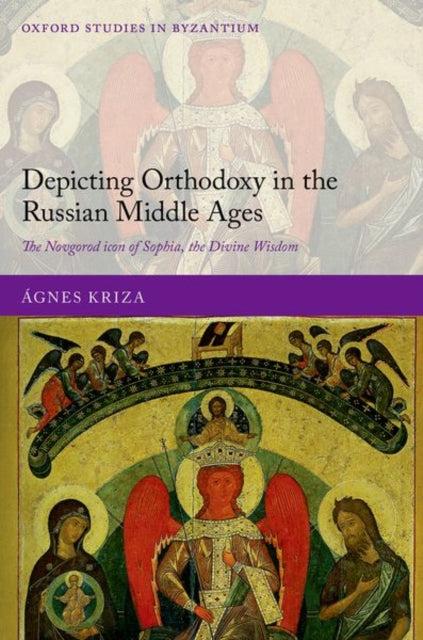
The image of Divine Wisdom, traditionally associated with the Sophia Cathedral in Novgorod, is an innovation of the fifteenth century. This icon represents the winged, royal, red-faced Sophia flanked by the Mother of God and John the Baptist. By exploring the message, roots, function, and historical context of the creation of the first, most emblematic and enigmatic Russian allegorical iconography, Depicting Orthodoxy in the Russian Middle Ages deciphers the meaning of this icon. Kriza argues that the winged Sophia is the personification of the Orthodox Church and that the icon, together with its commentary, was a visual-textual response to the Union of Florence between the Catholic and Orthodox Churches. This interpretation challenges some key assumptions concerning the relevance of the Church Schism of 1054, the polemics between the Greeks and the Latins about the bread of Eucharist, and the role of the Union of Florence in the history of Russian art.
Format: Hardback
Length: 384 pages
Publication date: 28 April 2022
Publisher: Oxford University Press
The image of Divine Wisdom, traditionally associated with the Sophia Cathedral in Novgorod, is a remarkable innovation of the fifteenth century. The icon portrays the winged, royal, red-faced Sophia flanked by the Mother of God and John the Baptist. While the image has a contemporaneous commentary and exerted a profound influence on Russian cultural history, its meaning, along with the dating and localization of the first appearance of the iconography, has remained an art-historical conundrum. By delving into the message, roots, function, and historical context of the creation of the first, most emblematic, and enigmatic Russian allegorical iconography, Depicting Orthodoxy in the Russian Middle Ages deciphers the significance of this icon.
In contrast to previous interpretations, Kriza argues that the winged Sophia represents the personification of the Orthodox Church. The Novgorod Wisdom icon, in essence, portrays the Church of Hagia Sophia, or Orthodoxy, as it was perceived in fifteenth-century Rus. Depicting Orthodoxy asserts that the icon, along with its commentary, was a visual-textual response to the Union of Florence between the Catholic and Orthodox Churches, signed in 1439 but rejected by the Russians in 1441. This interpretation is based on extensive interdisciplinary research, drawing on philology, art history, theology, and history. Kriza's study challenges some key assumptions concerning the relevance of the Church Schism of 1054, the polemics between the Greeks and the Latins about the bread of Eucharist, and the role of the Union of Florence in the history of Russian art.
In particular, by studying both well-known and lesser-known works of art alongside overlooked textual evidence, this volume investigates how the Christian Church and its true faith were defined and visualized in Rus a. The study explores the complex interplay between religious, political, and cultural factors that shaped the development of Russian allegorical iconography. It sheds light on the ways in which artists and intellectuals responded to the challenges and opportunities presented by the Union of Florence and the broader Christian East-West divide.
Through a detailed analysis of the iconographic elements, stylistic characteristics, and historical context, Kriza demonstrates how the Novgorod Wisdom icon became a powerful symbol of Orthodoxy in fifteenth-century Rus. The icon's winged Sophia, with her outstretched wings and radiant face, symbolizes the transcendent nature of the Church and its ability to reach beyond earthly boundaries. The Mother of God and John the Baptist, positioned on either side
side of Sophia, represent the earthly and heavenly dimensions of the Church, with Mary as the embodiment of purity and grace and John as the herald of the coming Messiah.
The icon's commentary, written by a fifteenth-century scholar, provides further insight into the meaning and significance of the image. The commentary emphasizes the importance of the Union of Florence and the role of the Orthodox Church in preserving Christian unity. It also highlights the significance of Sophia as a symbol of wisdom and knowledge, emphasizing her role as the embodiment of divine wisdom and the source of all spiritual knowledge.
The dating and localization of the first appearance of the Novgorod Wisdom icon have also been a subject of debate among art historians. Kriza argues that the icon was created in the early fifteenth century, specifically in the years around 1420-1430. He bases this argument on a detailed analysis of the iconographic elements, stylistic characteristics, and historical context. He also challenges previous assumptions about the icon's origins, suggesting that it may have been created in Novgorod rather than in Constantinople, as previously believed.
The study of the Novgorod Wisdom icon offers valuable insights into the development of Russian allegorical iconography and the broader Christian East-West divide. It challenges traditional interpretations and provides a fresh perspective on the role of the Orthodox Church in shaping Russian cultural and artistic heritage. The icon's message, roots, function, and historical context continue to inspire and intrigue scholars and enthusiasts alike, and its significance as a symbol of Orthodoxy and Christian unity remains undiminished.
Weight: 788g
Dimension: 240 x 162 x 24 (mm)
ISBN-13: 9780198854302
UK and International shipping information
UK and International shipping information
We deliver throughout the United Kingdom and to 128 countries and territories worldwide, including the United States, Australia, Canada, Germany, Spain and France.