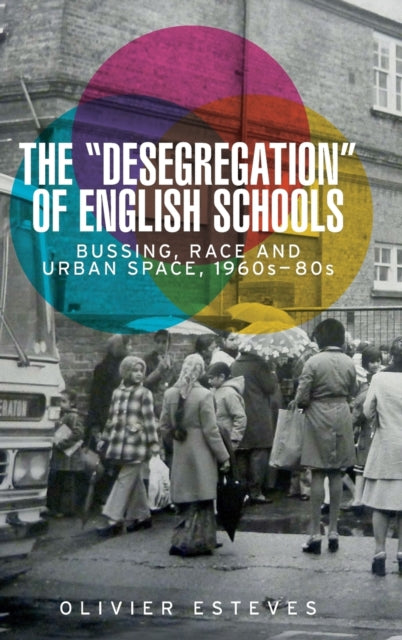
Olivier Esteves
'Desegregation' of English Schools: Bussing, Race and Urban Space, 1960s-80s
'Desegregation' of English Schools: Bussing, Race and Urban Space, 1960s-80s
💎 Earn 376 Points (£3.76) on this item.
We can order this item for you. Delivery usually takes about 4 to 6 weeks.
This item is not held in our immediate stock. We will order it for you after checkout.
Estimated delivery: About 4 to 6 weeks
YOU SAVE £9.77
- Condition: Brand new
- UK Delivery times: Usually arrives within 2 - 3 working days
- UK Shipping: Fee starts at £2.39. Subject to product weight & dimension
Bulk ordering. Want 15 or more copies? Get a personalised quote and bigger discounts. Learn more about bulk orders.
Couldn't load pickup availability
- More about 'Desegregation' of English Schools: Bussing, Race and Urban Space, 1960s-80s
The early-1960s introduction of dispersal in England was intended to promote linguistic and cultural integration, but it failed due to racial identity and increased segregation. This is the first book on English bussing based on an in-depth study of local and national archives and interviews with formerly-bussed pupils.
Format: Hardback
Length: 240 pages
Publication date: 14 December 2018
Publisher: Manchester University Press
In the early 1960s, a significant shift occurred in England when white parents expressed concerns about the rapid influx of non-Anglophone South Asian children. Their primary concern revolved around the potential impact on their own children's education. To address this issue, a controversial policy known as dispersal, or "bussing," was implemented. The essence of dispersal was to transport busloads of predominantly Asian children to predominantly white suburban schools. The intention behind this initiative was to alleviate the burden on overburdened inner-city schools and promote linguistic and cultural integration. However, the outcome of dispersal was far from what was intended. It was based on racial identity rather than linguistic deficiency and, as a result, inadvertently led to an increase in segregation. Bussed pupils faced daily encounters with racial bullying, which further exacerbated the existing divisions within schools.
This groundbreaking book, the first ever to delve into the topic of English bussing, is a result of an extensive study of local and national archives, coupled with interviews conducted with formerly-bussed pupils decades after their experiences. The authors have delved deep into the historical context, examining the social, political, and educational factors that shaped the dispersal policy. Through their meticulous research, they have shed light on the personal stories of those affected by bussing, providing a poignant and eye-opening account of a controversial period in English education.
The book explores the various motivations behind the introduction of bussing, including the desire to alleviate overcrowding in inner-city schools and promote social mixing. However, it also highlights the unintended consequences of this policy, such as the reinforcement of racial stereotypes and the exacerbation of existing tensions between different communities. The authors argue that bussing was a flawed approach that failed to address the root causes of educational inequality and instead perpetuated segregation and division.
One of the key findings of the book is that bussing was not solely driven by educational considerations but also by broader social and political factors. The authors argue that the policy was heavily influenced by the prevailing racial attitudes of the time, which saw Asian children as a threat to the social and economic stability of white communities. This perception led to the stigmatization of Asian pupils and the marginalization of their cultural practices and languages.
Furthermore, the book highlights the impact of bussing on the lives of the pupils who were subjected to it. The authors describe the experiences of bussed pupils, including the discrimination they faced, the challenges they encountered in adjusting to new environments, and the emotional toll of being subjected to racial bullying. They also explore the long-term effects of bussing on these pupils, including their educational outcomes, social relationships, and sense of identity.
The book also provides a critical analysis of the policies and practices that led to the implementation and continuation of bussing. The authors argue that the policy was flawed from the outset and that it was based on a narrow understanding of educational equality and social integration. They suggest that a more comprehensive and inclusive approach to education, which recognizes the diversity of students and their unique needs, would have been more effective in promoting social harmony and educational achievement.
In conclusion, this book is a valuable contribution to the study of education and social history. It provides a comprehensive and nuanced account of the introduction and consequences of bussing in England in the early 1960s. Through their research, the authors have shed light on the complex web of factors that shaped this policy and its impact on the lives of those affected by it. The book serves as a reminder of the importance of addressing educational inequality and promoting social harmony in a diverse and inclusive society.
Weight: 500g
Dimension: 235 x 161 x 22 (mm)
ISBN-13: 9781526124852
UK and International shipping information
UK and International shipping information
UK Delivery and returns information:
- Delivery within 2 - 3 days when ordering in the UK.
- Shipping fee for UK customers from £2.39. Fully tracked shipping service available.
- Returns policy: Return within 30 days of receipt for full refund.
International deliveries:
Shulph Ink now ships to Australia, Belgium, Canada, France, Germany, Ireland, Italy, India, Luxembourg Saudi Arabia, Singapore, Spain, Netherlands, New Zealand, United Arab Emirates, United States of America.
- Delivery times: within 5 - 10 days for international orders.
- Shipping fee: charges vary for overseas orders. Only tracked services are available for most international orders. Some countries have untracked shipping options.
- Customs charges: If ordering to addresses outside the United Kingdom, you may or may not incur additional customs and duties fees during local delivery.