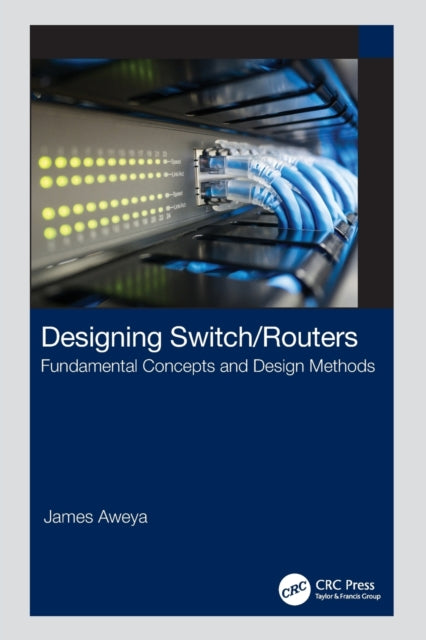
James Aweya
Designing Switch/Routers: Fundamental Concepts and Design Methods
Designing Switch/Routers: Fundamental Concepts and Design Methods
💎 Earn 429 Points (£4.29) on this item.
We can order this item for you. Delivery usually takes about 4 to 6 weeks.
This item is not held in our immediate stock. We will order it for you after checkout.
Estimated delivery: About 4 to 6 weeks
YOU SAVE £5.10
- Condition: Brand new
- UK Delivery times: Usually arrives within 2 - 3 working days
- UK Shipping: Fee starts at £2.39. Subject to product weight & dimension
Bulk ordering. Want 15 or more copies? Get a personalised quote and bigger discounts. Learn more about bulk orders.
Couldn't load pickup availability
- More about Designing Switch/Routers: Fundamental Concepts and Design Methods
A switch/router is a networking device that combines the functions of a switch and a router. It uses a routing protocol to select the best path to a network destination and forwards data packets to their destination. There are different design methods and architectures associated with switch/routers, such as layer 2 switching and layer 3 routing. Example architectures include the Clos network and the Internet backbone.
Format: Paperback / softback
Length: 332 pages
Publication date: 04 October 2022
Publisher: Taylor & Francis Ltd
The switch/router is a critical component of modern computer networks, responsible for forwarding data packets between devices on a network. It plays a vital role in ensuring the efficient and reliable operation of networks, and its design and architecture are crucial to its performance. In this article, we will provide an introductory level discussion that covers the functions and architectures of the switch/router.
Focuses on the fundamental concepts that underline the design of switch/routers in general.
Explains how a routing protocol uses a routing metric to select the best path to a network destination when multiple paths exist.
Discusses in greater detail the various design methods, and the well-known architectures associated with switch/routers.
Provides example architectures that illustrate how real-world switch/routers are designed.
A switch/router is a networking device that connects devices on a computer network. It is designed to forward data packets between devices based on their IP addresses or other network parameters. Switch/routers can be classified into two main types: layer 2 switch/routers and layer 3 switch/routers.
Layer 2 switch/routers operate at the data link layer of the OSI model, which is the second layer of the TCP/IP protocol stack. They are responsible for forwarding data packets between devices on a network based on their MAC addresses. Layer 2 switch/routers do not perform any routing or packet filtering and are mainly used for connecting devices in a local area network (LAN).
Layer 3 switch/routers, on the other hand, operate at the network layer of the OSI model, which is the third layer of the TCP/IP protocol stack. They are responsible for routing data packets between devices on a network based on their IP addresses. Layer 3 switch/routers also perform packet filtering and can route data packets to different destinations based on their IP addresses, network protocols, and other parameters.
One of the most important features of a switch/router is its ability to forward data packets quickly and efficiently. Switch/routers use a variety of techniques to achieve this, including fast switching algorithms, queuing mechanisms, and traffic management protocols. Fast switching algorithms allow switch/routers to quickly forward data packets to the correct destination, while queuing mechanisms ensure that data packets are queued in a specific order and are forwarded in a FIFO (first-in, first-out) manner. Traffic management protocols, such as port blocking and rate limiting, are used to control the amount of traffic that is forwarded to different devices on a network.
Another important feature of a switch/router is its ability to provide redundancy and fault tolerance. Switch/routers can be configured to provide multiple paths to a network destination, allowing for redundancy in case one path becomes unavailable. Additionally, switch/routers can be configured to detect and isolate faults, such as network outages or hardware failures, and can automatically reroute data packets to avoid the affected area.
Switch/routers are also used in a variety of applications, including enterprise networks, data centers, and home networks. In enterprise networks, switch/routers are used to connect multiple devices and provide high-speed, reliable connectivity between them. In data centers, switch/routers are used to connect servers and storage devices and provide high-speed, reliable connectivity between them. In home networks, switch/routers are used to connect multiple devices, such as computers, televisions, and smartphones, and provide high-speed, reliable connectivity between them.
In conclusion, the switch/router is a critical component of modern computer networks, responsible for forwarding data packets between devices on a network. Its design and architecture are crucial to its performance, and it can be classified into two main types: layer 2 switch/routers and layer 3 switch/routers. Switch/routers use a variety of techniques to achieve fast and efficient data forwarding, provide redundancy and fault tolerance, and are used in a variety of applications.
Dimension: 234 x 156 (mm)
ISBN-13: 9781032315829
UK and International shipping information
UK and International shipping information
UK Delivery and returns information:
- Delivery within 2 - 3 days when ordering in the UK.
- Shipping fee for UK customers from £2.39. Fully tracked shipping service available.
- Returns policy: Return within 30 days of receipt for full refund.
International deliveries:
Shulph Ink now ships to Australia, Belgium, Canada, France, Germany, Ireland, Italy, India, Luxembourg Saudi Arabia, Singapore, Spain, Netherlands, New Zealand, United Arab Emirates, United States of America.
- Delivery times: within 5 - 10 days for international orders.
- Shipping fee: charges vary for overseas orders. Only tracked services are available for most international orders. Some countries have untracked shipping options.
- Customs charges: If ordering to addresses outside the United Kingdom, you may or may not incur additional customs and duties fees during local delivery.