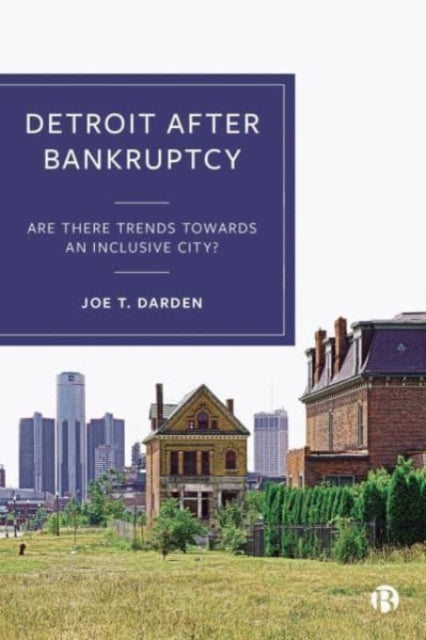
Joe T.Darden
Detroit after Bankruptcy: Are There Trends towards an Inclusive City?
Detroit after Bankruptcy: Are There Trends towards an Inclusive City?
💎 Earn 141 Points (£1.41) on this item.
YOU SAVE £1.68
- Condition: Brand new
- UK Delivery times: Usually arrives within 2 - 3 working days
- UK Shipping: Fee starts at £2.39. Subject to product weight & dimension
Bulk ordering. Want 15 or more copies? Get a personalised quote and bigger discounts. Learn more about bulk orders.
Couldn't load pickup availability
- More about Detroit after Bankruptcy: Are There Trends towards an Inclusive City?
This book examines whether Detroit's patterns of race and class neighborhood inequality have persisted or whether investments have led to improvements in academic achievement, homeownership, employment, and reductions in poverty and violent crime. It provides evidence to answer whether Detroit is becoming an inclusive city.
Format: Paperback / softback
Length: 234 pages
Publication date: 31 July 2023
Publisher: Bristol University Press
Detroit's bankruptcy marked a significant turning point, with some policymakers suggesting that it had embarked on a 'new beginning.' This book delves into the evidence supporting and challenging this assertion. Joe T. Darden examines whether the city's patterns of racial and class-based neighborhood inequality have persisted or if investments have brought about improvements in academic achievement, homeownership, employment, and poverty reduction. He employs quantitative metrics to assess the benefits and drawbacks of staying in urban Detroit versus relocating to the suburbs. Furthermore, he provides compelling evidence to answer whether Detroit is indeed becoming more inclusive after its bankruptcy.
Detroit's bankruptcy was a pivotal moment in its history, leading to discussions about its future. While some policymakers argued that it marked a new beginning, others questioned whether the city had truly overcome its challenges. This book aims to critically examine the evidence supporting and challenging this claim.
Joe T. Darden takes a comprehensive approach to analyzing the situation in Detroit. He examines whether the city's patterns of racial and class-based neighborhood inequality have persisted or if investments have led to improvements in various areas such as academic achievement, homeownership, employment, and poverty reduction. To do so, he employs quantitative metrics and statistical analysis to measure the benefits and drawbacks of staying in urban Detroit versus relocating to the suburbs.
One of the key findings of the book is that while Detroit has made progress in some areas, such as reducing poverty and improving access to healthcare, there are still significant challenges to be addressed. Darden notes that the city's patterns of racial and class-based inequality have persisted, with certain neighborhoods experiencing higher rates of poverty, unemployment, and crime than others. This inequality has had a detrimental impact on the city's overall economic development and social well-being.
Despite these challenges, Darden argues that investments in education, infrastructure, and job creation have the potential to transform Detroit into a more inclusive and prosperous city. He highlights the success of programs such as the Detroit Promise, which provides college scholarships to high school graduates, and the Detroit Land Bank, which has worked to revitalize vacant properties and promote homeownership. These initiatives, along with other efforts, have shown promising signs of improving the lives of Detroit's residents.
However, Darden also acknowledges that there are obstacles to overcome in achieving these goals. He points out that the city's financial crisis has left it with a significant debt burden, which can hinder its ability to invest in critical infrastructure and programs. Additionally, there are concerns about the effectiveness of government policies and programs in addressing the city's complex social and economic issues.
In conclusion, Detroit's bankruptcy has presented the city with a unique opportunity to rebuild and transform itself. While there are challenges to be addressed, there is also evidence to suggest that investments in education, infrastructure, and job creation can lead to positive outcomes. However, it is important to ensure that these efforts are sustainable and that they address the underlying issues of racial and class-based inequality that have persisted in the city. By doing so, Detroit can become a model for other cities facing similar challenges and work towards a more inclusive and prosperous future.
Weight: 382g
Dimension: 156 x 234 x 17 (mm)
ISBN-13: 9781529235678
This item can be found in:
UK and International shipping information
UK and International shipping information
UK Delivery and returns information:
- Delivery within 2 - 3 days when ordering in the UK.
- Shipping fee for UK customers from £2.39. Fully tracked shipping service available.
- Returns policy: Return within 30 days of receipt for full refund.
International deliveries:
Shulph Ink now ships to Australia, Belgium, Canada, France, Germany, Ireland, Italy, India, Luxembourg Saudi Arabia, Singapore, Spain, Netherlands, New Zealand, United Arab Emirates, United States of America.
- Delivery times: within 5 - 10 days for international orders.
- Shipping fee: charges vary for overseas orders. Only tracked services are available for most international orders. Some countries have untracked shipping options.
- Customs charges: If ordering to addresses outside the United Kingdom, you may or may not incur additional customs and duties fees during local delivery.